
In this guide Show sections
General guidance, not a professional assessment. Confirm site-specific advice and current requirements before work.
Planning tree work in Bedford or nearby?
Start with the postcode, the work you have in mind and any access considerations.
Prepare your enquiryNo obligation. A site assessment may be needed to confirm the work and price.
Before you make arrangements
Identify the property, tree location and person responsible for handling the enquiry. Read the relevant tenancy, lease and management arrangements, and obtain appropriate advice where responsibilities are unclear. This guide is a practical coordination aid, not a determination of a particular agreement. Our rented-property tree-work guide explains the initial distinction between noticing a concern and having authority to instruct work.
Manage the site, not just one visit
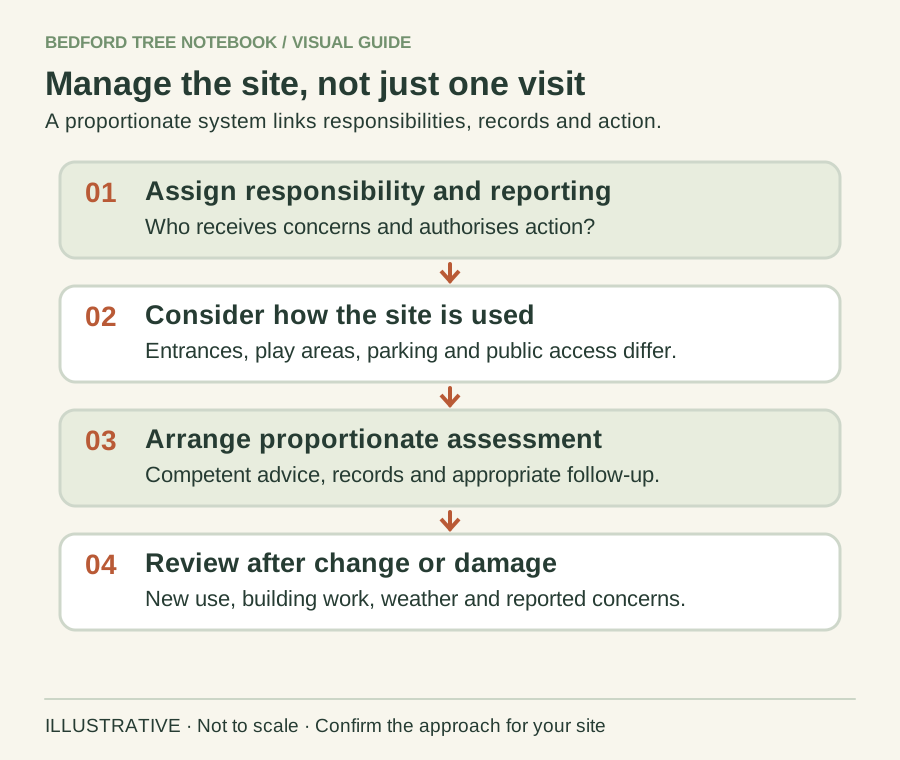
- Keep a clear reporting and authorisation route for concerns.
- Inspection scope and review timing should reflect the actual site and risk.
- Coordinate access, site users, contractor work and records; a quotation alone is not a management system.
Background sources: GOV.UK guidance · National Tree Safety Group guidance
Establish the decision-making chain
Write down who receives observations, who can commission advice and who can approve expenditure and work. For a shared garden, confirm whether instructions come through a managing agent, residents’ company or another owner. A contractor needs one understandable authority chain, not competing verbal requests from several occupiers.
Use GOV.UK private-renting guidance as background to the wider relationship, while checking the actual documents and circumstances. Do not infer permission to enter neighbouring land or alter a protected tree from an ordinary garden-maintenance clause. If the position is disputed, clarify it before a routine work booking rather than asking the contractor to resolve the disagreement on arrival.
Keep tree locations consistent across records
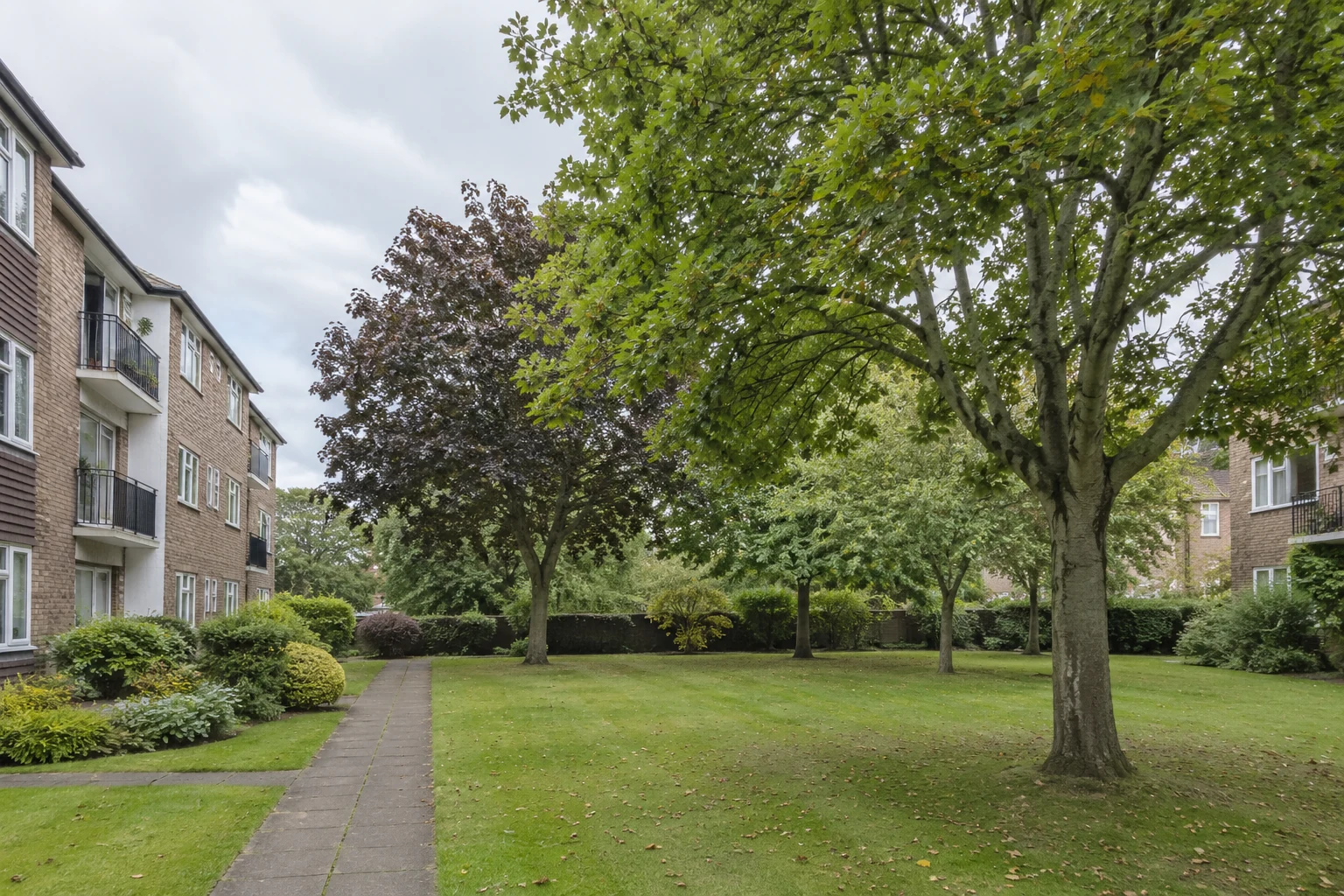
Label trees on a simple site plan so that a tenant’s report, an assessor’s advice and a work quotation refer to the same specimen. Include the building or entrance served by a shared garden and distinguish trees on neighbouring land. Avoid assuming that the closest fence establishes ownership.
Our tree-location plan guide and shared-boundary guide help organise that information. If an occupier supplies photographs, keep their date and explanation. A file named “tree.jpg” may become ambiguous when several properties are managed. Record uncertainty about ownership or location explicitly rather than allowing it to become an unsupported instruction in a later job sheet.
Give residents a useful reporting route
Tell occupiers how to report a new lean, fallen branch, visible damage or another concern, including arrangements when the usual agent is unavailable. Ask for plain observations and a safe description of location. Do not require residents to approach a suspected hazard, climb or obtain close-up evidence before their concern is considered.
The assessment-signs guide can help frame the message. Make clear who decides the response and how the resident will hear what happens next. Routine gardening requests and immediate safety concerns need different handling. Avoid treating an automated acknowledgement as evidence that the site has been assessed or that it is safe to keep using the affected area.
Use a proportionate management approach
A management system should consider the site and its use rather than impose an identical inspection or pruning timetable on every property. A secluded garden and a busy shared entrance can require different attention. Ask a competent adviser to explain the appropriate observations, inspections and review triggers for the portfolio or site.
The National Tree Safety Group’s guidance provides a framework for balanced tree-risk management. It should not be turned into a blanket claim that every rental tree needs an annual professional survey. Retain the reasoning for the chosen arrangements and revisit it when use, ownership or conditions change, rather than copying a schedule indefinitely between unrelated properties.
Commission the right kind of service
If the question is about condition, risk or a disputed recommendation, decide whether an independent assessment is needed before requesting a cutting price. Provide earlier reports, known changes and the exact purpose of the commission. A grounds-maintenance visit does not necessarily include an arboricultural inspection.
Our consultant and contractor comparison helps separate advice from delivery. Ask what the proposed service will document, who can rely on it and what remains outside scope. If an insurer, surveyor or freeholder requests information, confirm their requirements first. Otherwise the landlord may purchase a brief visit that cannot answer the specific question and then need a second commission.
Check tree controls before authorising work
For the actual property, establish the responsible planning authority and relevant tree controls. Keep the exact work proposal connected with any application, notification or decision. Our Bedford protection checks and planning-condition guide provide starting questions.
Ownership, resident consent and planning permission are different matters. A request to reduce shade or improve access does not bypass wildlife requirements either. Tell the business about cavities, suspected nests or other relevant features before it finalises arrangements. Where the proposal changes, obtain the necessary revised authority and records rather than letting the work team interpret a general instruction to “tidy the trees”.
Arrange access with the occupier
Agree the visit date, route, contact person and any areas that will remain inaccessible. Follow the applicable agreement and legal requirements for access; this article does not set a universal notice period. Where a home must be entered, confirm the specific arrangement rather than assuming a key held by an agent is unrestricted permission.
Read unattended assessment visits if nobody will be home. Keep keys and security information in an appropriately private channel, not a widely circulated tree plan. Tell the contractor about pets, shared entrances and residents who need access during the visit. The occupier should understand whether the appointment is only an assessment or involves actual work.
Align the quotation with the resident communication
The written work scope should say which trees, operations and material handling are included, along with permission and preparation responsibilities. Give residents an accurate description of likely disruption based on the contractor’s proposal. Do not promise a completion time or restored garden condition that has not been agreed.
The quotation checklist helps keep commercial assumptions visible. If several businesses handle tree work, waste and reinstatement, define each handover. The agent should know who resolves a changed condition on the day. Avoid leaving residents to authorise extra work because the person with spending authority is unavailable when the team arrives.
Close the action without losing the history
After the visit, retain the advice, final specification, permission evidence and completion record together. Tell the occupier what was completed and how to report a further concern. Keep outstanding recommendations visible instead of marking the entire tree file closed because one invoice has been paid.
On a change of agent, landlord or tenancy, hand over tree identifiers, review arrangements and unresolved matters. A short summary linking to the original documents is more useful than an unsupported note that all trees were “made safe”. Tree management is a continuing responsibility chain; records should make the next decision easier without implying that any visit guarantees future condition.
Your next step
Clarify authority, provide a consistent reporting route and commission advice that answers the actual question. Agree access with the occupier before booking, and connect every work instruction with the relevant tree and records. If the intended visit is unattended, use the access-planning guide to avoid an unclear handover between resident, agent and contractor.
Community grounds have their own use and responsibility patterns; see tree management for village halls and recreation grounds for that setting.
Turn the advice into a useful project brief.
Start with the postcode, the work you have in mind and any access considerations.
Prepare your enquiryNo obligation. A site assessment may be needed to confirm the work and price.
Sources & further reading
- GOV.UK: private renting rights and responsibilities
- National Tree Safety Group: common sense tree-risk management, 2024 summary
- Bedford Borough Council: protected trees
- GOV.UK: TPOs and trees in conservation areas
Sources checked 31 October 2026. How we prepare guidance.