
In this guide Show sections
General guidance, not a professional assessment. Confirm site-specific advice and current requirements before work.
Planning tree work in Bedford or nearby?
Start with the postcode, the work you have in mind and any access considerations.
Prepare your enquiryNo obligation. A site assessment may be needed to confirm the work and price.
Before you make arrangements
Identify who owns or controls the land and who can commission advice, approve expenditure and authorise work. Check any lease, trustee or management arrangement rather than assuming the booking secretary holds every role. Gather existing reports and a site plan. Our consultant or contractor guide helps define the service needed before a quotation is requested.
Review dates and review triggers
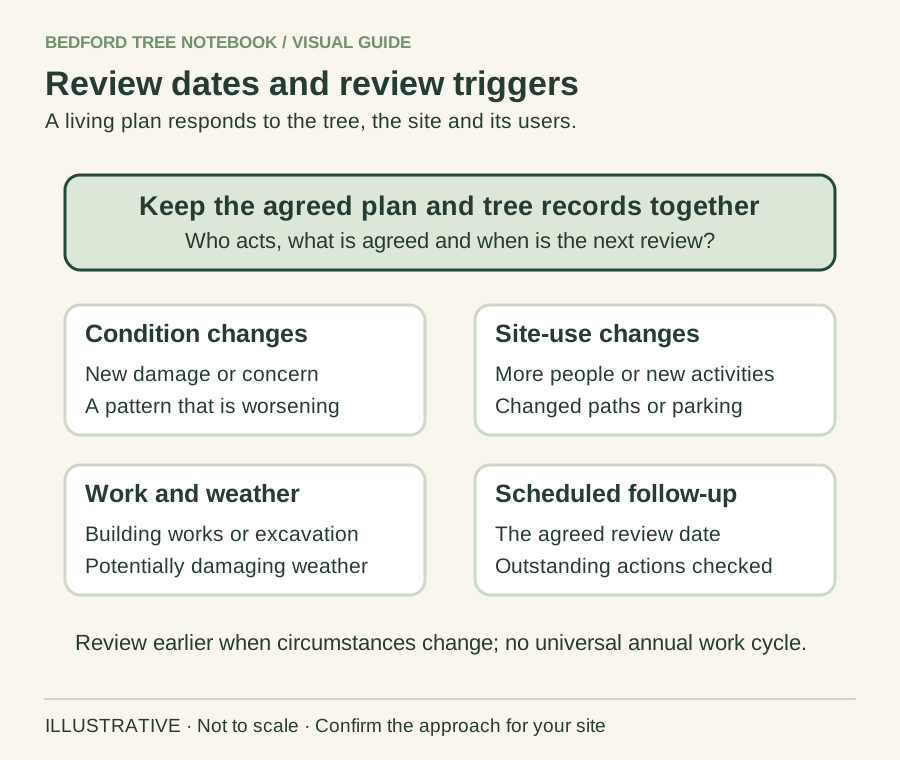
- Record responsibility for reporting concerns, decisions and completing actions.
- Agree review timing proportionate to the site and competent advice.
- Bring a review forward when relevant conditions change rather than waiting for a calendar date.
Background sources: National Tree Safety Group guidance
Give the tree record a responsible home
Decide where plans, reports, decisions and completed-work records will be kept. The system should remain accessible when volunteers change, while protecting any personal or security information it contains. An assessment held only in one former committee member’s email account is difficult to use when a new concern appears.
Link the record to the site’s existing management and maintenance arrangements. Name who reviews incoming advice and who makes sure actions are considered by the appropriate decision-maker. A contractor can provide recommendations, but the organisation still needs a practical way to receive and act on them. Record an unresolved recommendation explicitly rather than allowing it to disappear inside general meeting minutes.
Map use as well as trees
Show entrances, paths, car parking, play areas, seating, pitches, buildings and regular gathering places. Tell the adviser about occasional uses such as fairs or outdoor performances, not just what happens on a quiet weekday. A corner that appears little used during inspection may become busy during a seasonal event.
The National Tree Safety Group guidance describes a proportionate approach to tree-risk management in context. It should not be converted into a blanket requirement for every tree to receive an identical annual professional survey. Ask the adviser to explain arrangements suited to the actual grounds, use and known concerns, including when the approach should be reconsidered.
Use consistent tree identifiers
Give each relevant tree or group an identifier that connects the plan with observations, advice and work. Labels should be understandable to the people who use the record, rather than relying on a volunteer’s private description of “the big tree behind the hall”.
Read tree-location plans for the relationship between identifiers and fixed site features. If the same tree appears in several reports, make that connection visible. Say where a boundary or ownership is uncertain. A clear identifier avoids inspecting one tree and later pricing work on another, particularly where several organisations manage adjoining plots or the grounds include trees beyond the hall’s direct control.
Provide a reporting route for new concerns
Tell volunteers, hirers and grounds staff whom to contact about a new lean, hanging branch, damage or other observation. Ask for a location and plain description from somewhere safe, not close photographs or measurements obtained by approaching a suspected hazard. Explain how the report reaches someone when the usual caretaker is away.
Our assessment-signs guide helps frame these observations. A routine maintenance request should not be the only route for an immediate concern. Avoid relying on a booking inbox that nobody checks between events. The organisation should know how advice will be obtained and how users will be informed of any arrangements affecting access while the concern is considered.
Commission advice for the decisions you face
Explain whether the need is a management overview, investigation of a specific observation or advice supporting a proposed facility. Supply earlier records and identify actions whose completion is uncertain. If grant funding or another body requires a particular output, confirm that requirement before buying a visit.
Our school and nursery planning guide describes a similar need to connect premises responsibilities with competent advice, though the governance arrangements differ. Ask what the service covers and whether a written report is included. A quotation to carry out a chosen operation may not answer a question about whether that operation is appropriate or whether another approach should be considered.
Check permissions and the site’s constraints
Community ownership or charitable status does not remove relevant tree-protection, wildlife or access requirements. Establish the responsible authority for the exact site and connect the checks with the proposed operation. Use Bedford TPO checks and village protection checks as starting points.
Mention possible bat features, active nests and habitats before the programme is fixed. Explain any public right of way or neighbouring access involved. If the proposal changes, revisit the applicable controls instead of assuming the original committee approval covers it. Keep commercial authorisation, regulatory decisions and permission to enter other land distinct in the record.
Coordinate hirers, volunteers and contractors
Check the full site diary, including classes, deliveries, maintenance and occasional use of sports facilities. Tell the tree business about those activities before it agrees its arrangements. A hall booking may be cancelled while someone still expects to use the car park or recreation path.
The HSE public-safety guidance provides relevant background on coordination around work. Ask who controls the site and communicates agreed changes to users. Volunteers should not be left to improvise a route or stop traffic when equipment arrives. If a public route needs restriction, investigate the correct process separately; an internal booking decision does not itself authorise a closure.
Buy a defined scope and clear handover
The written proposal should identify trees, operations, access assumptions, permission responsibilities and material handling. State any protection for pitches, play surfaces, buildings or retained trees. If reinstatement is a separate job, identify the expected handover condition so the next contractor knows what they will receive.
Use the quotation checklist and waste scope guide to compare proposals. Agree who may authorise a change and how it will be recorded. A volunteer present on the day should understand whether they can approve additional work or simply pass a question to the organisation’s decision-maker.
Carry learning into the next season
Record what was completed, outstanding recommendations and any review triggers. If the organisation adds a new play area, changes access or increases event use, tell the adviser rather than assuming an old management arrangement remains suitable. Keep benefits and retention objectives in the discussion alongside identified concerns.
Our long-term tree-care plan helps organise future decisions without prescribing routine cutting for every specimen. On a committee handover, provide a concise action summary linked to the original documents. The next volunteer should be able to find the correct tree, understand why work was done and see what remains, without reconstructing the story from invoices and recollections.
Your next step
Connect the site’s responsible body, tree record and booking arrangements before commissioning work. Seek advice appropriate to actual use, then turn recommendations into a defined, authorised scope. Keep the handover understandable for the next volunteer, and use the completion checklist to record the result and any further action.
A commercial site needs its own responsibility and access brief; small-business premises tree care covers that setting.
Turn the advice into a useful project brief.
Start with the postcode, the work you have in mind and any access considerations.
Prepare your enquiryNo obligation. A site assessment may be needed to confirm the work and price.
Sources & further reading
- National Tree Safety Group: common sense risk management, 2024 summary
- HSE: managing public safety
- Bedford Borough Council: protected trees
Sources checked 31 October 2026. How we prepare guidance.