
In this guide Show sections
General guidance, not a professional assessment. Confirm site-specific advice and current requirements before work.
Planning tree work in Bedford or nearby?
Start with the postcode, the work you have in mind and any access considerations.
Prepare your enquiryNo obligation. A site assessment may be needed to confirm the work and price.
Before you make arrangements
Check the lease or ownership arrangement and identify who may authorise advice and tree work. A landlord, managing agent and occupying business may have different roles. Gather earlier reports and explain the problem you want addressed. Our landlord and agent guide helps organise the responsibility chain without deciding the meaning of a particular commercial lease.
Connect responsibility with site use
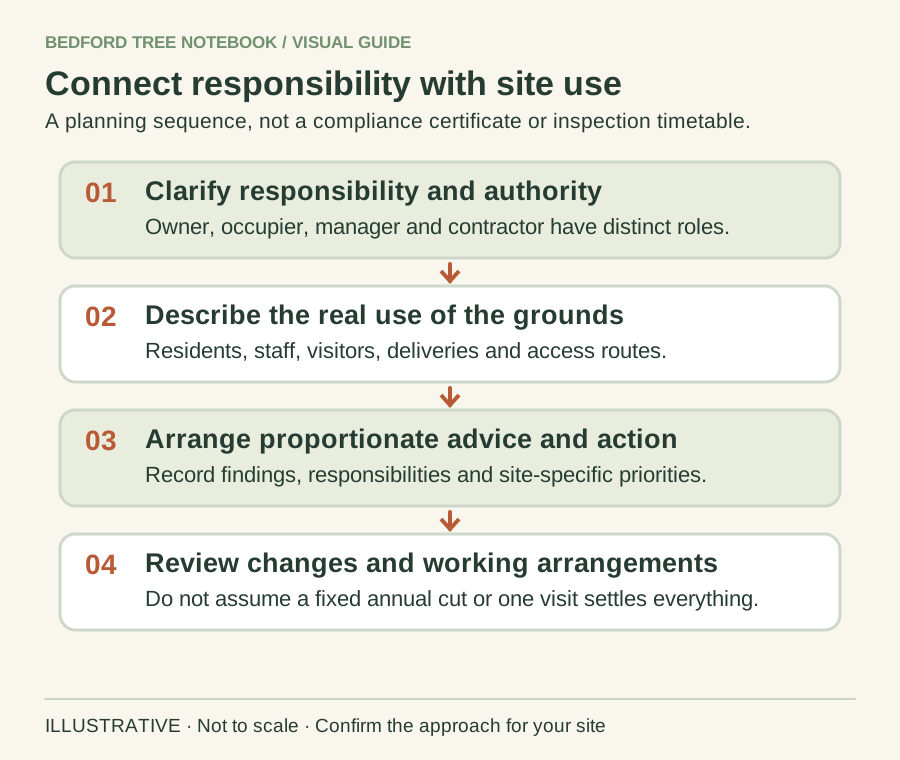
- Clarify who can commission advice, approve work and act on findings.
- Describe how people actually use the grounds, including access requirements and occasional activities.
- Keep appropriate records and review arrangements proportionate to the site; a contractor does not remove every duty of the operator.
Background sources: National Tree Safety Group guidance · HSE guidance
Confirm the scope of your control
Identify the tree, the land on which it grows and the access needed for a visit. Do not assume that maintaining a forecourt gives the occupying business authority to prune every tree beside it. If responsibility is unclear, obtain the relevant property or legal advice before instructing routine operations.
For shared premises, establish who coordinates activity between occupiers. A job can affect another unit’s entrance, loading area or staff route even if the tree stands in your part of the site. Give the contractor one understandable instruction chain, with unresolved authority questions stated clearly. An informal request from a neighbour or delivery driver should not become the sole basis for a work order.
Describe people and vehicle movements
Show customer routes, staff entrances, parking, loading, deliveries and any public access on a simple plan. Explain changes through the day rather than saying the site is normally quiet. A car park empty during a quotation visit may have a very different pattern at opening time.
The HSE workplace-transport guidance on organisation highlights coordination at premises, including shared sites. Use that background to prepare operational information, not to design the contractor’s work method. Ask which activities could conflict and who can agree changes. The useful brief connects the tree’s surroundings with how the business actually operates instead of treating the forecourt as empty working space.
Set the tree question before buying a service
Explain whether the request is about an observed condition, clearance, building contact, a proposed facility or routine management. Provide previous reports and identify recommendations that remain unresolved. A business that asks only for a pruning price may receive a proposal that does not answer its original concern.
Our tree consultant or contractor comparison helps define the commission. Ask about relevant competence, written output and inspection limitations. If an insurer or landlord requires information, confirm those requirements first. A grounds-maintenance invoice is not automatically evidence that a formal tree assessment has been completed. Keep the service purchased connected with the decision the business needs to make.
Choose proportionate management
The appropriate arrangements depend on the trees, site use and known concerns. Ask the adviser how observations, assessments and review triggers should work for the premises. Do not assume that all small businesses need identical annual professional surveys or routine heavy pruning.
The National Tree Safety Group summary provides a balanced framework. Keep its context rather than converting a recommendation for one tree into a universal policy. Record the reasons for the chosen approach and revisit it when use changes, such as new outdoor seating, a different entrance or increased public access. Retaining useful trees and managing identified concerns should be considered together rather than beginning with a clearance assumption.
Make reporting simple for staff
Provide a route for a staff member to report a new lean, hanging branch, visible damage or another observation. Ask for the location and what was seen from safe ground, not a technical diagnosis. Staff should not climb, pull material or approach a suspected hazard to complete a report.
Our assessment-signs guide helps frame the information. Decide who receives concerns when the usual site manager is away and how suitable advice will be obtained. A routine maintenance email may be insufficient for an immediate issue. Avoid treating a message sent to a contractor as confirmation that a response is underway or that an affected route can continue in normal use.
Check controls and surrounding services
Before a tree operation is agreed, establish relevant protection, ownership and wildlife requirements. Use Bedford TPO checks to start. Tell the business about overhead lines, known underground services, fragile roofs and other constraints before it selects its working arrangements.
Read overhead cables and underground-services planning where appropriate. Do not assume an equipment route is clear because it has served earlier maintenance visits. If the job may affect a road, pavement or public route, resolve the appropriate arrangements separately. Landlord approval or an internal purchase order should not be described as blanket clearance for every external control.
Coordinate the contractor with normal operations
Appoint an operational contact who can explain the site and deal with questions within their authority. Agree arrival, access, visitor procedures and coordination with other trades. Tell the contractor about deliveries or business activities that cannot simply be assumed absent.
HSE’s managing contractors guidance is useful background for the relationship. Both the site and contractor need relevant information and practical coordination; purchasing the service is not the end of the business’s involvement. Do not leave reception or warehouse staff to improvise an exclusion area when vehicles arrive. Make clear who can pause conflicting activity and obtain clarification if the agreed arrangements cannot be implemented.
Buy a clearly defined result
The proposal should identify the trees, operations, permission responsibilities, access assumptions and waste handling. Ask what is included in protecting retained features and reinstating any affected surface. Confirm qualifications relevant to the work and appropriate insurance, while keeping those checks separate from the quality of the specification.
Use the quotation checklist and insurance guide. If another contractor handles reinstatement or drainage, define the handover. Clarify how scope changes and additional prices are authorised; someone opening a gate may not hold spending authority. A general instruction to make the frontage tidy leaves too much uncertainty about the intended operation and finish.
Keep a usable business record
Retain the advice, plan, relevant approvals, final work scope and completion information with the premises record. Assign outstanding actions and reviews to a named role, not only the employee who happened to book the visit. That supports continuity when the business moves manager, changes agent or renews its lease.
Our completion checklist and long-term plan guide help connect each job with future decisions. Record significant changes in use and share them with the adviser where relevant. The useful record explains what was assessed and done, without turning a limited visit into a guarantee that every tree will remain unchanged or that no further review is needed.
Your next step
Clarify control of the tree and premises, describe normal activity and commission advice for the actual question. Coordinate the work with staff, customers and deliveries before booking. Use the quotation checklist to record a definite scope and retain the findings and follow-up in the premises system rather than treating the contractor’s visit as the whole management process.
Turn the advice into a useful project brief.
Start with the postcode, the work you have in mind and any access considerations.
Prepare your enquiryNo obligation. A site assessment may be needed to confirm the work and price.
Sources & further reading
- HSE: managing contractors
- HSE: workplace-transport organisation
- National Tree Safety Group: 2024 summary guidance
- Bedford Borough Council: protected trees
Sources checked 31 October 2026. How we prepare guidance.