
In this guide Show sections
General guidance, not a professional assessment. Confirm site-specific advice and current requirements before work.
Planning tree work in Bedford or nearby?
Start with the postcode, the work you have in mind and any access considerations.
Prepare your enquiryNo obligation. A site assessment may be needed to confirm the work and price.
What to check
Observe only from a safe position. Do not climb, cut or test damaged branches yourself. Keep people and pets away from the area of concern.
Record a concern without diagnosing
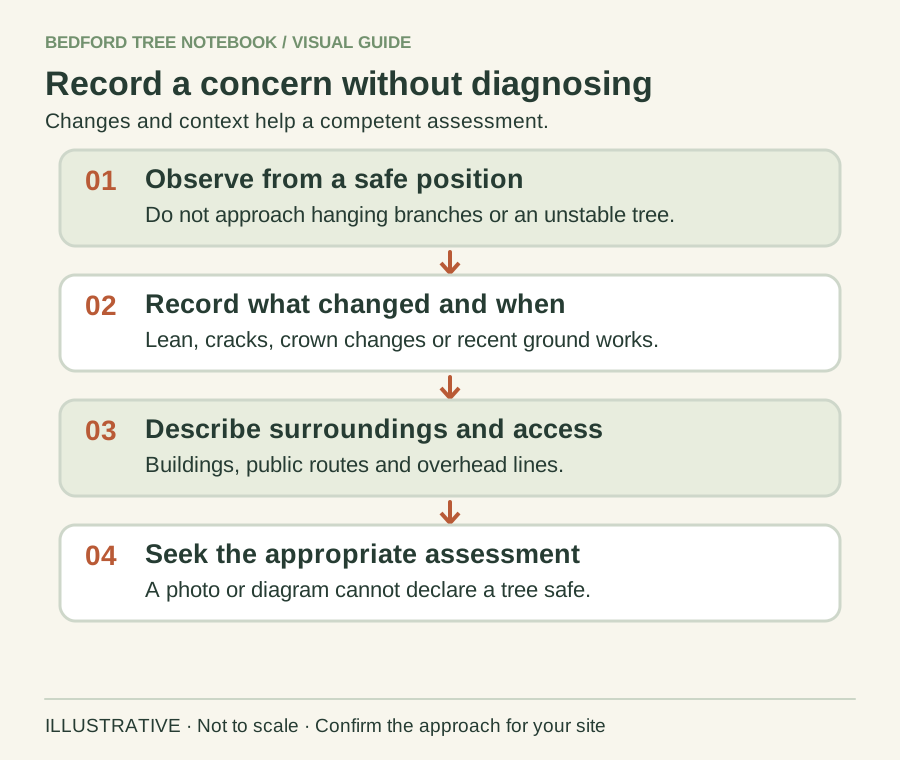
- Do not approach a potentially unstable tree to collect evidence.
- Similar visible symptoms can have different causes.
- Do not infer safety or a legal exemption from this workflow.
Observation is not diagnosis
Visible changes can be a reason to seek advice without proving that a tree is about to fail. Equally, an apparently full canopy does not certify sound structure. Avoid using a checklist or photograph to declare a tree safe, particularly when people, buildings or public routes could be affected.
Describe symptoms plainly
Tell the professional what you can see and when you noticed it. Examples include a branch hanging after wind, a fresh split or movement in the soil. Avoid approaching hazards to measure them. A distant photograph can help explain a concern but should not be taken at the expense of safety.
Choose the right assessment
Tell the business that the enquiry concerns condition or safety rather than routine pruning. Ask what assessment they can provide and whether a separate suitably qualified consultant is needed. Do not assume that a quote to cut branches is a comprehensive safety report.
After an assessment
Keep the findings and agreed actions. Ask what follow-up is recommended and what changes should prompt further contact. Recommendations relate to the tree and circumstances assessed; changes in weather damage, ground conditions or surrounding use may need a fresh look.
Use a change log rather than a home safety score
A short factual note can help a professional understand why you are asking for an assessment. Record what you noticed, the date and any event that appears to coincide with it. If you already have older photographs, keep them available. They may help explain a change, but do not return to a hazardous position to recreate a matching view. Uncertainty is useful information: say when you do not know whether a feature is new.
Do not award the tree points from an online checklist or decide it passes because only one concern is visible. The purpose of your note is communication, not certification. Our leaning-tree guide illustrates the difference between a longstanding appearance and a reported change. A professional needs to consider the tree in context; a homeowner's photograph can support that conversation without replacing the assessment.
Explain who or what may be affected
Tell the assessing business about nearby houses, garages, play areas, paths and places people regularly stop. Include the route used by visitors or delivery drivers if it passes near the concern. Do not calculate an exclusion distance from this guide or assume that standing beyond a garden boundary removes every exposure. Keep away from the area of concern and ask for appropriate help where it cannot be managed safely.
If the tree is public rather than private, use the Bedford council-tree reporting guide to identify the relevant route. A planned contractor quotation and a public-tree report have different purposes. Give the location accurately so that the person receiving the information can identify the tree; a message saying 'the one near my road' may not be enough when several mature trees stand in the same area.
Hypothetical example: a full canopy and a worrying split
Imagine a homeowner who sees plenty of leaves but notices a fresh-looking split from a bedroom window. They should not use the leaf cover to dismiss the observation or approach the trunk to test the wood. A factual account of the visible feature, how it was noticed and what lies nearby is the useful starting information. The significance and appropriate response require professional consideration.
This invented example is not an identification rule: a split-looking feature in a photograph does not establish a diagnosis, just as foliage does not establish safety. If the situation appears immediate, use the appropriate urgent route instead of waiting for a normal quotation response. Our dangerous-tree permissions guide explains the separate issue of protection controls. A safety concern and a permission question both need attention, but neither can be settled by the presence of a single symptom in this example.
Request the assessment you actually need
When contacting a business, say that you are asking about condition or safety and describe the concern. Ask what level of inspection or written advice it can provide, whether a site visit is needed and whether another specialist should be involved. A quotation for pruning answers a commercial question about work; it should not be assumed to answer every question you might have about the tree's condition.
Ask what the findings will cover and what is outside the service. If several people need to rely on a written document, explain that before commissioning it. Keep the inspecting professional's role separate from any business eventually carrying out work. Our choosing a tree surgeon guide helps with relevant competence and identity checks. A referral service can organise an enquiry, but it cannot turn a contractor's availability into assurance that the requested assessment has already happened.
Make the follow-up understandable
After the assessment, ask for an explanation of the findings, proposed action and any limits. If monitoring is recommended, clarify what it means for you: whether another professional visit is proposed, what information to retain and which changes should prompt contact. Do not interpret monitoring as an instruction to test branches, measure movement beneath a concern or repeatedly enter an area you have been told to avoid.
If work is recommended, obtain a specification that relates to the findings. Compare it with any relevant permission documents and keep the final quotation with the assessment record. Use removal or pruning to prepare questions about alternatives where appropriate. The right outcome may involve more information before a work decision. A clear record of what was assessed and recommended is more useful than an unqualified statement that somebody has 'looked at the tree'.
Is a contractor visit the same as a written assessment?
Not necessarily. Ask what service is being provided and what record you will receive. A business may visit to understand a quotation without offering the kind of assessment or report another party requires. Explain your need before arranging the visit. This helps the professional confirm suitability, avoids assuming that a verbal comment covers every concern and makes any separate assessment fee or recommendation clear from the outset.
Your next step
A photograph cannot certify a tree as safe. If there is immediate danger to life, contact emergency services. Otherwise arrange a suitable professional assessment.
If the concern follows prolonged rain, describe the change using our waterlogged gardens and trees guide rather than approaching the base to investigate.
Turn the advice into a useful project brief.
Start with the postcode, the work you have in mind and any access considerations.
Prepare your enquiryNo obligation. A site assessment may be needed to confirm the work and price.
Sources & further reading
- HSE: tree-work safety topics
- HSE: roles and competence in tree work
- Bedford Borough Council: protected trees
Sources checked 31 October 2026. How we prepare guidance.