
In this guide Show sections
General guidance, not a professional assessment. Confirm site-specific advice and current requirements before work.
Planning tree work in Bedford or nearby?
Start with the postcode, the work you have in mind and any access considerations.
Prepare your enquiryNo obligation. A site assessment may be needed to confirm the work and price.
What to check
Keep clear of the tree and its potential fall area. Avoid trying to support it with ropes or remove branches to balance it yourself.
Record a concern without diagnosing
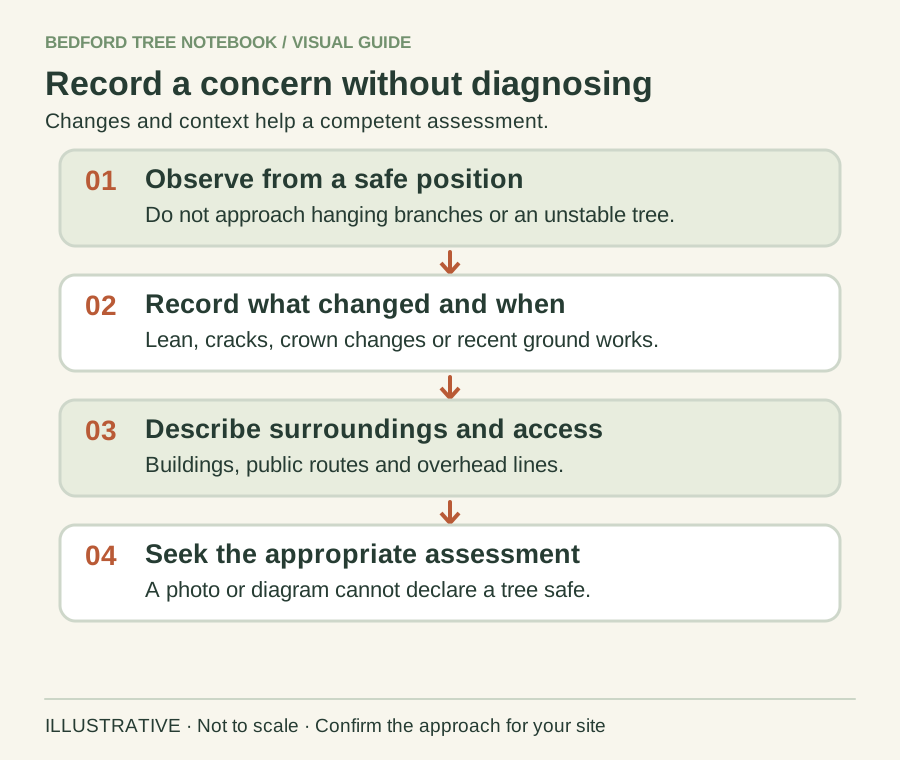
- Do not approach a potentially unstable tree to collect evidence.
- Similar visible symptoms can have different causes.
- Do not infer safety or a legal exemption from this workflow.
Explain the history you know
A photograph taken years earlier may help show whether the lean has changed, if you already have one. Do not go into a hazardous area to recreate a view. Tell the assessor whether building work, excavation, flooding, impact or a recent storm coincided with the concern, without assuming that one caused the other.
Keep people away from the concern
Choose a safe alternative route and prevent children or pets entering the affected space where you can do so safely. A fence, rope or warning note is not a professional assessment of a safe exclusion area. Seek appropriate help when the situation cannot be managed safely.
Do not prescribe the remedy
Removing weight from one side, staking or attaching ropes can create additional problems and may be unsafe. Ask the professional to assess the whole situation before recommending work. Pruning or removal may have permission implications as well as practical ones.
A useful request for assessment
State the location, the change you have noticed, the approximate size and what lies nearby. Explain any access restrictions. Make clear that you are seeking advice about the condition and next action, rather than asking for an uninspected fixed-price removal.
Distinguish a remembered lean from a documented change
It is easy to notice a familiar tree differently after strong wind or after moving into a property. Tell the professional what you actually know. You may have an older garden photograph, a report from a previous assessment or only a recent impression. Each is worth describing honestly. Do not claim that the lean has changed if you are unsure, and do not assume it is harmless merely because someone recalls it leaning for years.
Use existing photographs where available rather than setting up a new measurement. Avoid going beneath the tree, attaching a string line or disturbing soil to compare angles. Our assessment-signs guide gives a broader enquiry framework. Your role is to explain why you are concerned and what may have changed, leaving the assessor to decide which features and history matter to the present situation.
Describe the surrounding changes as well
Mention recent excavation, drainage work, vehicle impact, altered ground levels or changes in how the nearby area is used. These are background observations, not proof of cause. A professional may need to consider information about the site alongside the tree. If another contractor has been working nearby, retain the relevant plans and dates rather than relying on a vague account that something was done 'around the roots'.
Explain where the house, garden entrance and frequently used spaces lie. Do not try to establish a safe fall zone from a photograph or a height estimate. Where you cannot keep people away without entering the area of concern, seek appropriate assistance. This guide does not provide a method for physically managing a leaning tree; it helps prepare information for a competent assessment without asking the homeowner to become part of the working operation.
Hypothetical example: a familiar tree after nearby ground work
Suppose a homeowner becomes concerned about a tree leaning towards a garage after a new drainage trench was installed nearby. They may suspect a connection, but a useful enquiry does not begin with an accusation or a conclusion. It records the drainage work's position and timing, the feature now causing concern and any earlier information about the tree. The relevant professionals can then consider what assessment is needed.
This fictional example does not establish that trenching caused a problem or that a leaning tree should be removed. It shows why dates, drawings and observations should remain separate from diagnosis. If the situation appears immediate, keep clear and use an appropriate urgent route. Any later planned operation must also consider applicable tree controls; our dangerous-tree permission guide explains why the word dangerous is not a general authority to carry out an unrestricted removal.
Keep household arrangements practical and cautious
Tell other household members about the concern without inviting them to inspect it. Use an alternative route where you can do so safely, keep pets from the affected area and explain any access restriction to a visiting professional before arrival. Do not attempt to brace the trunk, tension a rope or remove branches to balance the tree. Those actions involve technical and safety judgements that this article cannot provide.
If the tree stands near a public route or another property, make the location and surrounding use clear in the report. Our shared-boundary guide deals with planned access arrangements; it should not be treated as a substitute for urgent help. A professional needs enough information to decide how to approach the site. Do not offer to lead them beneath the tree or demonstrate movement in order to make your concern seem more convincing.
Understand the recommendation before commissioning work
Ask the professional to explain what was assessed, what remains uncertain and the recommended next action. It may need another visit, a written report or input from another specialist. If pruning or removal is proposed, ask how the operation relates to the findings and what permissions need checking. Avoid assuming that reducing height will necessarily resolve the reason for a lean; obtain a recommendation for the actual tree and circumstances.
Use removal versus pruning to frame the options and choosing a tree surgeon to check the business offering the work. Retain the assessment and final specification together. If further monitoring or inspection is advised, clarify who is responsible for arranging it and what changes should prompt renewed contact. The purpose is an understood management decision, not a simple guarantee about what a living tree will do in future weather.
Should I send an approximate height?
Only include an estimate you can make without entering the area of concern, and label it approximate. The professional may need to establish dimensions and site relationships itself. An uncertain number is less useful than a clear statement that you have not measured. Do not use the estimate to choose where people may safely stand or to decide how the tree should be supported, pruned or removed before an appropriate assessment.
Your next step
Record what changed from a safe location. A qualified professional can assess the tree, soil and targets before recommending action.
After strong wind, our storm-damaged trees guide helps organise a safe report and assessment without attempting clearance.
Turn the advice into a useful project brief.
Start with the postcode, the work you have in mind and any access considerations.
Prepare your enquiryNo obligation. A site assessment may be needed to confirm the work and price.
Sources & further reading
- HSE: tree-work safety topics
- HSE: roles and competence in tree work
- GOV.UK: Tree Preservation Orders and conservation areas
Sources checked 31 October 2026. How we prepare guidance.