
In this guide Show sections
General guidance, not a professional assessment. Confirm site-specific advice and current requirements before work.
Planning tree work in Bedford or nearby?
Start with the postcode, the work you have in mind and any access considerations.
Prepare your enquiryNo obligation. A site assessment may be needed to confirm the work and price.
What to check
Map boundaries and individual tree descriptions need careful interpretation. Ask the council for confirmation if the records are unclear; an empty-looking map is not permission to work.
Read the map and the record
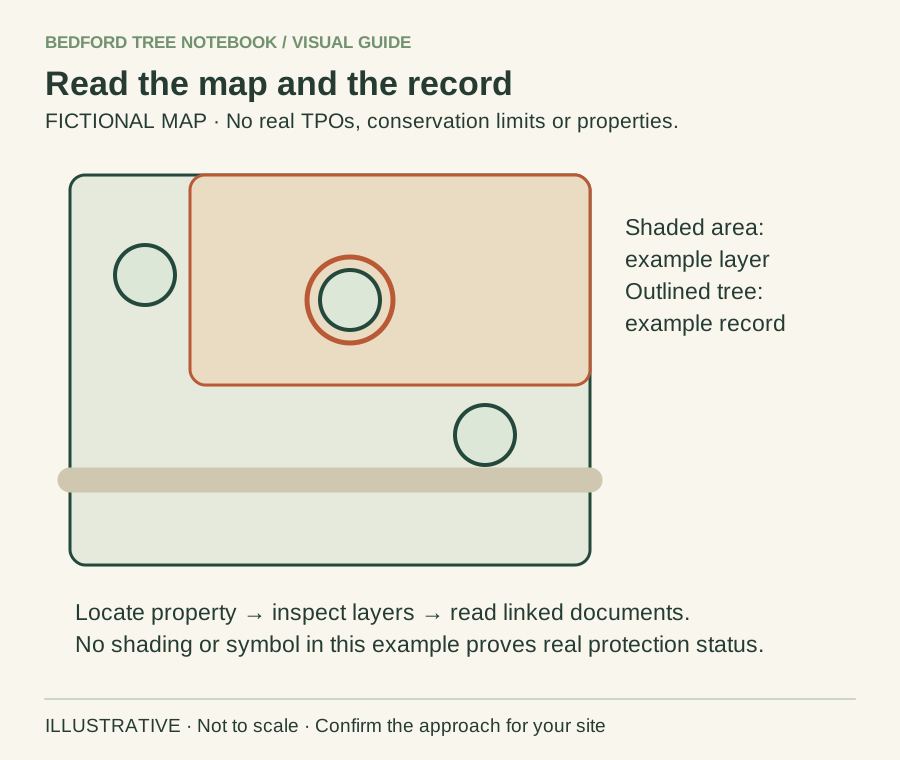
- Find the actual property on the official council map.
- Inspect relevant layers and open the linked order or document.
- Ask the council where the record or boundary is unclear.
Background sources: Bedford Borough Council guidance
Prepare the location information
Have the full address and a simple plan showing the tree’s position. If several trees stand near the boundary, label them consistently in your photographs and notes. A location pin for the house is not necessarily enough to distinguish the tree you want to discuss.
Do not stop at a coloured map layer
Read the record associated with the location. The description, plan and any relevant decisions need to be considered together. If you cannot identify whether the record applies to the tree, ask the council for help rather than treating uncertainty as an absence of protection.
Keep a record of the enquiry
Save the date of your check, the documents you read and any written response. Give the contractor the same tree labels used in your enquiry. If the proposed work changes, ask whether the existing advice or decision still covers it; a different scope may require a further check.
When professional help is useful
A contractor can help describe the proposed tree work, while a suitably qualified consultant may be appropriate for a more complex assessment. Confirm who is preparing any application and who will obtain the decision. Our referral form does not carry out either task or confirm the legal position.
Identify the tree before interpreting its status
Begin with a wide view of the property and a simple sketch that distinguishes the tree from its neighbours. Mark fixed features such as the house, street, fence and entrance. Where several trunks stand close together, explain which canopy and stem you mean rather than relying on a cropped photograph. Use the same label throughout your own enquiry, the contractor's proposal and any later application.
This is particularly helpful for a rear garden that cannot be understood from the street address alone. A tree near the boundary may appear closer to the neighbouring house on an online map. Our shared-boundary guide covers the separate ownership and access conversation. Your project label is an aid to communication, not an official tree number or proof that a particular planning record applies. Ask the authority to clarify the link where it is uncertain.
Ask a narrow question that can be answered
A general request such as 'are my trees protected?' may leave the council needing more information. A clearer enquiry identifies the address, tree position and the particular record you have found, then states what you cannot establish. For example: 'Does the group shown on this plan include the tree marked T1 on my sketch?' Include the relevant reference rather than asking an officer to recreate your search from an unexplained screenshot.
Use Bedford's tree-protection maps as the starting workflow. If no record is obvious, describe where you looked and ask whether further checks are needed. Do not alter or remove vegetation to make a map search easier. A well-framed enquiry records the uncertainty honestly and avoids implying that you have obtained a formal clearance when you have only asked for help interpreting the records.
Hypothetical example: the plan does not match the garden neatly
Imagine a homeowner who finds an old order plan covering several trees along a garden edge. The present planting includes a mature tree, smaller growth and a replacement planted later. Matching a symbol to today's canopy is not straightforward. The homeowner should not decide that an untidy match makes the document irrelevant; nor should they assume every plant in view has exactly the same status.
The practical response is to identify the proposed subject clearly and ask the council about the relevant documents. Provide the plan reference, sketch and safe photographs together. If professional assistance is needed to identify the tree or describe the intended work, arrange that separately. This invented example shows why map interpretation and tree identification are different tasks. It does not interpret an actual Bedford order, establish whether a replacement is protected or determine which legal controls apply to your particular property.
Protection and the proposed operation are separate questions
Once you understand the record, describe what you intend to do. Pruning, felling and ground disturbance are not interchangeable descriptions. An officer or contractor cannot assess the relevance of a previous decision if the new proposal is simply called 'maintenance'. If you do not yet have a suitable pruning specification, obtain a recommendation before treating a general status enquiry as an application for defined work.
Our protected-tree application guide explains the next paperwork stage. If development is involved, retain the relevant planning documents too. Establishing the tree's relationship with an order is important, but it does not answer every question about ownership, planning conditions or wildlife. Keep the decisions separate so that one helpful response is not accidentally expanded into a promise that the entire project may proceed without further consideration.
Build a record that someone else can follow
Save the current documents, their references and the written response with a short note of the question you asked. Give the contractor that complete record, not just an email saying you checked. If the quotation identifies trees differently, ask for the descriptions to be reconciled before the team arrives. The point is to prevent a correct answer about one tree being used to instruct work on another.
Revisit the position if the tree, proposed work or development plan changes. Our changing approved tree work guide helps frame a revised enquiry. Keep the original and final versions distinguishable, particularly when several people are involved in arranging the visit. The project planner can help assemble a contractor enquiry, but this website does not inspect council records on your behalf, certify a tree's legal status or issue permission to carry out work.
What if the property has changed its name?
Include the current address and any former name appearing in documents you already hold. Explain the relationship rather than assuming the search system will make it automatically. A simple plan and relevant reference can help connect the enquiry to the right location. Do not treat a failed search under one spelling as proof of absence; ask the authority how to check the actual tree when the address history makes the record uncertain.
Your next step
Keep the order details and any written decision with the job specification. Our guidance tool does not determine legal status.
Checking a village address? See tree protection in Bedford’s surrounding villages before choosing which council records to use.
For the wider permission questions, read whether you can cut down a tree in your Bedford garden.
Turn the advice into a useful project brief.
Start with the postcode, the work you have in mind and any access considerations.
Prepare your enquiryNo obligation. A site assessment may be needed to confirm the work and price.
Sources & further reading
- Bedford Borough Council: protected trees
- GOV.UK: Tree Preservation Orders and conservation areas
- GOV.UK: planning applications affecting trees and woodland
Sources checked 31 October 2026. How we prepare guidance.