
In this guide Show sections
General guidance, not a professional assessment. Confirm site-specific advice and current requirements before work.
Planning tree work in Bedford or nearby?
Start with the postcode, the work you have in mind and any access considerations.
Prepare your enquiryNo obligation. A site assessment may be needed to confirm the work and price.
What to check
Other restrictions may apply. Felling-licence exemptions depend on the circumstances, and an exemption from one regime does not remove other controls.
Separate the permission checks
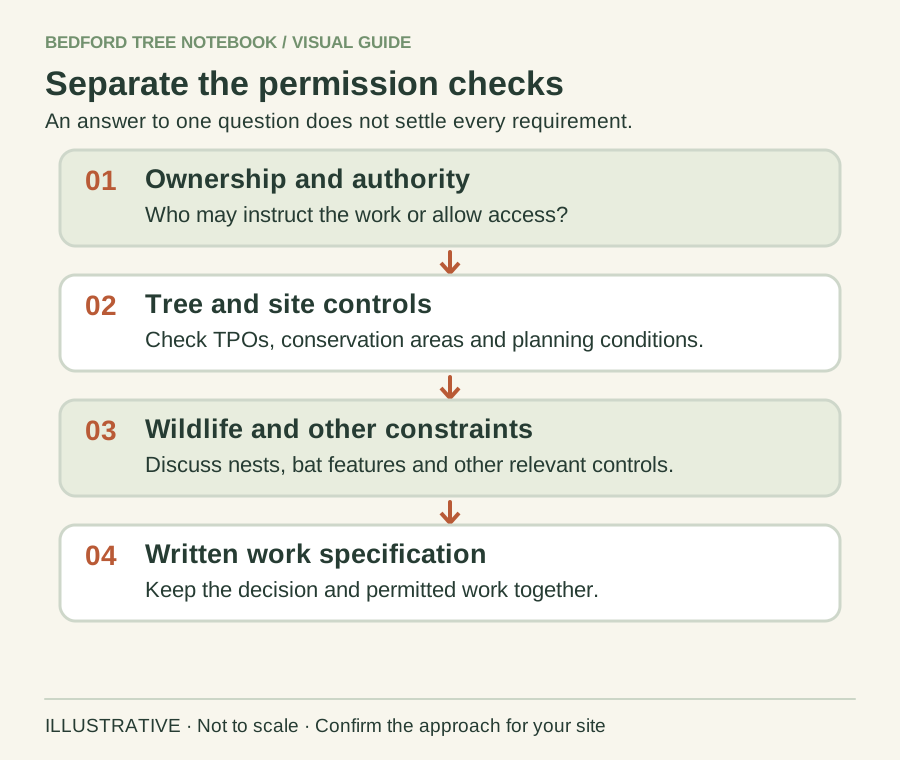
- Check every relevant control, not only the presence of a TPO.
- Keep written decisions with the exact proposal.
Background sources: GOV.UK guidance
Separate ownership from permission
Establish whose land the tree stands on and whether access is needed across another property. If ownership or the boundary is disputed, resolve that before instructing work. A contractor’s availability does not establish your authority to commission removal.
Check what the proposed outcome involves
Removing a tree, pruning it and excavating a stump are distinct operations. Describe the full intended job when seeking advice. If a building project is involved, give the contractor relevant planning documents and ask whether the tree work is consistent with the approved scheme.
Avoid assumptions from previous work
The fact that a neighbouring tree was removed, or that the same tree was pruned years ago, does not settle the current requirements. Keep checks specific to the tree and the present proposal. Get clarification when the records or intended work are uncertain.
A practical enquiry checklist
Provide the full postcode, a safely taken wide photograph, an approximate size, your reason for wanting removal and any known protection documents. Explain what you want to do with the space afterwards. Ask for alternatives and a written scope before deciding whether removal is the right approach.
Start with a decision about the garden, not a chainsaw method
Explain what you hope removal will achieve. You might need space for a different garden layout, be concerned about a recent change or want to reduce an ongoing maintenance problem. Those are different starting points. Ask a tree professional to consider the appropriate response rather than assuming that removal is the only way to meet the aim. Where a building issue is involved, the relevant building professional may need to contribute separately.
Our removal or pruning guide helps separate the objective from the operation. Do not describe a tree as unsafe solely because it looks large or inconvenient. A factual account gives the assessing professional more useful information and avoids presenting a diagnosis you cannot substantiate. If there is an immediate concern, keep people away and seek appropriate help instead of waiting for this planned-work enquiry service.
Ask the right authority about the actual address
Confirm which council covers the tree's location before using planning resources. A Bedford postal description does not by itself establish the authority. Use the full address and tree position, particularly for larger plots or village properties. Keep a simple sketch showing the tree, house and boundary so that an enquiry does not depend on a vague pin in the general area.
The council-boundary guide and TPO checking guide explain useful starting points. Read the documents associated with the location and seek clarification where a record is ambiguous. An absence of an obvious symbol on one map layer is not a complete answer about a proposed removal. Ask the authority which records or controls need consideration and retain its response alongside the specification you eventually commission.
Hypothetical example: removal linked to a new patio
Suppose a homeowner wants a tree removed because it occupies the intended position of a patio. They obtain a tree-removal quotation and assume that this resolves the whole project. In fact, the tree recommendation, any planning restrictions, stump treatment and the paving design still need to be connected. The contractor may quote accurately for removing the tree while leaving a stump that does not meet the next stage's requirements.
Before accepting, show the intended layout and ask what the tree-work scope will leave. Our stump work before paving guide covers that handover. If an existing development approval is relevant, give the designer and contractor the decision documents rather than assuming a small garden project cannot interact with them. This is an illustrative scenario, not a statement that every patio requires permission or that removing any particular tree is justified.
Do not let an old decision become a new instruction
A previous owner's account, an historic quotation or evidence that a neighbouring tree was removed may help you understand the background. None should be substituted for checking the current proposal. The tree, ownership, site and intended work may differ. Ask for the actual decision or supporting record when someone says the paperwork has already been dealt with, and establish what operation that record describes.
Use tree work and planning conditions where a development history is involved. If a contractor recommends changing from pruning to removal, make that change explicit in the authority enquiry and quotation. Keep the final work instructions aligned with the necessary approvals. A sensible process is to resolve the important uncertainty before choosing a date, rather than making the date the reason to overlook a missing document or unclear boundary arrangement.
Include the ground, material and replacement plan
If removal is the agreed outcome, state whether timber will leave the site, whether the stump is included and what happens to the resulting ground. Ask about the replacement planting position before ordering a new tree for the exact same spot. A site-specific planting recommendation may differ from your first idea, especially where old roots, structures or future garden use affect the available space.
Read replanting near a stump alongside the removal quotation. Keep the proposed tree work, its authorisation, debris handling and any later landscaping as distinct parts of one project record. Before the visit, confirm who can authorise the work and any required access. At handover, review the result against the written scope after the contractor says it is safe. This gives you an understandable route from a garden objective to a properly defined job.
Should I book removal while I check the paperwork?
Ask the contractor which arrangements can remain provisional. Do not describe the job as ready to proceed when ownership, access or permission is unresolved. A convenient date should follow the necessary decisions rather than become pressure to bypass them. Keep the business informed of the actual position, and obtain a final quotation that matches the work you are authorised to commission instead of relying on an earlier broad description.
If a different person will meet the contractor, give them the final agreed documents and explain any limits on the instruction. An early enquiry email should not become their only description of what is authorised.
Your next step
Give the contractor the relevant council documents. If you are uncertain, get written guidance from the appropriate authority before work starts.
For a property with development approvals, check tree work and planning conditions before treating removal as an unrelated garden job.
Turn the advice into a useful project brief.
Start with the postcode, the work you have in mind and any access considerations.
Prepare your enquiryNo obligation. A site assessment may be needed to confirm the work and price.
Sources & further reading
- Bedford Borough Council: protected trees
- GOV.UK: Tree Preservation Orders and conservation areas
- GOV.UK: planning applications affecting trees and woodland
Sources checked 31 October 2026. How we prepare guidance.