
In this guide Show sections
General guidance, not a professional assessment. Confirm site-specific advice and current requirements before work.
Planning tree work in Bedford or nearby?
Start with the postcode, the work you have in mind and any access considerations.
Prepare your enquiryNo obligation. A site assessment may be needed to confirm the work and price.
Before you start
Explain the intended use of the space before requesting a price. A stump that is unobtrusive beside a border may still obstruct a new path, fence post or planting position. Your future plans help the contractor define the right scope; the phrase “remove the tree” does not do that on its own.
Grinding or excavation?
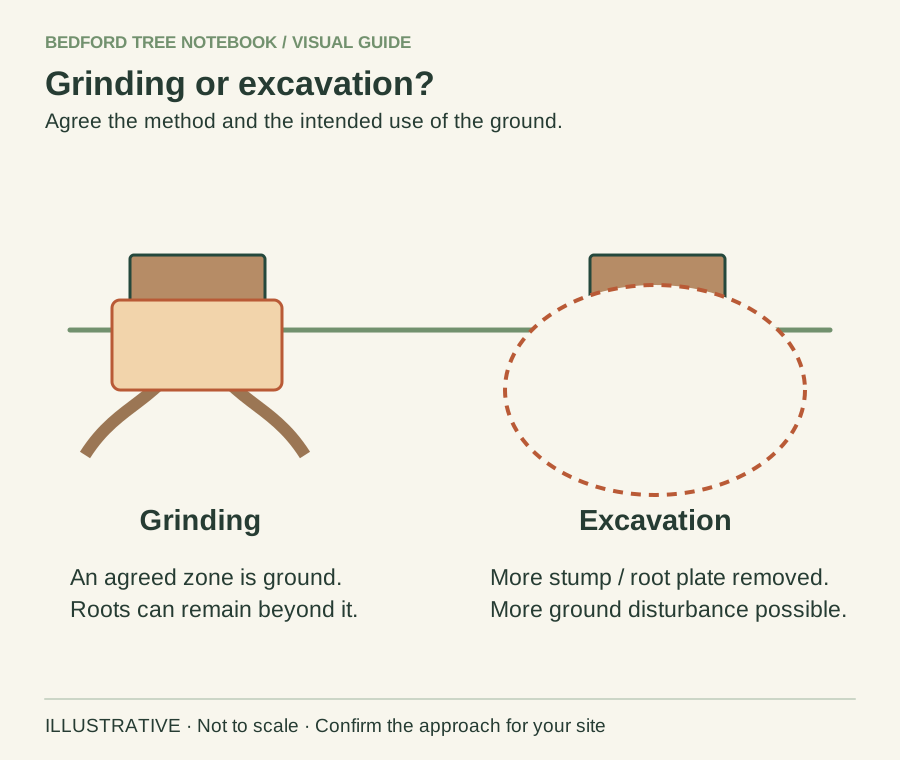
- Felling and stump treatment are separate scope items.
- Grinding does not remove the complete root system.
- Ground reinstatement and future use need separate agreement.
What the felling part normally describes
Felling concerns bringing down the above-ground tree. In a confined garden, that may mean dismantling it in sections rather than taking it down in one piece. The agreed scope should also say whether the stem is cut close to the ground and how the timber is handled.
The contractor’s method needs a site assessment. See what happens during professional tree removal for the homeowner’s preparation, rather than treating this guide as an instruction for carrying out felling.
Why the stump is a separate question
Stump work can involve a different machine, a different access route and another visit. The width of a side gate or a flight of steps may make the options different from those for the tree above it. Underground services and nearby structures also need consideration.
Ask whether stump work is undertaken by the same business and who takes responsibility for coordinating it. An additional visit is not automatically a problem, but you should know about it before planning the next stage of the garden.
Grinding and excavation give different results
Grinding breaks down stump material within an agreed area and depth. Excavation removes the stump and more of its root plate, with a different disturbance footprint. Neither term should be stretched into a promise that every root throughout the garden disappears.
The RHS overview of stump removal describes several approaches. Our grinding-versus-removal comparison helps frame the conversation. The suitable result depends on the site and what you plan to do next.
Be specific about the finish
There is a difference between a ground stump, a cleared hole and a reinstated lawn. Ask whether grindings are left in place, heaped elsewhere or taken away. If topsoil or turf is included, have that written into the proposal rather than inferring it from a promise to leave things tidy.
For a path or building project, ask the person designing that work what ground preparation is required. Ordinary stump grinding should not be assumed to provide an engineered foundation or a construction-ready surface.
A hypothetical quotation comparison
Imagine one proposal cuts down a tree, removes branches and leaves logs stacked. A second also removes the logs and includes a grinding visit. A third adds removal of grindings and fresh soil. These are three different outcomes, even if all are described casually as tree removal.
Compare each item on a short list. There is no useful conclusion to draw from the headline prices until you know which outcome you actually want. We do not publish a local stump-work average or infer a saving from combining visits.
Questions to settle before the booking
- Which tree and stump are included?
- What remains above and below ground?
- Is machine access confirmed, or still to be assessed?
- Who checks for buried services?
- Where do timber and grindings go?
- Who prepares the ground afterwards?
Mention your full Bedford-area postcode and any access restrictions. A contractor’s postcode screen is a starting point; it does not confirm that the machine can reach the stump or that the business has accepted the work.
Think backwards from what will use the space
Before choosing stump work, describe the next use of the area. A flower bed, replacement tree, lawn and paved surface raise different preparation questions. Show the intended footprint, not only the cut stump, and ask the person responsible for the next stage what ground condition they need. Then ask the tree contractor which part of that result it is offering.
This approach avoids paying for an operation that removes the visible obstacle but leaves the next installer expecting something different. Our stump-work-before-paving guide explains that handover in more detail. No general article can set the appropriate construction base or grinding specification for your particular garden.
Ask what happens between separate visits
Felling and stump work may be arranged for different dates or with different businesses. If that is proposed, ask what will remain after the first visit and how access will be kept usable until the second. Identify any part of the garden that should remain unavailable and ask the contractor to explain the temporary arrangement.
Tell the next business what has already been completed and share the agreed documents. Do not conceal a remaining obstruction under loose material simply to make the area look finished. If plans change and the stump will stay longer, ask what practical implications need attention rather than assuming the original short-term arrangement suits an indefinite delay.
Separate retained timber from unwanted residue
Some homeowners want useful logs left behind but do not want a stump or a heap of grindings. Those preferences can coexist, provided each is specified. Agree the pieces to retain, where they will be put and what you are able to handle later. Avoid accepting material you cannot safely move merely because taking it away was not discussed.
Our grindings guide addresses the different material produced by grinding. Keep that discussion separate from cutting and stacking logs. The final brief should let somebody unfamiliar with the original conversation understand what stays, what leaves and which finishing tasks belong to another stage.
Questions that make a revised quotation useful
If the original felling quote says nothing about the stump, ask for an explicit statement rather than an informal assurance. Useful questions include whether stump treatment is included, what area will be worked on, whether grindings leave the site and who supplies any replacement soil. Ask which access assumptions affect that part of the proposal.
For a future lawn, read preparing for turf after stump work before accepting the revision. Keep both the tree operation and the ground finish identifiable in the final paperwork. This gives you a practical way to review completion without expecting a single ambiguous phrase to cover several different trades or outcomes.
Putting it into practice
Ask for a written description of the stump treatment, working depth or extent, material removal and reinstatement. If you are unsure which approach suits your plans, request an assessment through the stump grinding service. Keep the tree-removal and ground-preparation items distinct when comparing quotations.
Turn the advice into a useful project brief.
Start with the postcode, the work you have in mind and any access considerations.
Prepare your enquiryNo obligation. A site assessment may be needed to confirm the work and price.
Sources & further reading
Sources checked 31 October 2026. How we prepare guidance.