
In this guide Show sections
General guidance, not a professional assessment. Confirm site-specific advice and current requirements before work.
Planning tree work in Bedford or nearby?
Start with the postcode, the work you have in mind and any access considerations.
Prepare your enquiryNo obligation. A site assessment may be needed to confirm the work and price.
What to check
Use the council application guidance and validation checklist. A sketch plan and supporting professional evidence may be needed depending on the proposal.
Read a tree location plan
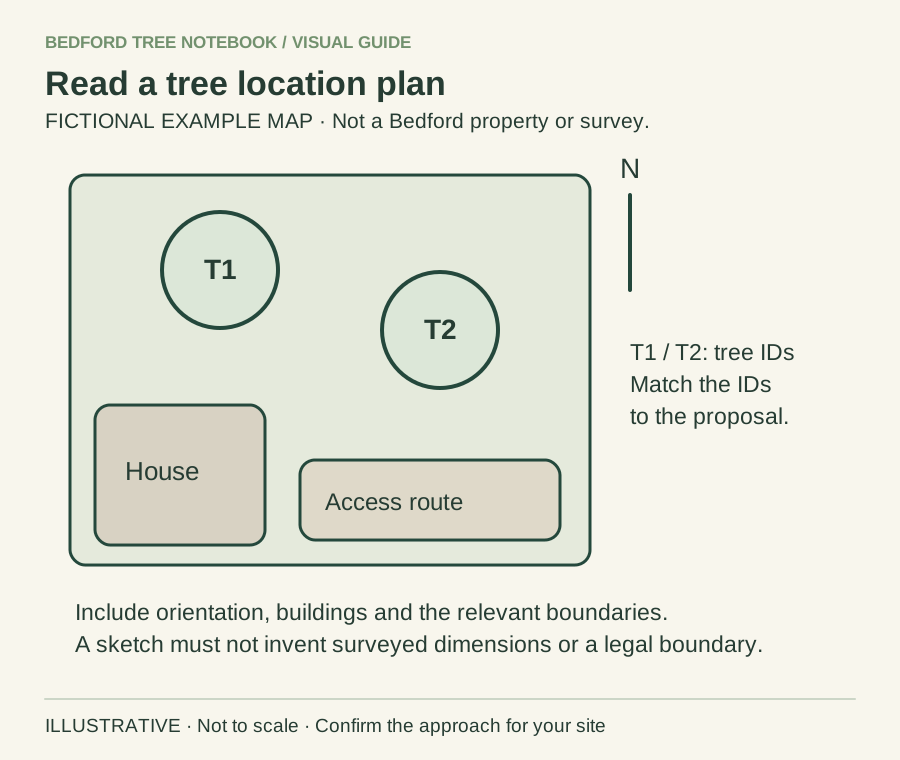
- Match each tree label with its written work specification.
- Check orientation and identifiable site features.
- Follow the relevant council’s actual plan requirements.
Background sources: Greater Cambridge Planning guidance
Make the proposal understandable
Identify each tree, its location and the work proposed. A request to tidy the tree gives little indication of the outcome. Ask the contractor to help prepare a specification that can be understood by both the authority and the people carrying out the job.
Explain the reason without overstating it
Describe the actual issue and provide relevant evidence. Concern about safety, light or damage may need different supporting information. Do not claim a professional diagnosis that you have not obtained. The council’s validation guidance is the starting point for what documents are required.
Agree responsibility for the paperwork
Check whether the contractor will act as agent, whether that service is included in the quotation and who will track the application. Keep copies of what was submitted. Ask to see the decision rather than relying on a verbal statement that the paperwork is sorted.
Read the outcome before booking work
Give the operative contractor the actual decision and relevant conditions. Confirm that the scheduled work matches the permitted scope. If a change is needed after inspection, ask the authority about it before extending the job. An application reference alone is not a work instruction.
Turn the garden problem into a defined proposal
Start by explaining what you want to change: a particular clearance, an obstruction or a concern requiring assessment. Then ask a suitable tree professional to describe the operation being proposed. The authority needs to understand the actual work, while the contractor needs a specification that can be used on site. Keeping those descriptions aligned reduces the chance of an application being treated as a broad request to do whatever seems useful later.
Our crown reduction versus thinning guide can help with terminology, but it should not be used to choose a technical operation without assessment. If the professional's recommendation differs from your first idea, understand the reason before submitting. A clearer proposal can support a more useful quotation too: it identifies what the business is being asked to price rather than leaving the extent of work to be negotiated once the team arrives.
Give every document the same identity system
Use one simple set of tree labels across the site sketch, photographs, specification and correspondence. Show the house, entrance and relevant boundaries so that a reader can orient the plan. Where a tree stands close to another property, make its position clear without treating your drawing as proof of ownership. An application reference should connect to a readable collection of documents, not an unexplained folder of similar close-up images.
For the initial records search, read checking a TPO in Bedford. If an agent prepares the application, ask for a copy of exactly what was submitted and check that it reflects the agreed proposal. Confirm whose contact details the authority will use and how you will receive updates. This helps prevent one person holding a decision while another person schedules work against an earlier version of the description.
Hypothetical example: a safety reason needs clarification
Suppose an application draft describes a tree as dangerous because the homeowner is uneasy about its size. A professional visit may identify a specific concern, suggest a different operation or find that the initial wording overstated what is known. The useful response is to improve the evidence and explanation rather than preserve the strongest-sounding claim. The reason and the proposed work should be supportable on their actual merits.
This invented example is not a diagnosis or a guide to securing consent. It illustrates why a homeowner's observation, professional assessment and authority decision have different roles. Our assessment-signs guide helps prepare a factual account for the first visit. Ask what evidence is relevant to your proposal and follow the authority's current requirements instead of copying an unrelated application from another property and assuming its supporting material will be sufficient.
Agree the agent's scope and the contractor's scope
Ask whether application preparation, tree identification, supporting assessment and follow-up correspondence are included or separately charged. A contractor offering to submit paperwork may not be offering every specialist report the authority might require. Equally, commissioning a report does not automatically book the eventual tree operation. Keep the responsibilities visible so that each stage has an identified owner and an understood fee basis.
Our quotation checklist is useful for recording these distinctions. Ask who will read and explain the decision, who checks any conditions and who supplies the final documents to the people doing the work. If the application timetable changes, update the working date rather than treating a booking as evidence that permission must have been obtained. An agent's involvement should make the record easier to follow, not remove your access to the documents describing the job.
Use the decision as a working document
When a decision arrives, compare it with the submitted proposal and accepted quotation. Check that the tree identifiers, operation and any relevant conditions are understood by the business before attendance. If the outcome does not match the work you expected, ask for clarification before authorising a different result. An approval is not a substitute for a complete contract, and a contract cannot extend an approval's scope.
Use changing approved tree work if a later inspection leads to a revised recommendation. Keep the decision with the final specification and retain it after the visit alongside the invoice and any advice. A future owner, contractor or designer may need to understand the tree's management history. A coherent record is easier to use than an assertion that an application was once made, particularly when the next proposal differs from the work originally considered.
Can my own sketch be useful?
A clear sketch can help explain which tree and property you mean, provided it is not presented as a surveyed boundary or a substitute for required documents. Show fixed features and use consistent labels. Ask the authority or appointed agent what standard of plan is needed for the particular submission. The important distinction is between a useful communication aid and evidence that satisfies the current application requirements for your actual proposal.
Your next step
An application is not permission. Wait for the necessary decision, read its conditions and ensure your contractor receives it.
If the recommendation later changes, read changing a proposal after permission before relying on the original decision.
Use reading a tree location plan to check that the tree described in your proposal can be identified consistently.
Turn the advice into a useful project brief.
Start with the postcode, the work you have in mind and any access considerations.
Prepare your enquiryNo obligation. A site assessment may be needed to confirm the work and price.
Sources & further reading
- Bedford Borough Council: protected trees
- GOV.UK: Tree Preservation Orders and conservation areas
- GOV.UK: planning applications affecting trees and woodland
Sources checked 31 October 2026. How we prepare guidance.