
In this guide Show sections
General guidance, not a professional assessment. Confirm site-specific advice and current requirements before work.
Planning tree work in Bedford or nearby?
Start with the postcode, the work you have in mind and any access considerations.
Prepare your enquiryNo obligation. A site assessment may be needed to confirm the work and price.
What to check
Neither is a universal remedy for shade or concern about safety. The proposed work should respond to a clear objective and the tree’s condition.
Reduction and thinning
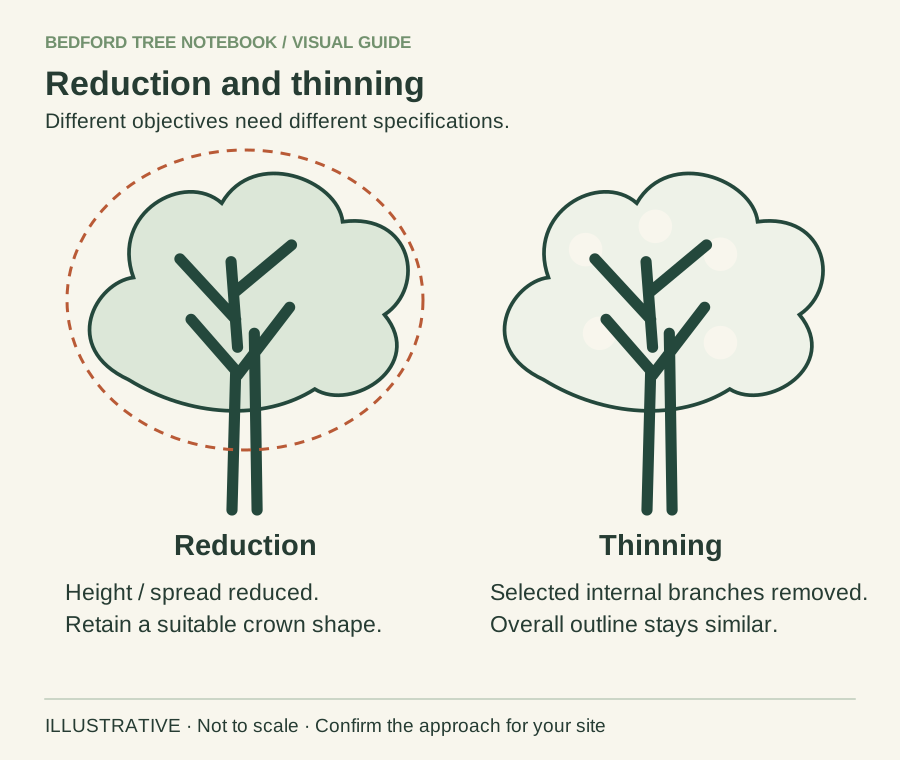
- Reduction changes height or spread.
- Thinning changes density, not the intended overall dimensions.
- Neither diagram prescribes a pruning percentage or cutting points.
Background sources: RHS guidance · Greater Cambridge Planning guidance
Choose the objective before the label
If branches are close to a roof, describe that relationship. If you want more light in a specific area, explain when and where shade is a problem. Naming a pruning operation at the start can distract from whether it would actually address the concern.
Ask what the finished tree will look like
A useful quotation should explain the intended outcome and the parts of the tree involved. Ask the contractor how the specification suits the species and condition. A generic percentage without context can be difficult for a homeowner to understand or compare.
Do not treat either as a safety guarantee
Pruning terminology does not establish the condition of the tree or prove that it will withstand a future storm. If safety is the concern, tell the professional and ask what assessment is appropriate. Do not accept a routine pruning quote as a substitute for a requested assessment.
Useful details for the enquiry
Include a wide view taken safely, approximate dimensions, obstacles below the crown and the reason you are considering work. Add any protection documents. A professional can then recommend the appropriate approach and a written scope for quotation.
Translate a gardening aim into a tree-work question
Start with a sentence about the problem rather than a cutting label. 'The branch touches the shed roof' identifies a relationship to assess; 'thin the tree' assumes the remedy. If the aim is light, record the space and time of day that matter. If the aim is a perceived safety concern, describe the change or feature that prompted it. Ask the professional to recommend an operation only after understanding that objective and the tree.
Our branch touching the roof guide and patio shade guide show how different aims need different descriptions. Neither reduction nor thinning is an all-purpose treatment. Asking what each would achieve in your case is more useful than choosing the term that appears most often in advertisements. A well-defined objective also helps you understand a recommendation to use another approach or to investigate further before specifying pruning.
Understand dimensions and internal selection separately
When discussing reduction, ask how the intended outside dimensions and form will be described. When discussing thinning, ask which purpose the selected internal work serves and how it relates to the tree's structure and condition. The contractor should explain the proposal in language you can follow without asking you to design cuts. A percentage by itself may leave you uncertain about the reference, extent or expected appearance.
Use crown-reduction cost for the commercial implications of a clear specification. If two quotations use the same term differently, resolve the meaning before comparing their totals. You do not need to become an arborist to request clarity about the result. The description should identify the tree and the relevant operation, connect it to the objective and make important limitations visible rather than allowing a familiar label to conceal an undefined amount of work.
Hypothetical example: a quote that promises more light
Imagine a homeowner receives a short proposal for thinning with a broad assurance that the patio will be sunny afterwards. Before accepting, the homeowner should ask what change is realistically expected and how the tree's position affects that expectation. Another business may recommend a different operation or explain limits to what pruning can achieve. The comparison should focus on the reasoning and intended result, not simply which assurance sounds more appealing.
This is an illustrative example, not a prediction about a Bedford tree or a statement that thinning never affects light. It shows why a garden objective needs more explanation than a technical term. If the main issue is that the entire tree feels too large for the plot, our large-tree small-garden guide helps frame the broader decision. Any proposal should remain specific to the actual tree rather than a general promise attached to an operation's name.
Keep severe cutting and established management distinct
If a quotation uses words such as topping, lopping or pollarding, ask for an explanation of the intended operation and the tree's management history. Those labels should not be swapped casually with crown reduction. A tree that has been cut severely before is not automatically evidence that repeating the same appearance is suitable. Ask the professional how the recommendation relates to this specimen and what future care it anticipates.
Our pollarding versus topping guide addresses that terminology in more detail. If safety is your concern, ask what assessment is being provided separately from the proposed pruning. A routine crown operation should not be presented as a guarantee against future failure or storm damage. Keep the record of findings, recommendation and work scope together so that you can distinguish an assessed reason for work from a general maintenance suggestion or a homeowner's initial preference.
Check the final written instruction before the visit
Make sure the quotation describes the agreed operation and is consistent with any necessary permission. If the professional changes the recommendation after another visit, compare the new description with the authority documents before proceeding. A decision about limited pruning should not quietly become a broader crown operation because the team is already available. Ask who will clarify the change and issue the final version everyone will use.
Read changing approved tree work for that situation and use the completion checklist after the work area is released. At handover, ask the contractor to explain the finished result against the specification. Your check is about the agreed service and any remaining questions; it is not an independent assessment of every cut. Clear terminology is valuable when it leads to shared expectations, suitable advice and an operation that can be understood before it begins.
Can I use a photograph of another finished tree?
It may help communicate your aesthetic preference, but make clear that it is a reference rather than a required pruning specification. Another specimen may have different species, structure and management history. Ask the professional what is suitable for your tree and what appearance is realistically expected. A reference image should support the conversation about an objective, not override the assessment or turn an unrelated example into a promise about the finished result.
Your next step
Ask the contractor to describe the intended result in writing and explain why it is suitable for your tree.
If a quotation proposes a severe cut, read pollarding versus topping before comparing the terminology.
For a lime tree with vigorous shoots, read lime regrowth and maintenance before assuming another crown operation is the only relevant response.
Turn the advice into a useful project brief.
Start with the postcode, the work you have in mind and any access considerations.
Prepare your enquiryNo obligation. A site assessment may be needed to confirm the work and price.
Sources & further reading
- RHS: pruning trees
- RHS: reducing tree size safely
- GOV.UK: Tree Preservation Orders and conservation areas
Sources checked 31 October 2026. How we prepare guidance.