
In this guide Show sections
General guidance, not a professional assessment. Confirm site-specific advice and current requirements before work.
Planning tree work in Bedford or nearby?
Start with the postcode, the work you have in mind and any access considerations.
Prepare your enquiryNo obligation. A site assessment may be needed to confirm the work and price.
Before you make arrangements
Photograph the tree as a whole and the affected area only from safe, accessible ground. Keep dates and specifications for previous work. Our long-term tree-care guide helps organise those records so the next recommendation can account for the actual management history.
History before the next intervention
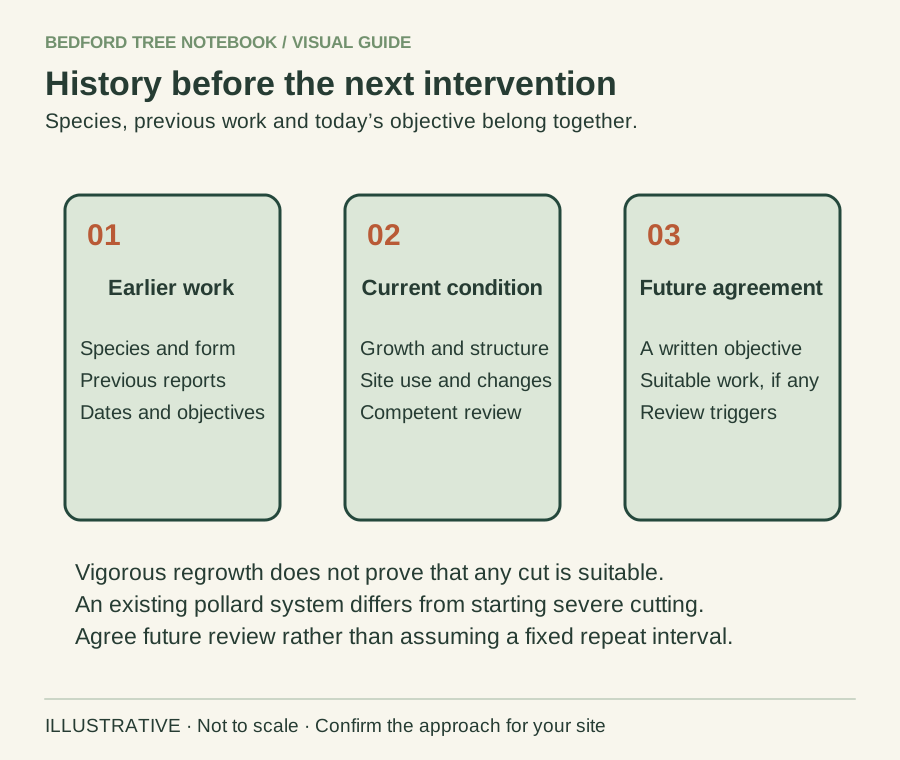
- Identify the species and any established management system.
- Distinguish basal shoots, crown regrowth and structural concerns.
- Ask what future care is appropriate instead of assuming regrowth permits repeated severe cutting.
Background sources: RHS guidance · RHS guidance · RHS guidance
Describe where the growth is occurring
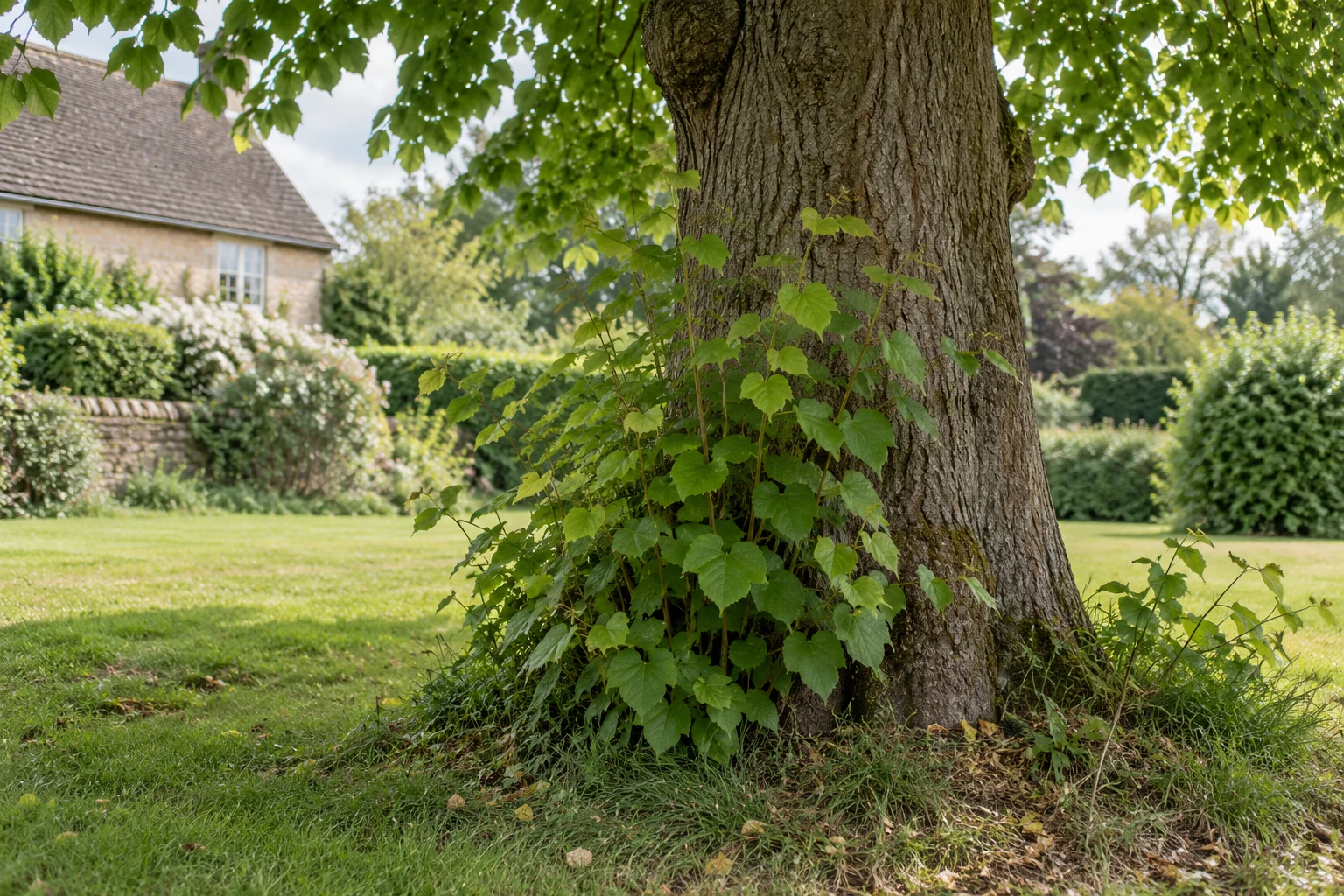
Say whether shoots are around the base, on the trunk, within the crown or near previous pruning points. A wide view helps the professional understand the relationship; a close photograph of leaves alone may not. Avoid cutting shoots first if identifying their origin is part of the question.
If you are uncertain whether the tree is a lime, ask for identification. Different species and individual trees can behave differently, so a common name is not a complete maintenance specification. Our tree consultant guide helps define whether you need an assessment, management advice or simply a quotation for an already agreed practical operation.
The common lime, Tilia × europaea, is described by RHS as often producing basal suckers and burrs. Shoots around its base can therefore be a characteristic of the plant rather than automatic evidence of decline or poor work. Other lime species and cultivars can differ, which is a practical reason to identify the tree before deciding what recurring care is justified.
Keep regrowth separate from a condition diagnosis
Producing vigorous shoots does not, by itself, show that a tree is structurally sound or that it is failing. Tell the adviser about any other changes, such as altered foliage, damaged branches or recent work around the roots. Ask what assessment is needed to interpret the complete picture.
Read changes in leaf colour if foliage has also changed. Avoid concluding that new shoots prove the previous contractor did poor work without comparing the specification and expected response. Equally, do not accept growth as a blanket assurance that an old wound or other structural concern no longer needs consideration. The explanation should address your actual tree.
Understand previous pruning before repeating it
Find the last written specification and, where possible, photographs from before and after the work. Was the tree reduced, lifted, pollarded or managed in another way? Familiar labels can be used loosely, so ask the professional to explain the operation rather than relying on the invoice heading.
Our pollarding-versus-topping guide explains why management history matters. Do not assume that a tree with dense new shoots can be converted to a suitable long-term system simply by repeating a severe cut. Ask whether the current structure and condition support the proposed approach, and what future review or maintenance obligations it would create.
Set the practical objective for basal growth
Shoots at the base may obstruct mowing, a path, access to a gate or inspection of the lower stem. Describe that specific issue. A limited access objective is different from a request to shrink the whole tree, and the quotation should not silently combine those operations.
Keep tools and lawn equipment away from the trunk while the proposal is being considered. Repeated damage during garden maintenance can create a separate problem. Ask what practical arrangement would make the area manageable without assuming every green shoot is harmful. If there is ivy or other planting at the base, identify that too so the professional does not mistake several different management questions for one task.
Ask what a crown proposal is expected to achieve
If the concern is height, shade or clearance, explain where the issue matters and ask what change is realistically expected. New growth after earlier work should inform the discussion about suitable operations and future management. An immediate smaller outline is not the same as a lasting resolution.
RHS tree-pruning guidance provides useful background on assessed pruning rather than indiscriminate cutting. Our reduction-versus-thinning guide separates two common objectives. Ask how the recommendation suits the tree's condition and whether a different garden arrangement would meet your need with less intervention.
Include neighbouring boundaries and public routes
Tell the professional about adjacent gardens, shared entrances, pavements and roads. Recurrent growth may affect access or visibility, but the appropriate response still needs ownership, permissions and safe working arrangements to be considered. Do not assume a narrow obstruction can be managed from any convenient piece of land.
Use the shared-boundary guide to prepare a clear record. If the tree belongs to a council or other organisation, report the concern through the right route rather than instructing your own contractor. For an actual public hazard, use the appropriate reporting process; a routine planning form is not an urgent-response service.
Check controls for repeat visits as well as major changes
Previous work does not provide blanket permission for all future operations. Check the current position for the actual tree and proposal, including any relevant conditions or limits in earlier decisions. If you are unsure which record applies, ask the responsible council before instructing work.
Our Bedford tree-protection guide and permission-records guide help organise the enquiry. Wildlife checks also need to reflect the circumstances, not just the fact that similar work happened before. A repeat maintenance booking should have an understood scope and relevant checks rather than relying entirely on familiarity with the site.
Build a future plan around reviewable actions
Ask which operations are recommended now, what should be observed afterwards and when professional review is appropriate. Keep that separate from a promise to cut on the same date every year. The timing and extent should respond to the individual tree, site use and findings.
If a staged approach is proposed, ask what each stage is intended to achieve and what would lead to changing the plan. Our quotation checklist helps record the practical scope. Make responsibility for follow-up clear, especially where the property is rented or several owners share the garden. A useful plan remains understandable after the original conversation has been forgotten.
Compare the result with the specification
At handover, ask the contractor to explain what was completed and what remains. Record any revised advice, access limitations or recommended future assessment. Do not judge the whole service solely by whether all visible shoots have disappeared; that may not have been the assessed objective.
The end-of-visit checklist helps keep that conversation practical. If future growth is expected, ask how it should be reviewed rather than treating its appearance as an automatic defect. Clear records make it easier to distinguish normal management questions, a changed objective and a genuine concern about work differing from the agreed quotation.
Your next step
Give the professional a record of where the shoots occur and what earlier work was done. Ask for a clear explanation of the current objective and longer-term implications. Keep basal-growth management separate from any crown operation, check relevant controls and retain the specification so future decisions are based on evidence rather than an assumption that all regrowth needs the same response.
Turn the advice into a useful project brief.
Start with the postcode, the work you have in mind and any access considerations.
Prepare your enquiryNo obligation. A site assessment may be needed to confirm the work and price.
Sources & further reading
- RHS: pruning trees
- Bedford Borough Council: protected trees
- GOV.UK: Tree Preservation Orders and conservation areas
- Natural England: wild birds, protection and licences
- RHS: Tilia × europaea plant profile
- RHS: pollarding
Sources checked 31 October 2026. How we prepare guidance.