
In this guide Show sections
General guidance, not a professional assessment. Confirm site-specific advice and current requirements before work.
Planning tree work in Bedford or nearby?
Start with the postcode, the work you have in mind and any access considerations.
Prepare your enquiryNo obligation. A site assessment may be needed to confirm the work and price.
Before you make arrangements
Photograph the whole tree and any safely visible affected foliage. Note the date and what seems different from previous years. Do not climb for samples, strip bark or cut branches to improve identification. Our tree assessment signs guide helps distinguish useful observations from conclusions that need competent assessment.
A record is more useful than a guess
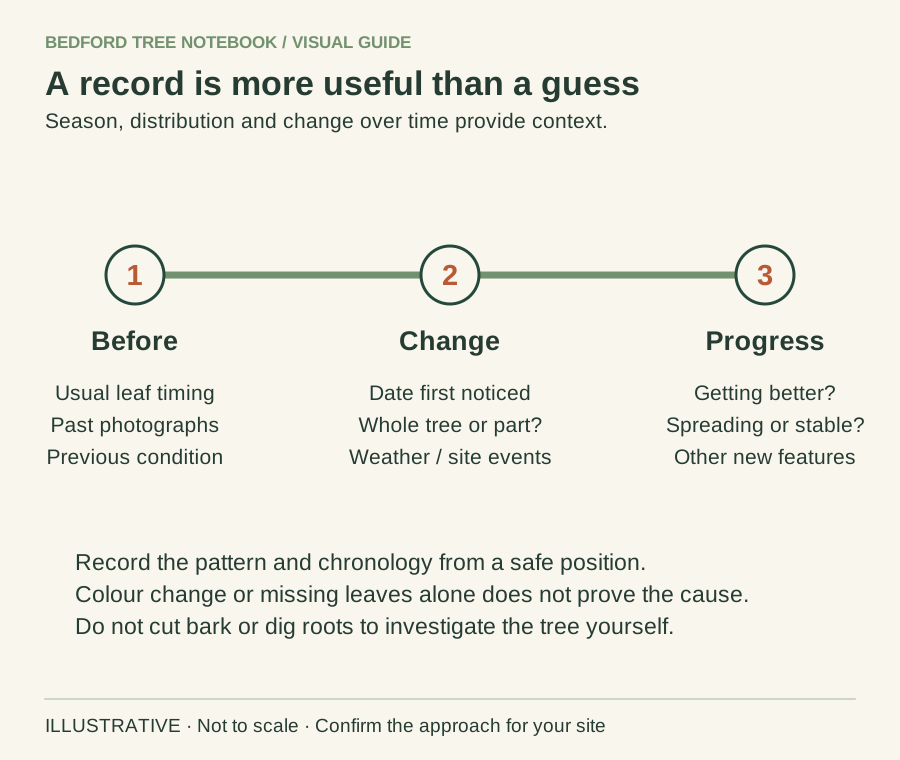
- Record dates, location on the tree and relevant site or weather changes.
- Photograph only from safe, accessible ground without approaching hazards.
- Seek appropriate assessment if changes persist, worsen or accompany structural concerns.
Background sources: RHS guidance · RHS guidance · RHS guidance
Confirm the tree and expected seasonal appearance
Ask for identification if it is uncertain, using any reliable planting record or previous report. Some ornamental forms have distinctive foliage, while deciduous trees change colour as part of their seasonal cycle. A comparison with a different species in the same street may therefore be misleading.
Describe what is new for this tree rather than whether its leaves match a general idea of healthy green. If you recently bought the property, say that your reference history is limited. The neglected-garden priorities guide helps organise an inherited site without assuming that every unfamiliar feature represents decline or that immediate corrective cutting is needed.
Record the pattern within the crown
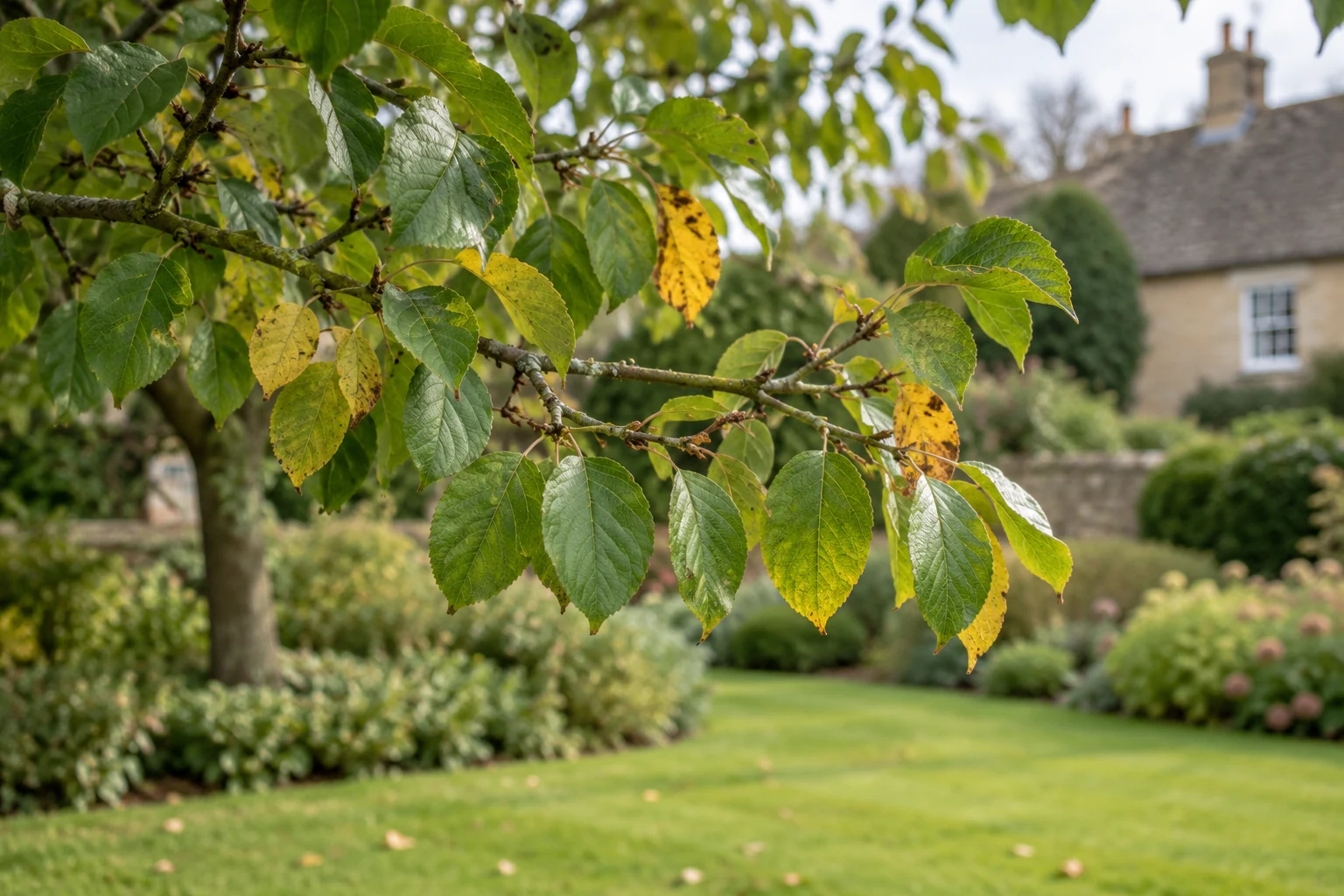
Note whether the change affects the whole tree, one branch, one side, leaf edges or scattered patches. Record whether leaves remain attached, have fallen early or appear different alongside another visible change. Photographs from a safe viewpoint can help the professional understand where to look.
The RHS guidance on brown leaves on woody plants describes why several causes can produce broadly similar appearances. Use that information to appreciate the limits of image matching. Do not assume that an app result or a neighbouring plant's diagnosis identifies the problem in your tree, especially when important site details are missing.
Build a timeline with useful context
Write down when you first noticed the colour change and whether it developed suddenly or gradually. Include dates of planting, pruning, nearby building work and changes to the garden where known. Old photographs can help establish whether a pattern is genuinely new.
Our tree concerns after building work guide explains why a factual site history matters. Do not turn a timing overlap into proof that a contractor or weather event caused the change. The role of the record is to support assessment. Keep uncertain dates marked as approximate and separate your observations from explanations suggested by other people.
Describe moisture and ground conditions without testing roots
Tell the adviser about prolonged wet or dry conditions, visible standing water, altered drainage and new paving. Those observations can be relevant, but the surface appearance alone does not determine what is happening throughout the rooting environment. Avoid digging around the tree to establish the cause yourself.
Read mature trees in dry weather and waterlogged gardens where those conditions are part of the history. Do not automatically increase watering because leaves are brown, or assume recent rain excludes moisture-related concerns. Ask what information or investigation is appropriate before changing care or installing drainage that could disturb retained roots.
Keep diagnosis and treatment as separate decisions
An appropriate assessment may suggest a likely explanation, further investigation, observation or specialist input. Ask what can reasonably be concluded from the visit and what remains uncertain. A treatment recommendation should respond to the identified issue rather than to leaf colour in isolation.
Avoid applying a universal feed, pesticide or fungicide because the packaging shows a similar symptom. This article does not recommend a product or chemical application. If specialist identification is proposed, ask how the result would affect management. A useful diagnosis process should have a clear purpose, not simply add a series of treatments while the original uncertainty remains unaddressed.
Do not infer structural safety from the foliage
A green crown does not certify a tree as structurally sound, and altered foliage does not by itself prove imminent failure. If a new lean, split, hanging branch or other concerning feature is present, report it separately and keep clear of the affected area. Do not wait for a leaf diagnosis before seeking appropriate help with an apparent immediate hazard.
Our hanging broken-branch guide addresses one such situation. Tell the professional what people or structures are nearby so the concern can be prioritised. A photo of a leaf should not become the sole basis for either reassurance or an instruction to remove the entire tree.
Ask what service the visit will provide
Clarify whether you are arranging horticultural advice, a tree-condition assessment, specialist disease investigation or a quotation for practical work already recommended. Those services may overlap, but should not be assumed to be identical. Explain the concern before agreeing to a standard pruning visit.
The consultant-or-contractor guide helps define the role and deliverable. Ask whether a written record is included and who will use it. If the tree is shared, rented or managed by an organisation, establish who has authority to commission the advice and receive the findings. Clear instructions reduce the risk of a diagnosis question being replaced by a price for cutting.
Check consequences before changing the tree or garden
If management is proposed, ask how it addresses the findings and what other effects should be considered. Pruning, root disturbance, level changes or removal are not interchangeable remedies. Keep the proposed operation consistent with any relevant ownership, protection and wildlife requirements.
Our Bedford protection-check guide provides the local starting point, and the active-nest guide explains a separate concern. Do not treat the word “diseased” as automatic authority for all desired work. Where uncertainty remains, obtain appropriate clarification of the actual tree and proposal before a contractor is instructed.
Keep the follow-up record specific
Ask what to observe next, how to photograph it and which changes should prompt another contact. Avoid assuming that every tree should be reassessed on the same timetable. The appropriate review depends on findings, uncertainty and site use, not a universal date attached to discoloured foliage.
Use the long-term Bedford tree-care guide to keep notes, reports and completed actions connected. If the colour later returns to normal, record that without assuming it proves the original diagnosis. If it worsens, pass on the new information rather than trying progressively stronger remedies. A useful history makes future assessment more informed and proportionate.
Your next step
Prepare a dated record of the tree, colour pattern and site history, then seek advice appropriate to the actual concern. Keep observations separate from diagnosis and treatment, and report structural changes independently. Avoid automatic cutting or chemical responses. A clear brief helps the professional decide whether the next step is observation, further investigation or a justified management proposal.
Turn the advice into a useful project brief.
Start with the postcode, the work you have in mind and any access considerations.
Prepare your enquiryNo obligation. A site assessment may be needed to confirm the work and price.
Sources & further reading
- RHS: brown leaves on woody plants
- RHS: watering plants wisely
- RHS: pruning trees
- Bedford Borough Council: protected trees
- RHS: improving health of declining trees and shrubs
- RHS: weather damage
- RHS: why a tree or shrub has died
Sources checked 31 October 2026. How we prepare guidance.