
In this guide Show sections
General guidance, not a professional assessment. Confirm site-specific advice and current requirements before work.
Planning tree work in Bedford or nearby?
Start with the postcode, the work you have in mind and any access considerations.
Prepare your enquiryNo obligation. A site assessment may be needed to confirm the work and price.
Before you make arrangements
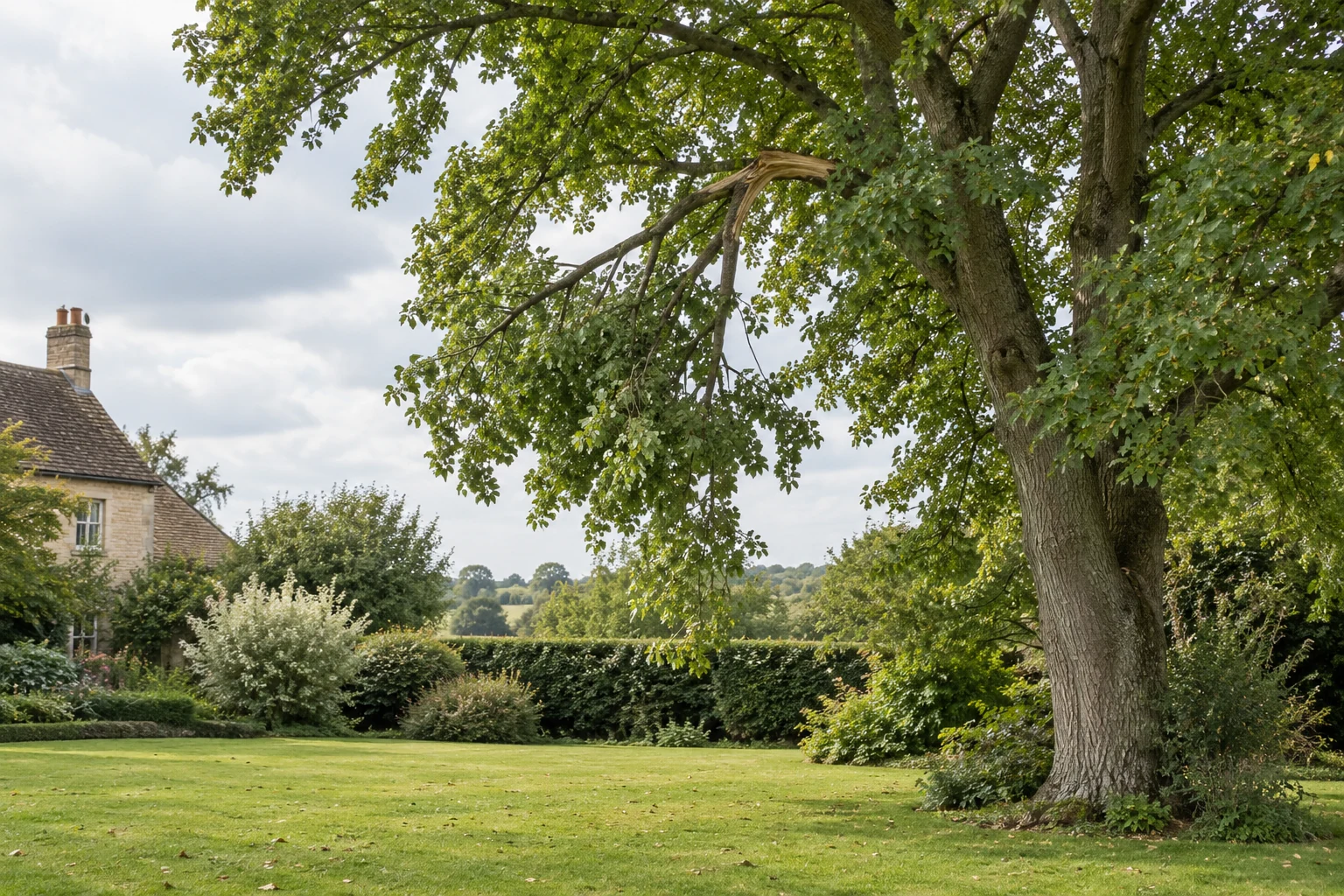
Stay out from beneath the branch and do not approach it to measure, retrieve belongings or take a closer photograph. Keep children and pets away without entering the affected area yourself. If people, a road or utilities appear to face immediate danger, use the appropriate urgent reporting route. A routine planning or quotation form is not an emergency response service.
A hanging branch is not a DIY task
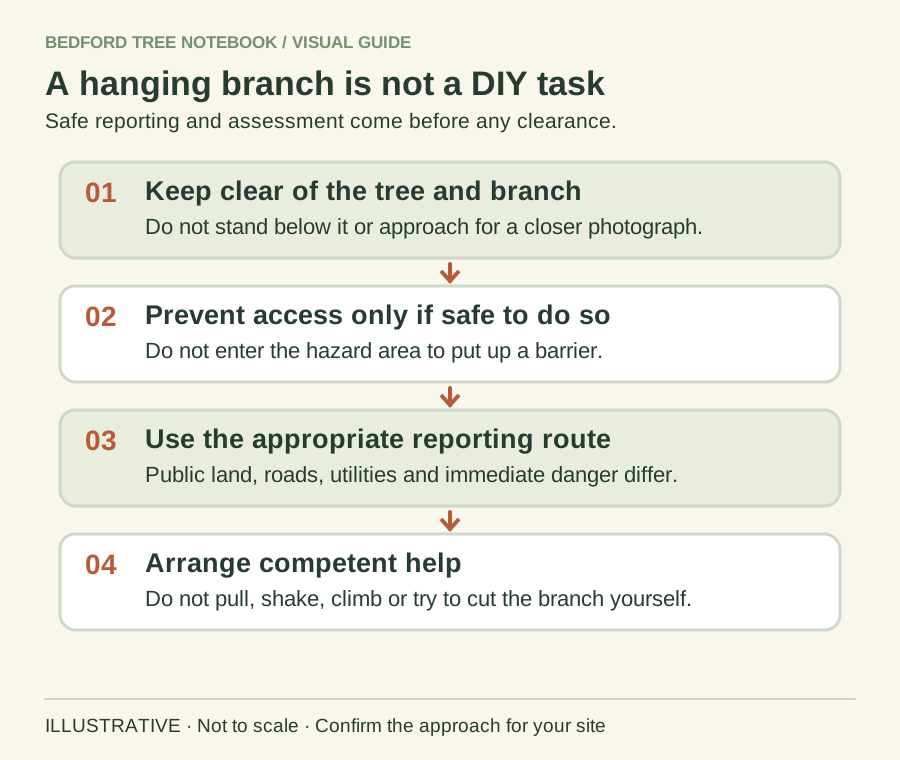
- Do not approach, stand beneath, pull or shake the hanging branch.
- Do not put yourself at risk to photograph it or restrict access.
- Use the relevant urgent reporting route where necessary; this website does not dispatch emergency help.
Background sources: HSE guidance · GOV.UK guidance
Describe what you can observe safely
Give the exact property location and say that the branch is broken and remains suspended or lodged. Explain whether it is over a garden path, roof, neighbouring land or public route. Do not guess a weight, attachment point or safe drop area that cannot be established from your viewpoint.
The Forestry Commission extreme-weather guidance recognises hanging branches and damaged trees as part of the post-weather response. A domestic homeowner should seek competent help rather than adapting woodland operations advice into a DIY method. Say if visibility is poor; an incomplete but accurate description is preferable to entering the area for certainty.
Do not try to make it fall
Avoid pulling ropes, shaking the tree, hitting the branch or cutting supporting material. Do not place a ladder underneath it or climb into the crown to look at the break. A limb that seems stuck may be held by several parts that cannot be evaluated from the ground.
The HSE tree-work safety topics explain the specialist hazards behind competent planning and work. The homeowner’s role is to communicate the situation and access, not test the branch’s security. Do not invite an unqualified helper to attempt a quick removal while waiting for a business to respond; that changes the risk without resolving the assessment.
Use the right route for the location
If the tree stands on council or highway land, report the concern through the responsible authority’s route and provide a clear location. Where ownership is unclear, explain that uncertainty instead of entering land to investigate. A tree beside the pavement may be privately owned, so its position alone does not settle responsibility.
Our Bedford council-tree reporting guide helps with location information. For private land, contact a competent professional able to assess the circumstances. Avoid assuming that a web enquiry acknowledgement means a response is underway or that the area is safe. Check the actual arrangements and use the appropriate urgent channel if circumstances demand it.
Mention cables and other surroundings first
Tell the professional about any nearby overhead lines, buildings, glass structures, roads or public access before a visit is arranged. Do not assume you can identify a line’s type or whether it is safe. Stay clear and let the relevant professionals establish what coordination is required.
Read overhead cables and tree work and work near roads for the information to share. Do not move a vehicle or garden object from under the branch to make the visit easier. The business may need other parties or access arrangements involved, and should decide that from a truthful brief rather than arriving to an undisclosed constraint.
Explain access without approaching the tree
Describe the normal route from the street and any locked gate, narrow passage, steps or shared drive. Use what you already know; do not walk the route into the suspected hazard simply to improve measurements. Say whether there is another safe place from which the setting can be viewed.
Our narrow access guide helps organise ordinary route information. If the only way into a garden passes beneath the branch, make that explicit. Do not assume the contractor can follow the usual route or that an earlier quotation for unrelated work establishes suitable access for this different situation. Agree the visit with the business directly.
Separate immediate handling from the wider tree question
The immediate task may concern the suspended material, while a further assessment considers the remaining tree and any other damage. Ask what the proposed visit will cover. Removing one hanging branch does not automatically answer every question about condition or explain why the failure occurred.
Our storm-damaged trees guide and deadwood-removal guide help keep those scopes distinct. Tell the professional about earlier failures or reports. If they recommend subsequent investigation, request the purpose and output before treating it as included. Avoid replacing a specific concern with a general request to cut the entire tree hard simply because one limb has broken.
Keep evidence and authority proportionate
Where it is safe to do so from an existing position, retain a dated wide photograph and note the sequence of events. Do not collect evidence by standing underneath, climbing or moving timber. Inform other relevant owners or managers through an appropriate channel if their land or access is affected.
Before work, establish who may authorise it and what tree controls or wildlife requirements apply. Our dangerous-tree permission guide explains why an urgent concern and a particular legal exception are not the same thing. Ask the professional or authority how the correct procedure applies to the circumstances; do not rely on the word “emergency” as blanket clearance.
Agree what the quotation includes
When the immediate arrangements allow a written scope, identify the tree, suspended material, any additional inspection and the destination of timber and debris. Clarify whether subsequent pruning, stump work or reinstatement is separate. A brief price for “storm clearance” can conceal important differences between businesses.
Use waste-removal scope and the quotation checklist to record those assumptions. Ask what remains conditional on inspection and how changes will be authorised. If another person is arranging the job while you are away, ensure they know the limit of their authority rather than leaving the work team to reconcile conflicting instructions on arrival.
Obtain a clear handover
After the professional has completed the agreed task, ask what has been done, whether any restrictions remain and whether further advice is recommended. Wait for the agreed release of the working area rather than entering because machinery has stopped or the branch is no longer visible.
Keep the findings and final scope with the tree record. If monitoring or another visit is recommended, identify who will arrange it and which changes require earlier contact. The end of the immediate job should not erase the reason it happened or turn a limited operation into a promise about all future tree behaviour. A practical handover tells the household what remains to do.
Your next step
Keep clear, describe the location and surroundings accurately, and arrange competent professional help through the right channel. Do not attempt to release the limb yourself. Once the immediate concern is managed, make sure the remaining tree question and any follow-up are clear in the record, using the completion checklist where appropriate.
Turn the advice into a useful project brief.
Start with the postcode, the work you have in mind and any access considerations.
Prepare your enquiryNo obligation. A site assessment may be needed to confirm the work and price.
Sources & further reading
- HSE: tree-work safety topics
- Forestry Commission: extreme-weather preparation and response
- GOV.UK: tree-protection guidance
Sources checked 31 October 2026. How we prepare guidance.