
In this guide Show sections
General guidance, not a professional assessment. Confirm site-specific advice and current requirements before work.
Planning tree work in Bedford or nearby?
Start with the postcode, the work you have in mind and any access considerations.
Prepare your enquiryNo obligation. A site assessment may be needed to confirm the work and price.
Before you make arrangements
Keep away from any area where the tree, ground or construction appears unsafe. If there is an immediate hazard, seek appropriate urgent help. For a planned assessment, gather existing documents and photographs without excavating roots or entering a suspect area. Our tree-assessment signs guide helps you describe observations rather than make a diagnosis.
The visible part is only part
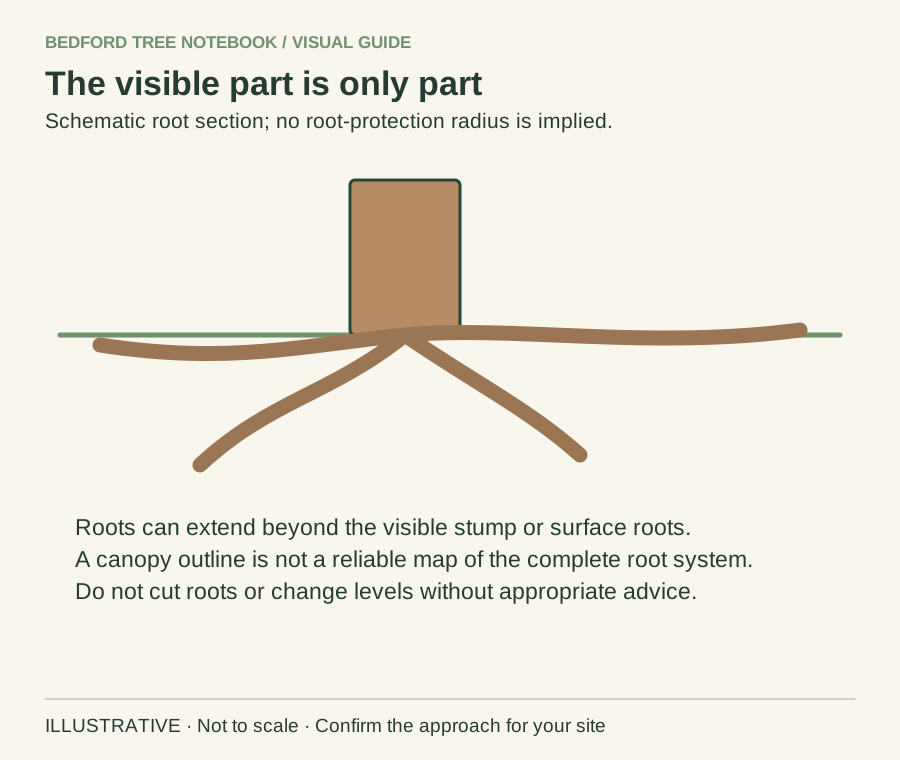
- Visible roots do not map the complete system.
- Root cutting, compaction and changes of level can affect a retained tree.
- Obtain site-specific advice before interfering with roots.
Create a factual timeline
Record when the building or landscaping work took place, what operations you know occurred and when the tree concern was first noticed. Distinguish a documented date from an approximate recollection. Include whether the concern is new or whether older photographs suggest it was already present.
Keep the language neutral. “Excavation occurred beside this boundary in March” records an event; “the builder killed the tree” asserts a cause that requires evidence. A timeline helps the assessor understand the sequence without forcing a conclusion. If several businesses worked at the property, identify the relevant stages and contacts rather than attributing every change to the most recent person on site.
Describe visible changes from safe positions
Say what you can actually see: altered foliage, broken branches, a new lean, a change at the base or a ground-level difference. Include photographs showing the whole tree and its surroundings if you can take them safely. Explain which images are before, during and after the works.
Avoid digging, lifting surfaces or pulling at roots to produce stronger evidence. A professional may need a specific investigation, but that should be planned and authorised appropriately. Our visible-roots guide explains the importance of keeping observations separate from a proposed cutting or excavation operation. If the concern develops materially while you are waiting, tell the assessor rather than relying on the first description alone.
Collect the relevant construction records
Look for approved plans, tree reports, protection schemes, site photographs and correspondence about access or ground works. Keep original versions and identify the parts that relate to the tree. Do not assume every drawing in a planning folder describes what was actually built.
Use tree work and planning conditions to connect the documents. If you do not have a record, say so rather than reconstructing it as fact. An assessor may ask the designer, contractor or authority for further information through an appropriate route. Share only what is relevant to the assessment; unrelated household or commercial documents are not needed simply to make the file appear comprehensive.
Understand why ground changes may matter
Forest Research identifies root damage and soil compaction as relevant considerations around trees and construction. This does not allow a general article to diagnose a particular tree or prescribe a remedy. Explain known excavation, vehicle movement, stored materials or level changes so the professional can decide what needs assessment.
Do not assume a tree's crown being untouched means every tree-related issue has been excluded. Equally, do not interpret any later symptom as proof of a construction cause. The useful question is what evidence and expertise are needed to assess the actual site. A routine work quotation may not provide the report required for a planning matter, insurance question or dispute.
A hypothetical post-project enquiry
Imagine a homeowner notices thinning foliage after a new patio has been built near a mature tree. The homeowner has photographs of the garden before work, a layout drawing and some construction images. The initial enquiry asks a contractor to remove the tree because it is presumed to be failing.
A more useful first step is to seek the appropriate assessment, supplying the chronology and observed changes without deciding the cause in advance. This hypothetical example does not establish that paving caused the symptom or that removal is required. It illustrates how a coherent information pack helps a professional identify the relevant investigation, which may involve more than pricing an immediate tree operation.
Choose the right professional output
Ask whether you need verbal advice, a written tree-condition report, planning-related input or another specialist investigation. Describe who needs to rely on the output and for what purpose. The surgeon-or-consultant guide explains why the deliverable matters when selecting expertise.
If there is a concern about building damage, ask the relevant insurer or building professional what information is required before commissioning reports or operations. Avoid instructing removal merely to demonstrate that you are taking the issue seriously. A change to the tree can affect the evidence available and may not answer the underlying building question. Keep the professional roles and commissioning instructions clear from the outset.
Keep proposed remedies provisional
An assessment may lead to further information gathering, monitoring, a management recommendation or a proposed operation. Ask what the conclusion is based on and what remains uncertain. Do not extend a limited opinion to cover areas that were not assessed.
Where work is recommended, check ownership, tree protection and other applicable requirements before booking. If an existing approval no longer matches the proposal, use changing tree work after permission. A contractor's availability should not determine the investigative conclusion. Settle the evidence and recommendation first, then obtain a quotation for the operation that is actually required and authorised.
Record follow-up and unresolved questions
Keep the report, correspondence and any recommended review dates in one place. Identify who is responsible for each next action and what information would trigger a further conversation. If several parties are involved, ask for a clear written summary rather than relying on different recollections of a site meeting.
Our permission-records guide offers a practical document structure even where the concern is broader than planning. If there is a dispute, use appropriate independent advice about that dispute rather than treating this guide as a legal opinion. A careful record helps you communicate facts, protect the usefulness of existing evidence and avoid commissioning a new operation before its purpose has been settled.
Your next step
Prepare a neutral chronology, relevant documents and safe observations, then ask for the professional assessment suited to the question. You can organise a planned enquiry through the project planner, but explain where a report or specialist investigation is needed. Keep the cause, tree recommendation and any building or contractual issue distinct until the evidence supports a conclusion.
For suspected building movement, read trees and subsidence concerns before assuming that nearby roots establish the cause.
If the project is on adjoining land, trees and a neighbour’s building work explains how to coordinate records and concerns without assuming access rights.
Turn the advice into a useful project brief.
Start with the postcode, the work you have in mind and any access considerations.
Prepare your enquiryNo obligation. A site assessment may be needed to confirm the work and price.
Sources & further reading
- Forest Research: soil compaction, practical considerations
- Forest Research: tree roots and trenching
- HSE: tree-work safety topics
Sources checked 31 October 2026. How we prepare guidance.