
In this guide Show sections
General guidance, not a professional assessment. Confirm site-specific advice and current requirements before work.
Planning tree work in Bedford or nearby?
Start with the postcode, the work you have in mind and any access considerations.
Prepare your enquiryNo obligation. A site assessment may be needed to confirm the work and price.
Before you arrange the work
Tell the professional what you know about earlier work and provide old photographs if available. Do not infer that a tree is an established pollard simply because it has been cut severely before.
A system is not a one-off cut
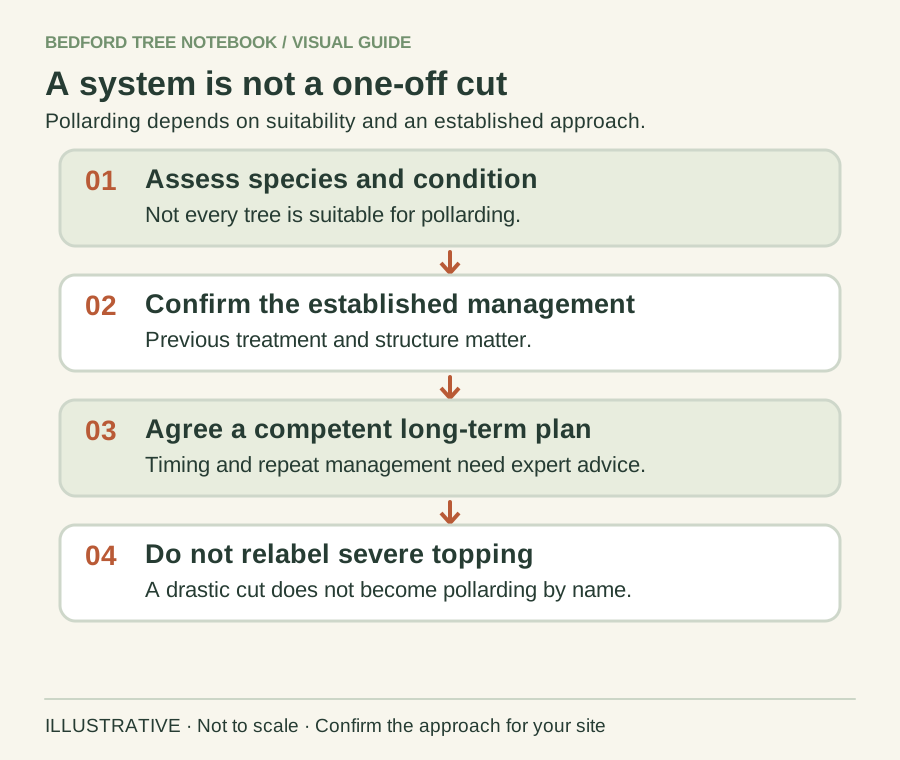
- Confirm suitability and existing management with an arborist.
- Do not treat topping as equivalent to pollarding.
Background sources: RHS guidance · Greater Cambridge Planning guidance
Understand the intended system
RHS guidance treats pollarding as a planned way of controlling growth in suitable trees and shrubs. Whether it is appropriate for your tree requires assessment. Ask which parts would be retained, how the proposed work relates to previous management and what future visits are anticipated.
The large-tree small-garden guide helps explain the objective without prescribing an operation. Wanting a smaller crown does not by itself determine the right method.
Question a vague severe-reduction proposal
A label such as topping, lopping or pollarding can conceal very different outcomes. Ask for a clear specification and an explanation of the expected effect on the tree. Request professional clarification if two quotations use similar words for visibly different amounts of work.
Read crown reduction versus thinning before comparing those options. A familiar term is less useful than a description tied to this tree and its condition.
Budget for the management plan
Ask about future pruning, inspection and the consequences of leaving the tree beyond the intended cycle. Record what is included now and what would be separately quoted later. Do not assume one visit permanently fixes size or eliminates future attention.
Permissions and wildlife checks still apply where relevant. If the proposed operation differs from an existing approval, use changing approved tree work before accepting a revised specification.
Start with the tree’s previous management
Ask what is known about the tree’s history and give the professional any dated photographs showing earlier work. A shape that looks familiar today may have developed through several different operations. Avoid describing every previously reduced tree as a pollard unless that management system has been established by an appropriate assessment.
If you have inherited the garden, say where the history is uncertain. It is better to provide a small honest record than invent a regular maintenance cycle from the current outline. The contractor can then explain what it can infer, what it needs to inspect and how that affects the recommendation.
Ask for a description beyond the operation’s name
A useful proposal identifies the tree and describes the intended work in terms that can be checked. If pollarding appears in a quote, ask the professional to explain how it applies to this particular tree and what continuing management is anticipated. Do not accept a verbal label as the entire specification.
Our quotation checklist helps separate the description from price and clearance. The same broad word can be used loosely in ordinary conversation, so clarification should happen before acceptance. Ask the business to correct its own wording where necessary rather than rewriting a technical description yourself and assuming the contractor agrees with your interpretation.
A hypothetical comparison of different proposals
Imagine one business proposes a defined crown reduction while another offers to pollard the tree, with little explanation. The offers cannot be compared fairly just by looking at their totals. Ask each contractor to describe the proposed result, why it considers the operation suitable and what future attention may follow.
This example does not establish that either proposal is correct. It illustrates a missing comparison question. Our reduction-versus-thinning guide explains other commonly confused terms. If the explanations remain contradictory or you are uncertain about a substantial intervention, ask what form of independent professional advice would help before choosing an irreversible operation.
Consider the appearance between maintenance visits
Ask how the professional expects the tree to look after the operation and during the proposed cycle of care. An immediate photograph is not the whole story when the plan depends on repeated management. Clarify how later work would be assessed and arranged, and what would happen if the intended programme is not followed.
This is a question about the management commitment, not a homeowner’s pruning schedule. Do not infer suitable timing or cutting points from a general article or a neighbour’s different tree. Keep the recommendation tree-specific and ask for an explanation that connects the current operation with the future plan.
Check whether your actual objective is different
A homeowner asking for pollarding may really want a branch away from a roof, more clearance over a path or a less shaded seating area. Describe that problem first. The professional can then consider a suitable operation rather than being asked to justify a term selected before the assessment.
Our large-tree small-garden guide helps frame the wider decision. If the objective changes during the conversation, ask for the final proposal to reflect it. A desire for a smaller outline does not automatically justify severe pruning, and a recommendation should not be judged only by how much material would leave the garden.
Keep permissions aligned with the final specification
If a tree is protected or the work relates to a planning condition, compare the actual proposed operation with the relevant documents. Do not assume that permission for one type of pruning covers a different intervention merely because both make the crown smaller. Ask the authority how any proposed change should be handled.
Read changing approved tree work before relying on an old decision. Save the written clarification with the accepted quote and make the final version available to the attending team. A revised commercial agreement and an authority’s response serve different purposes, so neither should disappear into a general note saying approval obtained.
Use completion to establish what was done
When the contractor releases the area, ask it to explain the operation against the written scope and any follow-up recommendation. Keep the records and photographs together, particularly if the tree is expected to need continuing management. A future contractor will find a dated account more useful than a remembered description that it was cut hard a few years ago.
If the appearance differs from what you understood, raise that specific point promptly. Avoid concluding from appearance alone that work has either been correctly pollarded or improperly topped. A professional assessment may be needed; your useful starting point is the agreed specification and a clear record of the concern.
Your next step
Ask the contractor to replace ambiguous wording with a tree-specific description and a maintenance explanation. Compare the final scope using the quotation checklist before booking.
For evergreen planting, reduction and regrowth questions help avoid assuming that different species respond in the same way.
Turn the advice into a useful project brief.
Start with the postcode, the work you have in mind and any access considerations.
Prepare your enquiryNo obligation. A site assessment may be needed to confirm the work and price.
Sources & further reading
Sources checked 31 October 2026. How we prepare guidance.