
In this guide Show sections
General guidance, not a professional assessment. Confirm site-specific advice and current requirements before work.
Planning tree work in Bedford or nearby?
Start with the postcode, the work you have in mind and any access considerations.
Prepare your enquiryNo obligation. A site assessment may be needed to confirm the work and price.
Before you start
Observe the pattern from normal safe positions over the times you use the garden. Note whether the issue is seasonal foliage, low branches, a dense crown or another feature casting shade. A single photograph taken at one time is a starting point, not a reliable prediction of what pruning will achieve.
Reduction and thinning
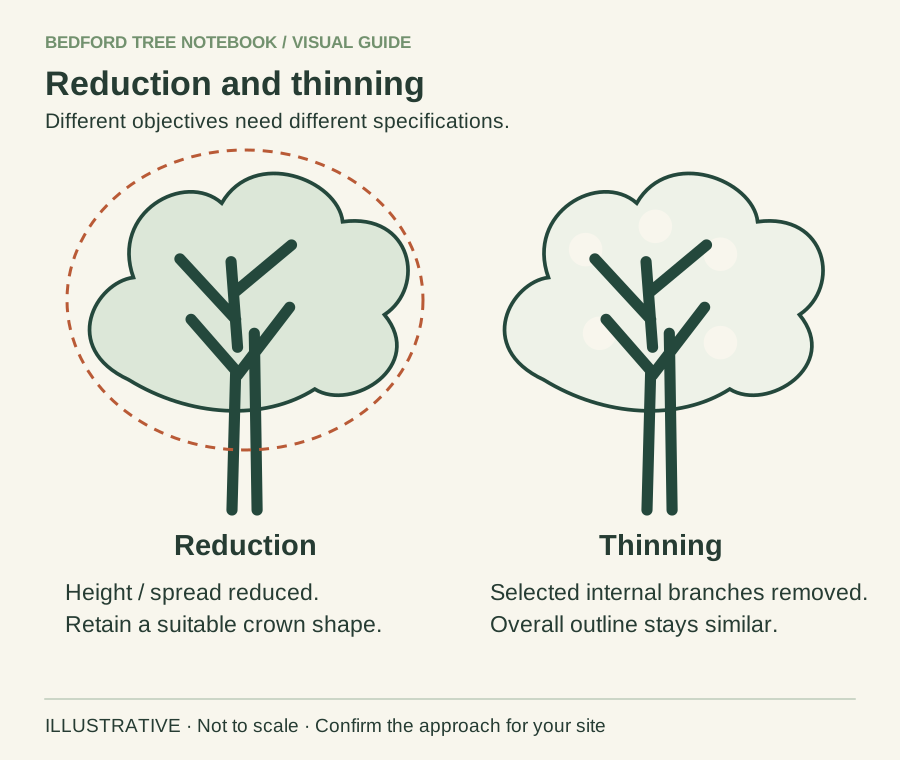
- Reduction changes height or spread.
- Thinning changes density, not the intended overall dimensions.
- Neither diagram prescribes a pruning percentage or cutting points.
Background sources: RHS guidance · Greater Cambridge Planning guidance
Define the part of the day that matters
Write down when you want to use the space and what is uncomfortable about it. Would a little more morning light help, or is the main aim an open view from a chair? Which season matters most? Those details are more useful than a broad instruction to remove all shade.
Keep neighbouring buildings, fences and other trees in the picture. If they contribute substantially, changing one tree may not deliver the improvement you have in mind. Explain the full setting before agreeing a tree-specific proposal.
Identify whose tree it is
Establish the tree’s location and who can authorise work. If it belongs to a neighbour, begin with a discussion rather than presenting pruning as already agreed. Read the overhanging-tree guide if branches cross the boundary, and obtain appropriate advice for a dispute.
For a council-managed tree, use the public-tree reporting guide and read the council’s current policy explanations. A preference for less shade and a concern about a damaged branch are different issues and should be described accurately.
Understand the operation being proposed
Reducing a crown changes its dimensions. Lifting concerns selected lower branches. Thinning concerns selected branches within the crown. Their names are not interchangeable and none is an automatic answer to every shaded garden.
Use reduction versus thinning and crown lifting to prepare questions. Ask the professional what their proposal is intended to achieve in your garden, what it will not achieve and how it suits the actual tree.
Consider changes to the space as well
Sometimes the first useful exercise is to compare where you sit, what can be moved and whether the garden has another usable area. That does not mean tree work is unnecessary. It prevents the first conversation from assuming that the tree is the only variable.
If you value privacy or summer shelter, say so. A proposal that improves one part of the garden may change another quality you wanted to retain. Write down your priorities in order so that an alternative can be assessed against them.
Compare the immediate and longer-term outcome
Ask what the tree is likely to look like after the proposed work and what future care may be needed. Pruning does not freeze a living tree at a chosen outline. Avoid converting a possible improvement into a promise of permanent light or a fixed repeat-cutting schedule.
The RHS pruning guide provides background on tree care. For your own proposal, rely on a site-specific recommendation and an understandable written scope rather than copying the appearance of a different tree in a photograph.
Prepare a useful light-and-space brief
Include a safe wide view, your main seating or window position, approximate tree size and the time of day that matters. Mention whether the tree should be retained where reasonable, any known protection record and access to the garden.
Before deciding, compare the professional’s recommendation with your original aim. The remove-or-prune guide helps frame that choice. Neither a favourable quote nor an available date establishes permission for the work, so complete the relevant checks separately.
Keep a short record of how you use the patio
Write down when the space is most important to you: an early meal, afternoon play or an evening seat. Record ordinary observations over several days without turning them into a formal light survey. A photograph from the same safe position can help explain the problem more clearly than saying the entire garden is dark.
Include what you value about the tree, such as privacy or shade at another time. This helps frame the decision around your actual priorities rather than a single instruction to remove more foliage. Our large-tree small-garden guide considers the wider balance between garden use, tree size and future maintenance.
A hypothetical choice between different improvements
Imagine a homeowner wants a sunnier place for a table but also values screening beside an upstairs window. The tree professional explains the limits of a suitable pruning proposal, while the homeowner considers moving the table within the garden. The eventual decision may combine modest tree work with a change to how the space is arranged.
The example does not imply that pruning is appropriate or that relocating furniture always solves shade. It shows why a useful conversation considers the desired experience before choosing an operation. Ask what difference the contractor reasonably expects and which uncertainties remain, rather than treating a particular percentage reduction as a guarantee of extra sunlight.
Distinguish private preference from a council request
If the tree appears to be on public land, use the responsible authority’s published policy and reporting route. A private homeowner’s preferred garden outcome does not establish that the council will carry out the requested pruning. Bedford’s council-tree reporting guidance helps separate maintenance concerns from a private job you can commission.
If a neighbouring private tree contributes to the shade, establish ownership and discuss the issue with the owner. Do not treat a boundary overhang question as a general authority to reshape someone else’s crown. Any proposed agreement should still identify who can authorise the work and how the contractor would reach the site.
Review the recommendation as a continuing choice
Ask the professional what future growth and maintenance may mean for the proposed benefit. The first appearance after pruning is only one part of the decision. Keep the expected result, limitations and any later review separate from a guaranteed long-term light level.
Use pollarding versus topping if a severe size-control suggestion enters the discussion, and ask for a tree-specific explanation. Before accepting a quote, compare its written operation with the outcome you described. If the proposal does not appear to address your priority, ask for clarification rather than agreeing simply because some tree work has been offered.
Putting it into practice
Give the professional your priorities and ask them to explain suitable options, limitations and likely maintenance. Use the crown reduction service if that is an approach you want assessed, while remaining open to a more targeted proposal. Do not treat a desired light level as a guaranteed result from a named operation.
For the wider garden decision, read a large tree in a small garden.
Turn the advice into a useful project brief.
Start with the postcode, the work you have in mind and any access considerations.
Prepare your enquiryNo obligation. A site assessment may be needed to confirm the work and price.
Sources & further reading
- RHS: pruning trees
- Bedford Borough Council: report a tree problem
- Bedford Borough Council: protected trees
Sources checked 31 October 2026. How we prepare guidance.