
In this guide Show sections
General guidance, not a professional assessment. Confirm site-specific advice and current requirements before work.
Planning tree work in Bedford or nearby?
Start with the postcode, the work you have in mind and any access considerations.
Prepare your enquiryNo obligation. A site assessment may be needed to confirm the work and price.
Before you start
Start by describing what needs clearance and how the area is used. A branch near a shed, a walking route and access for equipment may call for different assessments. Do not prescribe removal of every low limb before a professional has considered the tree and the desired outcome.
What crown lifting changes
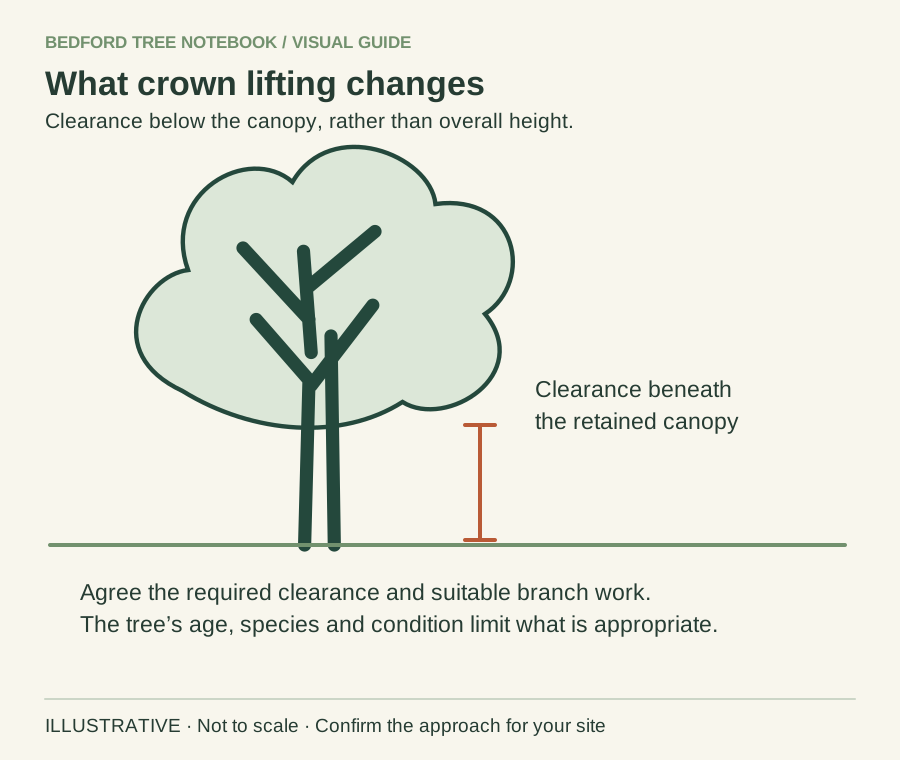
- Agree the required clearance in metres.
- An arborist decides whether lower-branch work is appropriate.
- Do not infer a safe pruning specification from a sketch.
Background sources: RHS guidance · Greater Cambridge Planning guidance
What the term means
Rossendale Borough Council’s tree-work guide describes crown lifting as removing parts or whole branches below a desired crown height. In an individual proposal, the specification needs to explain what is to be done and where the clearance is required.
It is different from crown reduction or thinning. Lifting the lower canopy should not be assumed to make the tree substantially shorter or to resolve every concern about shade or condition.
Describe the obstruction in practical terms
Say what cannot currently pass or be used comfortably. Identify the route, structure or space and explain whether the issue affects the whole area or one particular branch. Mention changes you are planning, such as a different gate or an altered garden path.
Do not select an arbitrary clearance figure from another job. A professional needs to understand both the use of the space and the tree. If a road or public route is involved, raise the location clearly so that the appropriate parties can be considered.
Ask whether a smaller change would meet the aim
The objective may be met by work to selected branches rather than a uniform lift around the entire crown. Ask the professional to explain the choices and the effect of each on the tree’s form. Avoid assuming that a symmetrical-looking diagram represents the appropriate treatment for an older or irregular tree.
A recommendation should also consider whether changing the route or the surrounding use is a reasonable alternative. This is a conversation about proportionate work, not an instruction to prune regardless of the tree’s response.
Discuss the appearance and future care
Removing a lower branch changes the shape of the tree as well as the space beneath it. Ask what the immediate result would look like and whether follow-up attention is anticipated. A clear explanation is particularly useful when the tree contributes privacy or screening from another property.
Different ages, species and conditions need different consideration. The general RHS pruning advice is background reading, not approval for a particular set of cuts or a guarantee about future growth.
Include the structures below
Give the contractor a wide view of fences, beds, sheds, roofs and any route beneath the branches. Describe access for people and equipment and what needs protection. The fact that work concerns the lower canopy does not make nearby surfaces irrelevant.
If the concern is contact with a building, read the roof-contact guide. If it is mainly shade, use the patio-shade guide to explain what you hope to improve before choosing an operation.
Put the finished specification in writing
A useful proposal identifies the tree, the purpose of the work, where clearance is intended and how the operation is described. It also sets out material removal, access assumptions and any unresolved site questions. An instruction merely to lift the crown can be too open to interpretation.
Check tree protection and other relevant requirements separately. Where the tree is subject to a decision or permission, give the contractor the actual document and ensure the final instruction matches the scope it covers.
Use the space beneath the tree as the reference
Describe how the area is used and what is obstructed: an ordinary garden path, a seating area or access needed for another planned task. Include nearby structures and the route people normally take. The contractor can then assess the actual objective instead of receiving a guessed instruction about how many lower branches should be removed.
Our shared-access guide is relevant if others use the same route. A need for pedestrian clearance does not automatically establish a suitable operation on the tree. Keep practical requirements and the professional recommendation connected, while allowing the assessment to identify limitations or a different way to meet the objective.
A hypothetical path-clearance enquiry
Suppose a family finds that a low branch catches people using a garden path. They photograph the route and explain where ordinary passage is affected. During a visit, the contractor considers the particular branch and the tree rather than treating the entire lower crown as a uniform obstruction.
This example illustrates a focused enquiry, not a recommendation to remove that branch. If the path is public or shared, additional arrangements may be needed. Our public-footpath guide addresses that separate planning issue. The finished proposal should identify the tree and operation clearly enough that another reader can understand which activity has actually been agreed.
Ask about the tree’s appearance after the work
A change to the lower canopy can affect how the tree relates to the garden. Ask the professional to explain the intended appearance and whether the proposed amount is appropriate for this specimen. If the description is difficult to visualise, request clarification using the existing photographs or a tree-specific written explanation.
Do not assume that a clearance instruction should be applied identically to every tree on the site. Different positions, forms and past management may lead to different recommendations. The quotation checklist helps retain those distinctions so an assessment of several trees does not become one ambiguous instruction to lift everything.
Keep clearance separate from the tree’s overall condition
Ask whether the discussion concerns access alone or whether the professional is also assessing a reported defect. A completed crown-lifting operation does not itself answer every question about condition, stability or future care. Record any separate advice and ask what kind of further assessment is recommended if concerns remain.
For visible dead material, see deadwood removal, which addresses a different objective. When the contractor finishes, review the agreed clearance only after the working area is released. Ask about an unexpected difference from the specification without entering the active work area to test a route or measure a branch yourself.
Putting it into practice
Ask the contractor to describe the intended clearance and the branches or pruning scope involved. Keep that specification with the quotation and any relevant permission. If the need is uncertain, use the tree pruning service to request a conversation about the objective rather than presenting an unassessed operation as settled.
If size control is the main concern, compare the questions in pollarding versus topping.
Turn the advice into a useful project brief.
Start with the postcode, the work you have in mind and any access considerations.
Prepare your enquiryNo obligation. A site assessment may be needed to confirm the work and price.
Sources & further reading
- Rossendale Borough Council: common types of tree work
- RHS: pruning trees
- GOV.UK: Tree Preservation Orders and conservation areas
Sources checked 31 October 2026. How we prepare guidance.