
In this guide Show sections
General guidance, not a professional assessment. Confirm site-specific advice and current requirements before work.
Planning tree work in Bedford or nearby?
Start with the postcode, the work you have in mind and any access considerations.
Prepare your enquiryNo obligation. A site assessment may be needed to confirm the work and price.
Before you make arrangements
Tell the contractor that you are considering retained timber before accepting the quotation. Ask it to distinguish the tree operation from any additional preparation of the wood. The waste-removal guide explains why a clearance price should make retained and removed material explicit rather than relying on one broad inclusion.
Three different material streams
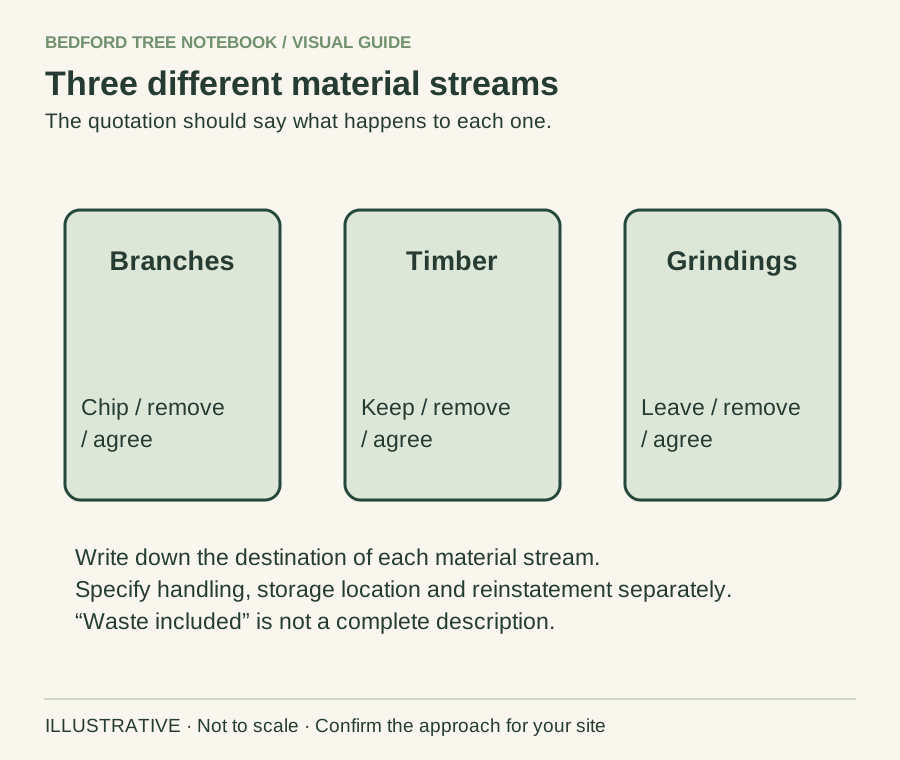
- Identify which materials are kept and which leave the site.
- Agree where retained material will be left.
- Check whether clearing and reinstatement are separate items.
Start with the intended use
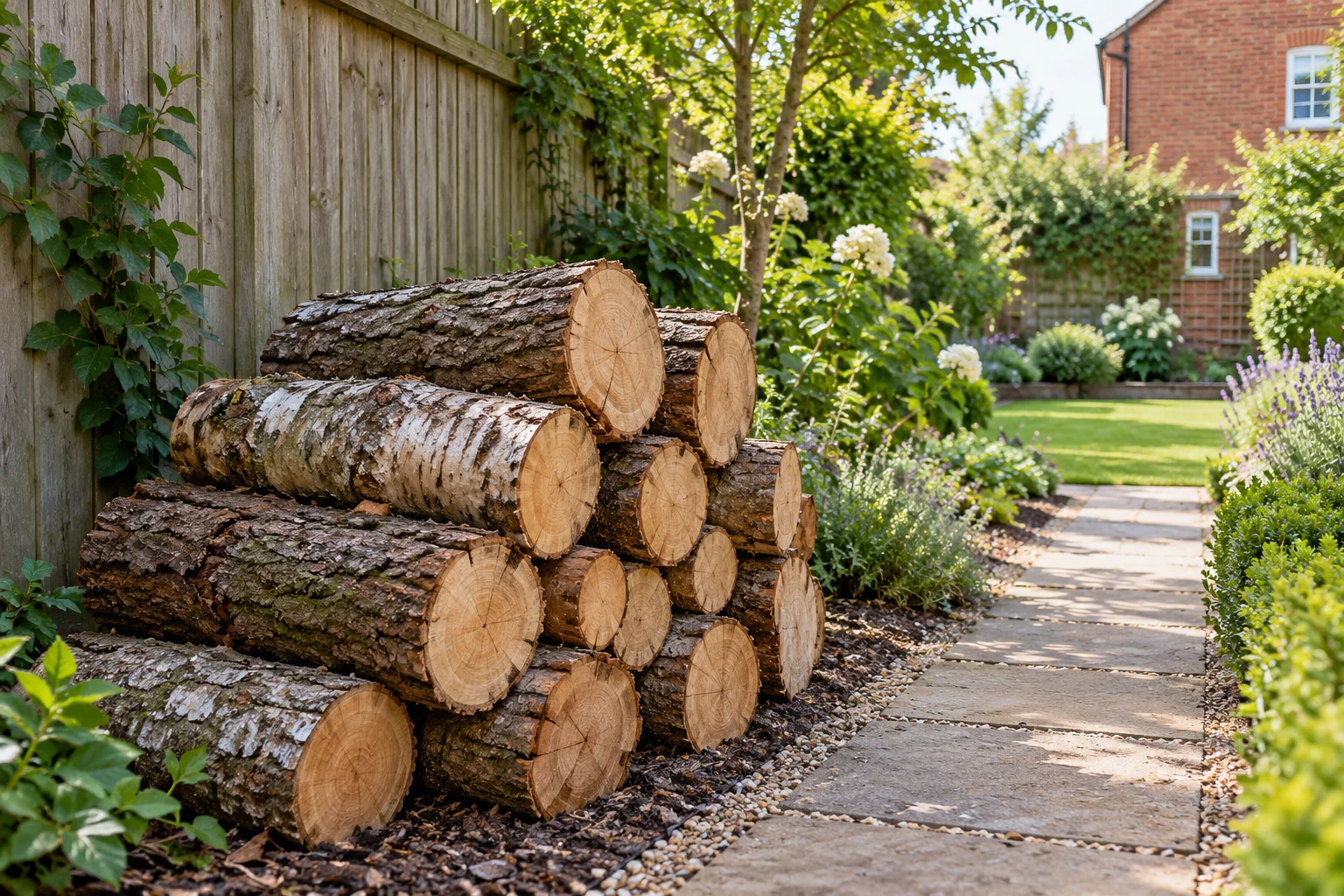
Write down why you want the timber. You might be considering a garden habitat feature, future woodworking or fuel, but each intention raises different questions. Do not assume that a contractor leaving stem sections is also supplying ready-to-use material for that purpose.
Ask what condition the wood will be in and whether another person with appropriate expertise should advise on its suitability. If a disease concern is part of the original tree problem, raise that before deciding to keep or move material. Our tree-consultant guide helps when a question needs advice beyond the proposed cutting operation. A useful brief states your objective while leaving technical assessment to someone qualified to provide it.
Describe the handling you are actually buying
Agree whether the quote covers leaving large sections, cutting manageable lengths, splitting, stacking or moving material to another part of the garden. These should not be treated as interchangeable descriptions. Ask the contractor what it can reasonably include and what would need a separate arrangement.
Avoid giving a length alone if access or weight is the real concern. Explain where the timber must end up and who will handle it after the visit. Do not promise that household members will move pieces that they have not assessed as safely manageable. Our professional removal guide introduces the wider working plan; retained timber must fit that plan rather than dictate an unsafe method.
Choose a location before work starts
Mark an agreed storage area on a simple garden sketch. Keep everyday access, gates, drains, inspection covers and neighbouring land in view. Tell the contractor if that corner needs to remain available for another project. A convenient place during dismantling may be inconvenient for the household afterwards.
Consider how the material would leave or move again if your plans change. A rear corner reached only through a planted border may not be a sensible destination for timber you expect to process elsewhere later. The contractor can explain the practical implications of the proposed location. Ask for those handling assumptions in the quotation, especially if a significant amount of material will remain on a small plot.
Keep people and access routes in the discussion
Tell the business about children, pets, shared paths and anyone who routinely uses the garden. Ask how retained material will be left and whether any area should remain out of use. Follow the contractor's instructions rather than rearranging sections while work is underway.
If timber must pass through another garden, agree access with someone entitled to authorise it. Our shared-boundary guide covers the practical conversation. A neighbour agreeing to the tree work does not necessarily mean it has agreed to receive timber or store it temporarily. Identify the final destination clearly so no one discovers an unexpected pile on their side of the boundary.
A hypothetical small-garden decision
Imagine a homeowner wishes to keep every log from a removed tree because a relative might want some later. The only storage space is a narrow side passage used for bins and garden access. After discussing the layout, the homeowner realises that keeping all the material would obstruct a route the family needs each day.
A more useful agreement might identify a limited amount in a suitable garden location and removal of the rest, with the contractor confirming the practical scope. This is a hypothetical planning example, not advice about a particular quantity or a report of a Bedford job. The point is to choose retained material deliberately, rather than allow an uncertain future use to determine the entire clearance arrangement.
Ask separately about habitat and garden reuse
A garden feature made from retained wood should be considered in relation to where it stands, how the space is used and what you want it to do. Do not confuse deliberately retained material with a requirement to keep a tree or branch that needs professional assessment.
If wildlife is part of your motivation, ask an appropriate professional about a suitable approach for the site. Our deadwood-removal guide distinguishes assessment from a blanket instruction to remove every dead branch. Keep a proposed habitat feature out of the active work area until the contractor has agreed the arrangement. A considered plan can identify what is retained without turning every piece of cut material into an assumed garden asset.
Record removal and later processing responsibilities
A quotation might leave logs on site but remove branches, or include timber removal unless you request a change. Make sure the final version reflects your decision. If a third party will collect retained material, arrange its access and timing separately rather than assuming the tree team will wait or load an unfamiliar vehicle.
Ask what happens if the collector cannot attend. The household should understand who owns the next step and whether a later collection would be separately priced. Keep requests to cut, split or load material within the contractor's stated scope and competence. Do not ask the team to improvise an additional operation simply because equipment is already present.
Check the result against the agreement
Once the contractor says the area is safe, review the retained material and its position. Confirm that the agreed access routes remain available and that material intended for removal has been dealt with. Ask for any relevant follow-up instructions and write down unresolved points.
The completion checklist helps you keep that conversation specific. If your own plans have changed, explain that honestly; a new preference after the work is complete is different from a contractor failing to follow the quotation. Before agreeing a later movement or collection, obtain a clear additional scope. Keeping timber should reduce uncertainty about the garden's next stage, not leave a second undefined job behind.
Your next step
Decide the intended use, approximate retention scope and agreed location before the working day. Include them in the project planner and ask the contractor to confirm handling and clearance in writing. If you cannot yet identify a suitable use or place, settle that uncertainty before choosing to retain the material.
Turn the advice into a useful project brief.
Start with the postcode, the work you have in mind and any access considerations.
Prepare your enquiryNo obligation. A site assessment may be needed to confirm the work and price.
Sources & further reading
- GOV.UK: disposing of household waste responsibly
- HSE: tree-work safety topics
- RHS: dead wood and compost-heap habitats
Sources checked 31 October 2026. How we prepare guidance.