
In this guide Show sections
General guidance, not a professional assessment. Confirm site-specific advice and current requirements before work.
Planning tree work in Bedford or nearby?
Start with the postcode, the work you have in mind and any access considerations.
Prepare your enquiryNo obligation. A site assessment may be needed to confirm the work and price.
Before you start
Describe which boundary is involved, what needs to change and what screening you want to retain. If you know the hedge species, include it; if not, send a safely taken photograph rather than guessing. A mixed hedge may need more than one approach.
Agree the finished hedge
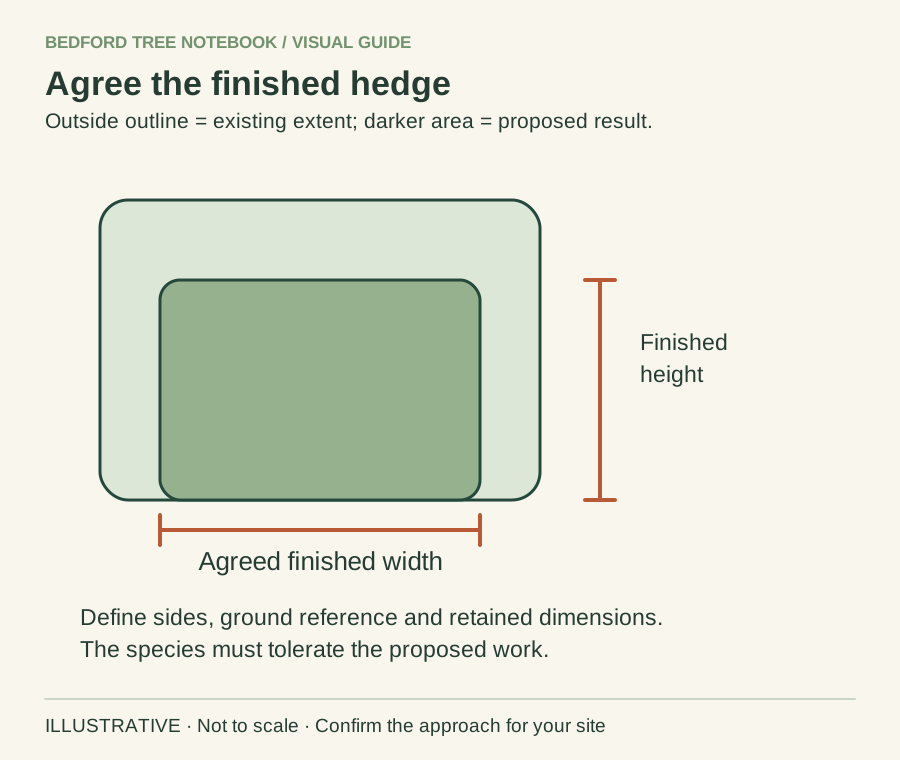
- Agree height, width and which sides are included.
- Check species-specific regrowth before any major reduction.
- Check for active nests; calendar timing alone is not enough.
When a maintenance trim is the right discussion
If the existing size works and the aim is to neaten recent growth, describe it as maintenance. Say whether the top, your side and the far side are all included. Explain any uneven sections rather than assuming a single height from one end of a sloping garden to the other.
A quote for regular trimming should identify the section to be maintained. It should not leave the business to discover on arrival that you wanted several metres of height removed or a neglected side renovated.
A reduction needs a different brief
A substantial change should start with the intended finished size, the reason for it and an assessment of the hedge. Is it blocking access, crowding a path or leaving too little usable space? Would changing only one face meet the need?
Ask how much live foliage would remain and whether the work should be staged. Avoid making an unsupported promise to a neighbour that one visit will restore a green face immediately. The proposed result should reflect the plants that are actually present.
Species affects the options
The RHS hedge-renovation guide explains that responses to hard cutting vary. Many broadleaved hedges can be renovated, while most conifers do not regenerate well from old wood; yew is an important exception. A contractor needs to identify the hedge before recommending a severe reduction.
This is why an attractive example photograph is not a specification. A result achieved on one species cannot simply be transferred to a different boundary hedge.
Agree a size that both parties understand
Use approximate dimensions to start the conversation, then ask the contractor to confirm the specification. Define where height is measured from if the ground changes level. State whether the far side requires neighbouring access and whether that access is agreed.
For a shared boundary in Bedford or a nearby village, the practical agreement matters more than a generic town label. Read the overhanging-tree guide for the wider ownership and protection questions, without assuming tree and hedge rules are identical.
Timing includes wildlife and the plant
Do not treat a date in the diary as clearance for cutting. Ask how the contractor will address wildlife and what happens if the proposed visit cannot proceed as planned. Our nesting-bird article explains the separate planning conversation.
Species-specific timing may also affect the recommendation. Discuss the hedge’s condition and the scope together; do not select a severe operation simply because a business has an available day.
Compare the whole job
A major reduction may produce far more material than a light trim. Include the route for carrying it out, any steps or narrow passages and the agreed clearance. Retained beds, a greenhouse or a fragile fence should be mentioned before pricing.
Ask for these points to be explicit: - The hedge run and faces included. - The finished size or staged proposal. - Material removal and what stays. - Access assumptions and neighbouring agreement. - What the hedge may look like immediately afterwards.
Keep any follow-up work separate from the first-visit price.
Identify the reason the hedge feels too large
Separate height, width, visibility and access concerns. A hedge may be an acceptable height but extend too far across a path, or provide useful privacy while making a gateway awkward. Photograph the affected section from your own land and describe the problem at an ordinary point of use. Do not lean into dense growth or climb to show the top.
This lets the contractor assess a specific objective. It may also reveal that one face or a short section needs a different proposal from the rest. Our mixed-boundary-hedge guide is particularly useful where different plants have been added along the boundary over time.
A hypothetical staged renovation discussion
Suppose a homeowner asks for a wide established hedge to be made much narrower in one visit. During assessment, the contractor explains that the desired finish may expose bare internal growth and recommends a different approach. The useful next step is to ask what each stage would achieve and how the hedge may look between visits, not simply repeat the original measurement.
The example does not establish that staged work is suitable for every species. It shows why a maintenance trim and renovation cannot be compared solely by the quantity of material removed. Ask the business to describe the expected appearance, limitations and further decisions before accepting a longer management programme.
Keep neighbouring views and access separate
Discuss which faces are included and whether the contractor needs to enter another property. A neighbour may agree to a date while still understanding the proposed finished height differently. Use a clear written description and an agreed reference point to reduce that uncertainty. Do not ask the contractor to decide ownership or enforce a disputed boundary position.
Read shared-boundary tree work for the access conversation. Make sure the clearance route and any retained screening are recorded too. Agreements about working space do not remove relevant wildlife or planning checks, and permission to enter a garden is not the same as permission to alter somebody else’s planting.
Plan the next routine maintenance visit
Before accepting renovation work, ask what maintenance would be needed to preserve the intended result. Agree whether the current quote includes only the immediate operation or any later visit. If future care will be carried out by another gardener, ask for a simple written description of the proposed continuing approach.
Keep the bird-nest planning guide alongside the programme so dates remain subject to appropriate checks. A repeat booking should not be treated as automatic clearance. When the work is complete, take a photograph from the same safe position as the original image; it can help explain the agreed shape when planning later maintenance.
Putting it into practice
Ask the contractor to recommend a suitable scope and explain the appearance you can reasonably expect. Then agree finished dimensions, sides included, timing and waste arrangements in writing. Our hedge cutting and reduction page provides the route for a project enquiry, subject to actual partner coverage.
For boundaries containing several species, use planning work on a mixed hedge before requesting one uniform cut.
For several jobs in one garden, combining tree and hedge work in Bedford explains how to make the separate scopes clear.
An overgrown Leylandii hedge needs particular attention to retained green growth, achievable dimensions and the consequences of a major reduction.
Turn the advice into a useful project brief.
Start with the postcode, the work you have in mind and any access considerations.
Prepare your enquiryNo obligation. A site assessment may be needed to confirm the work and price.
Sources & further reading
Sources checked 31 October 2026. How we prepare guidance.