
In this guide Show sections
General guidance, not a professional assessment. Confirm site-specific advice and current requirements before work.
Planning tree work in Bedford or nearby?
Start with the postcode, the work you have in mind and any access considerations.
Prepare your enquiryNo obligation. A site assessment may be needed to confirm the work and price.
Before you make arrangements
List the tree work and hedge work separately before discussing a joint visit. Note where access, permissions, wildlife or neighbouring land may affect either operation. Use the Bedford project checklist for the overall brief, then add enough detail for each part to be assessed and quoted on its own merits.
Coordinate the whole project
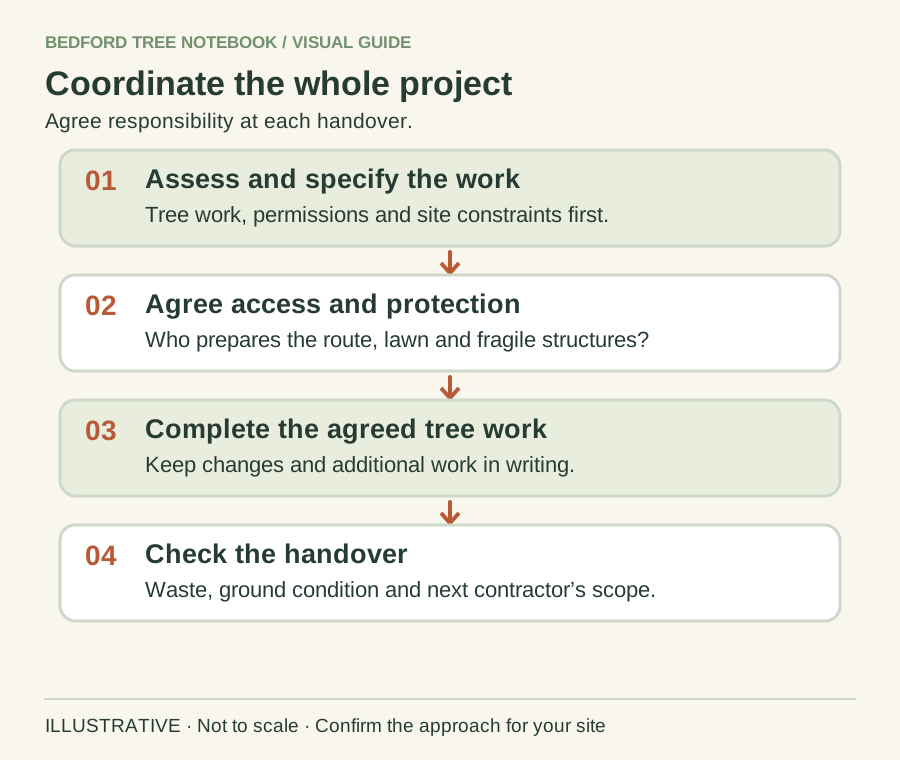
- Set the order and responsibility for each phase.
- Do not carry out hazardous preparation yourself.
- Check ground preparation separately before follow-on landscaping.
Give every feature a clear identity
A simple sketch can label a rear-garden tree T1 and a side hedge H1. Those working labels help distinguish the features in photographs and emails, but do not present them as official council identifiers unless they actually match an existing record. Explain where each feature stands and which section of the hedge is included.
Our tree-location-plan guide explains how consistent labels reduce confusion. If the hedge contains several species or changes ownership along its length, record those sections. The contractor can then recommend suitable work instead of assuming one cut applies everywhere. A combined quotation should make the individual elements easier to understand, not hide them behind a single garden-wide description.
Describe two outcomes rather than one tidy-up
For the tree, explain the concern: clearance, size, condition or another specific objective. For the hedge, explain the intended height, width and faces to be worked on. Do not assume a particular operation is suitable simply because the business can attend once.
Read hedge trimming versus reduction before describing a major change as a trim. The crown-reduction comparison helps with tree terminology. Asking for the same percentage reduction on a tree and a hedge may conceal entirely different biological and practical questions. Let the contractor connect the recommendation to the outcome, then ask for that recommendation to be written into the scope.
Check controls for each part separately
A tree-protection check for one identified tree does not necessarily answer the position of every woody feature in the garden. Explain any relevant orders, conservation-area information or planning conditions and ask the appropriate authority to clarify uncertainty. Ownership and access also require separate attention.
For Bedford addresses, start with tree protection and council records. Keep a shared job date provisional while required checks remain unresolved. If one operation is ready and the other is not, ask how the contractor would handle the split. Do not assume that combining the quotation gives permission to carry out every element together or eliminates the need for a precise work description.
Plan wildlife considerations across the site
Tell the contractor about relevant features without trying to investigate nests or possible roosts yourself. Ask how the proposed operations will be assessed and what happens if circumstances require a change. Treat the tree and hedge as parts of the same living garden rather than assuming one check covers everything automatically.
Our active-nest guide explains why a calendar alone is not clearance. A combined booking may need to be varied if one feature cannot be worked on as planned. Ask how any postponement, partial visit or changed scope would be agreed. That discussion should cover both the practical work and any effect on the commercial arrangement, without treating a financial agreement as ecological permission.
A hypothetical combined-garden brief
Imagine a homeowner wants more clearance above a patio and a narrower side hedge. The tree stands near the patio furniture; the hedge runs along a shared access route. A single request to “reduce the tree and hedge” misses the two main constraints.
A clearer brief identifies the patio clearance objective, the hedge faces and intended dimensions, the shared entrance and the material-removal route. The contractor can assess which operations are suitable and whether they can be coordinated. This hypothetical example does not promise a one-visit saving or a particular outcome. It illustrates why combining information is useful while combining assumptions is risky. Each feature still needs a recommendation and a checkable finished specification.
Ask how the working sequence affects access
The contractor should determine the method and sequence, but you can explain household constraints that matter. Mention when a shared drive must remain available, where pets will be kept and whether a route through the house is proposed. Identify any material that you want retained.
Use parking and shared access to prepare that discussion. Ask if work on one feature affects access to the other or creates a temporary obstruction. Do not move debris or enter a restricted area to help the sequence along. A coordinated plan should include who gives household instructions on the day and what you should do if an expected access arrangement becomes unavailable.
Compare combined and separate scopes fairly
Ask the business to identify inclusions, exclusions and any dependencies within the combined proposal. If you are comparing a joint offer with separate quotations, align the operations and clearance arrangements first. A shared total does not tell you whether stump work, hedge-side access or removal of timber is included.
The waste-removal guide helps make clearance specific. Ask what happens if one operation is removed from the project or postponed. A combined figure may rely on assumptions about the whole visit, so do not calculate a revised price yourself by subtracting an imagined share. Request a complete updated quotation that states what remains to be done and on what basis.
Review the project feature by feature
At the end of the visit, wait until the contractor says the area is safe, then compare each item with the written scope. Review the tree operation, hedge dimensions, retained material and shared access route separately. This avoids accepting one successful element as proof that the whole project matches the agreement.
Our completion checklist helps record outstanding questions. If the contractor explains that a feature could not be completed as planned, note the reason and agreed next step. Keep any revised scope alongside the invoice. A combined garden job is easier to manage when its separate results remain visible from the first enquiry through to the final review.
Your next step
Prepare one coordinated enquiry with a separate description for every tree and hedge section. Use the planner to start the project and explain the additional work in the conversation with the contractor. Confirm coverage, the full scope and any practical dependencies before accepting the final written proposal.
Turn the advice into a useful project brief.
Start with the postcode, the work you have in mind and any access considerations.
Prepare your enquiryNo obligation. A site assessment may be needed to confirm the work and price.
Sources & further reading
- RHS: pruning trees
- RHS: renovating overgrown hedges
- Natural England: wild birds, protection and licences
- Citizens Advice: before you get work done on your home (England)
Sources checked 31 October 2026. How we prepare guidance.