
In this guide Show sections
General guidance, not a professional assessment. Confirm site-specific advice and current requirements before work.
Planning tree work in Bedford or nearby?
Start with the postcode, the work you have in mind and any access considerations.
Prepare your enquiryNo obligation. A site assessment may be needed to confirm the work and price.
Before you arrange the work
Photograph the hedge in sections and mark gates, trees, fences and changes in planting. If ownership is uncertain, resolve that separately. Do not assume permission from one neighbour covers the entire boundary.
A canopy is not a boundary
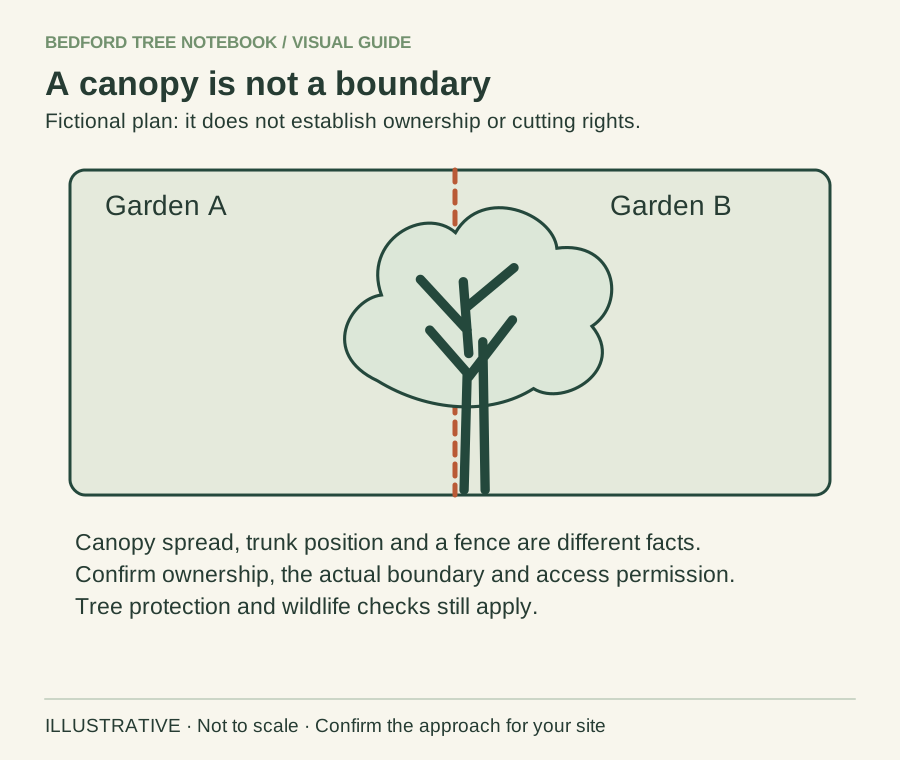
- Do not assume a fence precisely marks the legal boundary.
- Discuss proposed work with the owner.
- A diagram cannot establish a right to cut or enter land.
Separate trimming from renovation
A routine trim to maintain existing growth differs from a substantial height or width reduction. Ask which plants can tolerate the proposed work and whether some sections need a different approach. Old bare growth may not recover as you expect, particularly in many conifers.
Our hedge trimming versus reduction guide helps clarify the scope. The RHS hedge-renovation guidance provides background on why species matter.
Agree the faces and finished result
Identify which side and top are included, whether both gardens must be accessed and how arisings will be removed. Describe the finish you want while allowing the professional to explain biological and practical limits. A single height measurement does not settle width, gaps or the condition of individual plants.
Read shared-boundary tree work before arranging access through another property. Keep any agreed limitations in the quotation.
Plan for wildlife and follow-up
Active nests can affect the work; a booking outside a commonly described nesting season is not a guarantee that no birds are nesting. Ask the contractor how checks and any necessary postponement will be handled.
Use planning around active bird nests for the questions to raise. If a staged renovation is proposed, record the order, expected appearance between visits and what aftercare or later work is separately arranged.
Make a section-by-section hedge record
Draw a simple line showing the boundary and divide it where the planting changes. Use everyday labels if species identification is uncertain, then link those labels to safely taken photographs. Include gaps, individual trees within the hedge and areas that have previously been cut differently. This gives the contractor a route through the enquiry without asking you to identify every plant yourself.
State which sections concern you most and why. An area narrowing a path is a different objective from a section that no longer provides screening. A record organised by location is easier to use than one instruction to reduce the entire boundary by the same amount.
Keep species identification separate from the desired cut
Tell the professional what you hope to achieve, then ask whether the plants present can support that approach. The desired finished line should not be treated as proof that every section can be reduced to it. Ask the business to identify where the recommendation changes along the hedge and why.
RHS renovation guidance notes that many conifers do not recover from old wood in the same way as some other hedging plants. Use that as a reason to seek species-specific advice, not as a diagnosis from a distant photograph. The contractor’s proposal should explain the actual limits it sees in the planting being assessed.
A hypothetical mixed hedge with uneven options
Imagine a boundary contains an established broadleaf hedge, a later conifer section and a small tree retained near the gate. A request for one uniform reduction may involve three different assessments. The useful next step is to ask for separate descriptions, including any section that should be treated differently or left out of the current proposal.
This example does not recommend a cut for any of those plants. It illustrates why appearance alone does not make a mixed boundary one operation. Our hedge trimming versus reduction guide helps distinguish routine maintenance from a major change before quotations are compared.
Agree reference points for finished dimensions
Ask how the business will describe height and width so both parties understand the intended result. Identify where measurements are referenced where the ground slopes or the hedge varies along its length. Photographs can support the description, but an angle in a picture may not communicate a precise finished size.
Do not personally mark cutting lines inside dense planting or climb to measure the top. Provide safe information and ask the contractor what it needs to confirm on site. Keep the final dimensions with any exclusions, so an agreed limit in one section is not accidentally applied to another with different plants or ownership.
Arrange access without deciding a boundary dispute
Discuss which side of the hedge needs to be reached and who can authorise entry. An agreed appointment time does not resolve uncertainty about who owns a plant or which boundary line applies. If those points are disputed, seek appropriate advice before commissioning work that depends on a contested assumption.
Use shared-boundary tree work to organise the practical note. Include the route for debris and whether gates or parked vehicles affect it. Avoid telling the contractor to settle a disagreement during the visit; its working plan needs a clear scope and access arrangement before the team arrives.
Discuss the period between different stages
If the recommendation involves more than one visit, ask what the boundary will look like between stages and what is included now. Clarify whether later work is provisional or separately quoted. Tell the business about privacy, pets or garden use that may make an interim arrangement important, while allowing it to explain what is realistic.
Our active-nest planning guide covers a separate reason a programme may need to change. A staged plan should remain subject to relevant checks; do not describe the next calendar date as automatic clearance. Keep any revised arrangement clear enough that another team member can follow it.
Review the agreed sections after completion
Once the contractor says the area is safe, work through the boundary record and compare it with the final scope. Ask for an explanation of any section intentionally left different. Keep aftercare and future-maintenance suggestions distinct from work already included and completed.
The end-of-visit checklist helps record an outstanding point without turning a casual walk-round into your own horticultural inspection. If you expected a different result, identify the exact section and wording involved. A clear comparison of agreed and observed work is more useful than a broad complaint that a varied hedge does not look perfectly uniform.
Your next step
Request a section-by-section scope where the planting or ownership changes. Confirm access, checks and debris handling before choosing a date, and keep the agreed plan for the completion review.
Make the intended result checkable with finished hedge heights and widths rather than relying on a general request to tidy the boundary.
If young trees have appeared within the hedge, self-seeded boundary trees helps separate identification, ownership and the appropriate management decision.
Turn the advice into a useful project brief.
Start with the postcode, the work you have in mind and any access considerations.
Prepare your enquiryNo obligation. A site assessment may be needed to confirm the work and price.
Sources & further reading
Sources checked 31 October 2026. How we prepare guidance.