
In this guide Show sections
General guidance, not a professional assessment. Confirm site-specific advice and current requirements before work.
Planning tree work in Bedford or nearby?
Start with the postcode, the work you have in mind and any access considerations.
Prepare your enquiryNo obligation. A site assessment may be needed to confirm the work and price.
Before you make arrangements
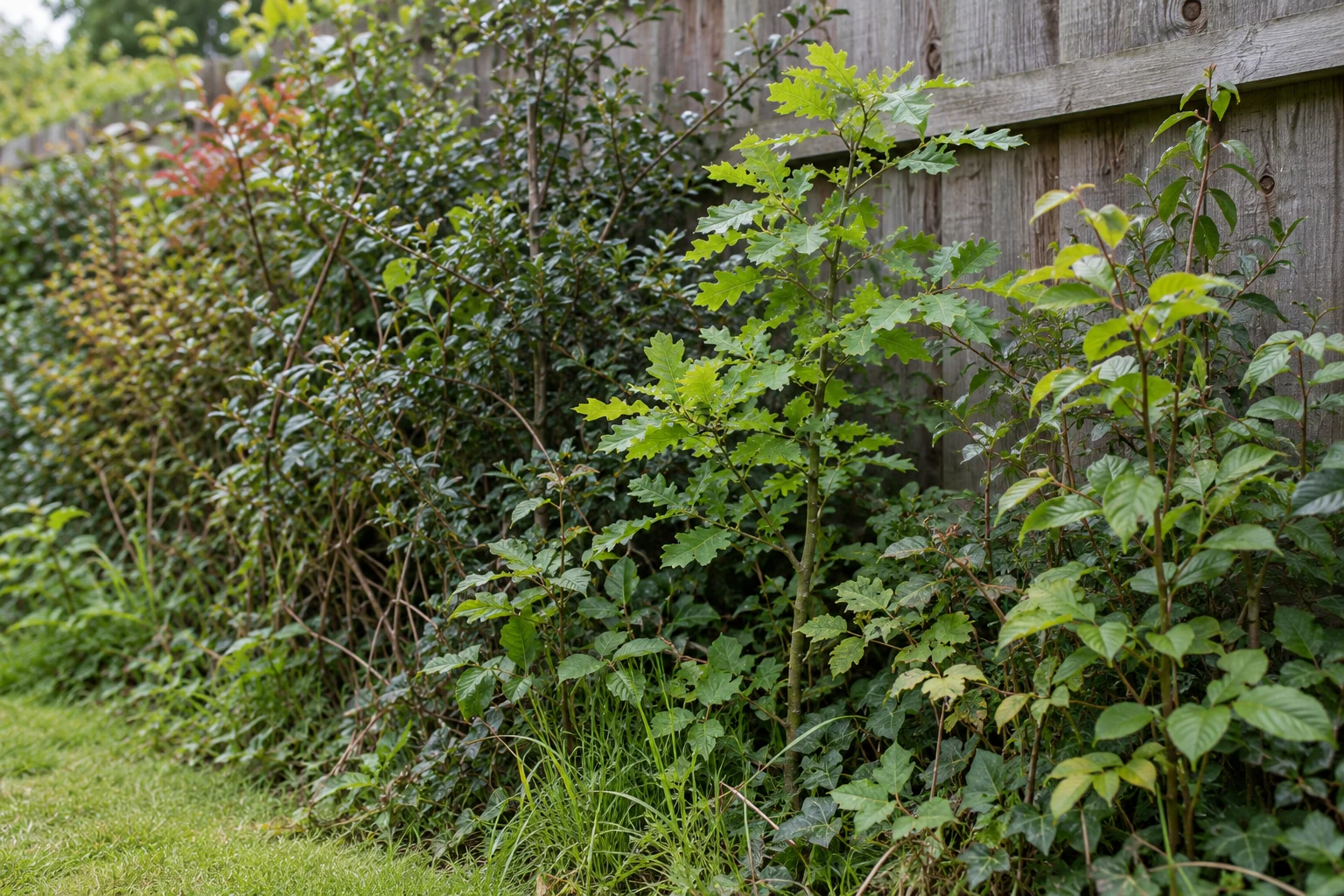
Record the location and approximate scale from accessible ground. Do not pull, cut or excavate along a disputed boundary to establish where stems belong. If growth is entwined with an established hedge, describe that relationship. Our mixed boundary hedge guide helps separate the plants and intended outcomes rather than assuming one treatment suits the whole line.
Self-seeded does not mean unchecked
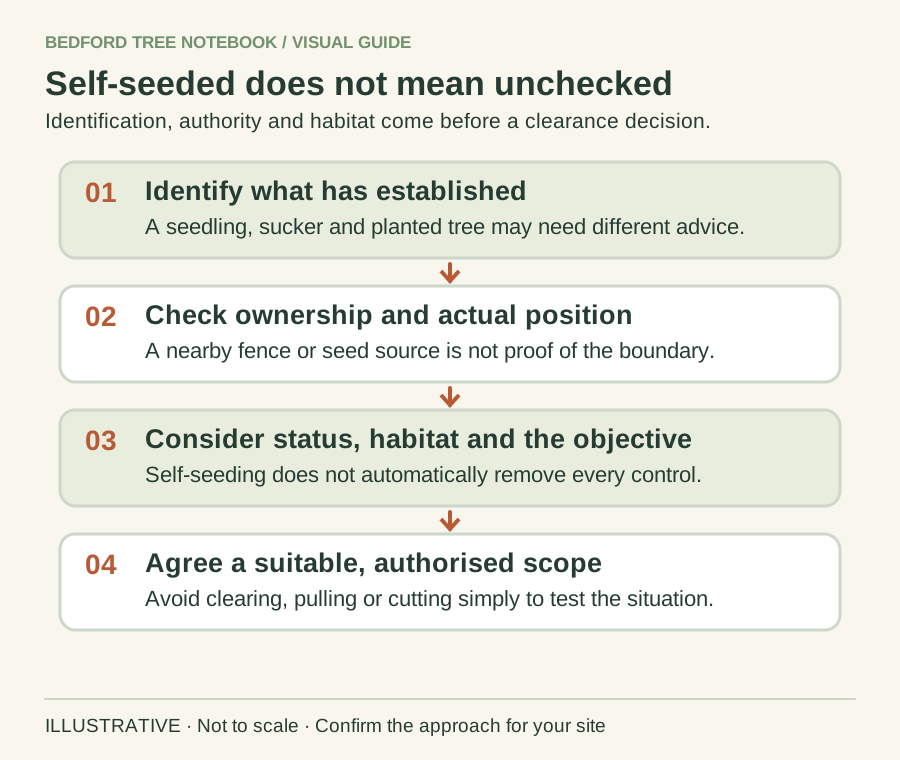
- Distinguish seedlings, root suckers and other boundary growth before choosing an approach.
- Check ownership and constraints rather than assuming the seed’s origin settles authority.
- Discuss active nests and other habitat before proposed clearance; a preferred date is not an all-clear.
Background sources: GOV.UK guidance · GOV.UK guidance · GOV.UK guidance
Identify the plant before deciding its future
A small stem may be a tree seedling, a shrub, a hedge component or growth associated with an existing plant. Ask for identification where uncertain and provide the whole setting rather than only a single leaf. Do not assume that all nearby stems are separate self-seeded trees.
The RHS guidance on tree and shrub suckers explains why some unwanted growth is connected with another plant rather than an independent seedling. Identification matters before a removal or retention decision. If you intend to keep a young tree, consider its mature form and position, not merely whether it fits between the fence and lawn at its current size.
Clarify where it is rooted
The canopy may lean into one garden while the stem is rooted elsewhere. A fence can help describe the position without necessarily establishing the legal boundary. Record what is visible and obtain appropriate advice if ownership or entry to land is uncertain.
Read shared-boundary tree work and overhanging branches before treating a plant as yours to remove. Talk to the relevant neighbour about the proposed outcome rather than beginning clearance and sorting authority out afterwards. If the base is obscured or access would require crossing land, do not force an inspection yourself. A contractor needs a clear brief about both the plant and the authority to work.
Separate a small current task from a future tree
Decide whether the aim is retaining the plant, removing unwanted growth or understanding the developing boundary. A tree that is acceptable today may eventually conflict with a fence, path or building. Equally, its accidental arrival does not mean it has no value in the garden.
Use trees planted near fences and replacement trees for small gardens to consider long-term space. If you want to retain the tree, ask what establishment and future management involve. If removal is proposed, make sure the assessment and method fit the actual size and site rather than borrowing a routine instruction for very small seedlings.
Do not assume origin removes protection
A tree’s self-seeded origin is not a blanket exemption from tree controls. Check the actual position where protection or conservation-area requirements may be relevant, and ask the authority about uncertainty. A hedge or boundary description does not itself answer whether an individual tree is subject to controls.
The GOV.UK tree-protection guidance is the official starting resource. Our Bedford TPO guide helps find local records. Avoid applying a remembered size threshold without checking which procedure and circumstances it relates to. Keep the proposed operation and identified plant connected with any advice, rather than relying on a general assurance that seedlings never need permission.
Consider wildlife within the boundary
A mixed hedge or rough boundary can contain active nests and other habitat. Do not treat a self-seeded tree as separate from everything around it when planning access or clearance. Explain whether the operation also involves opening the hedge, disturbing ground or moving accumulated material.
Read active nests and tree work and ponds and wildlife habitats where relevant. Timing alone does not establish that the boundary is clear. Ask the relevant professional how the actual proposal should be considered, especially if a larger clearance is being combined with the tree task. The absence of visible activity from the kitchen window is not a complete habitat check.
Check attachments and site constraints
Tell the business about fencing, wires, walls, sheds and any plant growth intertwined with them. A stem beside a fence can be difficult to distinguish from material woven through or growing around it. Do not attach a rope and pull to find out how securely it is held.
Our work near sheds and greenhouses helps identify fragile surroundings. If removal includes stump or root work, raise buried services and the intended ground use separately. An above-ground clearance quotation may leave material below the surface. Agree what finish you want so the removal of a visible stem is not mistaken for preparation ready for a new fence or planting bed.
Choose a limited and clear scope
Mark which stems or sections are included and which retained plants should remain. Where a line contains several species, use identifiers or labelled photographs instead of an instruction to clear everything that looks untidy. Ask what the operation will leave and whether further growth or treatment needs discussion.
The quotation checklist helps make that scope comparable. Do not leave identification decisions to an unbriefed team on the day. If uncertainty remains about a plant’s origin or relationship to a retained tree, resolve it first. A written description can be short while still distinguishing the intended removal from an accidental extension into the adjoining hedge or neighbour’s garden.
Plan the boundary after the task
If the plant is removed, consider what will occupy the space and how the retained hedge or fence will be managed. A gap may affect privacy, access or the appearance of both gardens. Discuss replacement or repair separately rather than assuming the tree-work business has included it.
Use replacement planting if a new tree or shrub is part of the plan. Avoid repeating a location problem by choosing another plant solely for immediate screening. If the self-seeded tree is retained, include it in ordinary garden records so its future is a conscious decision rather than an overlooked stem that later requires a much larger conversation.
Keep the decision easy to revisit
Save the identification, location and agreed outcome with any authority correspondence or contractor record. Note what remained uncertain and whether further advice is recommended. If new growth appears later, use that history instead of assuming it is automatically the same plant or proof that the original job was incomplete.
Our long-term care plan helps connect the boundary task with wider garden management. A good record also supports a future sale or gardener handover. It should explain what was kept or removed and why, without asserting ownership, safety or permission beyond what was actually established for the specific work.
Your next step
Identify the growth, clarify its position and authority, then decide whether to retain or remove it as part of a clear boundary plan. Check tree and wildlife controls where relevant, and avoid treating all woody growth as unrestricted clearance. Use the Bedford checklist to assemble the site information before requesting work.
Turn the advice into a useful project brief.
Start with the postcode, the work you have in mind and any access considerations.
Prepare your enquiryNo obligation. A site assessment may be needed to confirm the work and price.
Sources & further reading
- RHS: tree and shrub suckers
- GOV.UK: tree-protection guidance
- Natural England: wild birds, protection and licences
Sources checked 31 October 2026. How we prepare guidance.