
In this guide Show sections
General guidance, not a professional assessment. Confirm site-specific advice and current requirements before work.
Planning tree work in Bedford or nearby?
Start with the postcode, the work you have in mind and any access considerations.
Prepare your enquiryNo obligation. A site assessment may be needed to confirm the work and price.
Before you make arrangements
Gather the planting label, approximate planting date and any relevant garden or property records. Explain whether the concern is future size, contact with the fence, access or an observed change. Our replacement-tree selection guide helps frame the mature-space question, while the shared-boundary guide addresses ownership and access separately.
Plan for more than today’s canopy
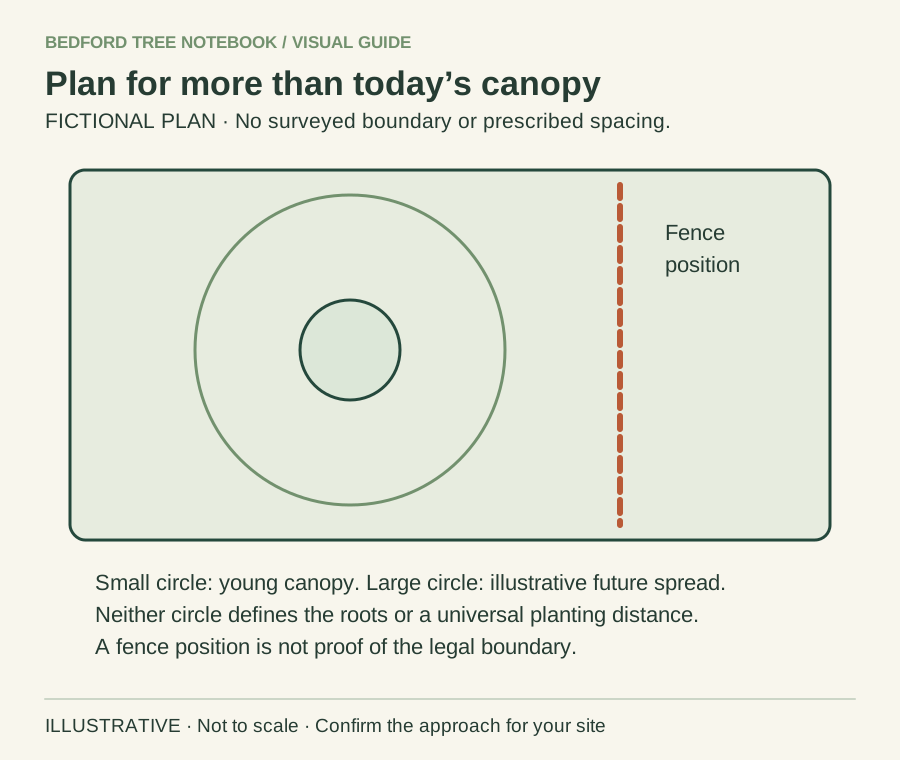
- Identify the tree and consider its mature form, roots and future maintenance access.
- Resolve ownership and any boundary uncertainty separately from horticultural advice.
- Coordinate fence works with retained-tree constraints rather than cutting roots to fit a post.
Background sources: GOV.UK guidance · RHS guidance
Identify the tree and likely mature habit
Check species and cultivar where possible, including whether a label describes a compact selection or a much larger eventual tree. The size at purchase does not establish how much space the plant will need. Consider crown shape, growth habit and the conditions in which it is growing, not height alone.
The RHS smaller-garden tree guide helps explain the value of choosing for the available space. Do not treat a general nursery dimension as a guaranteed final outline for every setting. Ask what the likely future relationship with the fence, neighbouring garden and other structures means for a realistic long-term plan.
Separate the fence from the legal boundary
A fence is a useful physical feature but is not, by itself, definitive evidence of every ownership or boundary question. Check the relevant property information and seek appropriate advice where the position is uncertain. Do not infer ownership solely from which garden contains most of the canopy.
The government guidance on trees and boundaries provides background, not a decision on your plot. Keep neighbour discussions factual and distinguish an observation about contact from a claim about legal responsibility. A contractor's convenient working route does not give automatic authority to enter another garden or remove a tree whose ownership is unresolved.
Define what is actually in conflict
Record whether branches touch the fence, the trunk appears close, a panel is displaced or the concern is only about future growth. Those are different problems. A photograph of roots or a leaning fence does not establish that the tree caused structural damage or that removing it is the correct remedy.
Our visible-roots guide explains why the surface picture is incomplete. If a wall, retaining structure or significant defect is involved, ask whether separate structural advice is needed. Do not let a routine fence-repair booking become an unassessed instruction to cut roots or excavate beside a retained tree.
Consider the tree’s establishment and condition
A recently planted tree and an established specimen present different choices. Tell the adviser the planting date where known, whether it has established well and what support or protection remains. An assumption that any young-looking tree can simply be lifted and reset may overlook roots, condition or an approved planting requirement.
Read new-tree summer care and stakes and ties where establishment is part of the concern. Do not start digging to see how large the root system has become. Ask whether moving is feasible and justified, what professional service would be needed and what consequences should be understood before that option is compared with retention.
Compare retention, relocation and replacement
Ask for the practical advantages and limitations of each realistic option. Retaining the tree may involve a different fence arrangement or accepting an appropriate amount of canopy spread. Relocation or replacement can involve establishment needs, access, cost and permission questions beyond the immediate operation.
Our replacement-planting guide helps expose those stages. Do not assume moving a tree is automatically less disruptive or more successful than another approach. The objective is a suitable tree and workable garden layout over time. A temporary smaller appearance should not conceal an expectation of repeated severe cutting to make an unsuitable species fit.
Avoid treating root cutting as routine fence preparation
New posts, trenches, edging or altered levels can affect roots even when the intended job is only replacing the fence. Tell the fencing contractor about retained trees and seek appropriate arboricultural advice before the method is fixed. A root obstructing a proposed post position should not automatically be removed.
The underground-services guide raises a separate set of hazards for ground disturbance. Ask how unexpected findings will be handled and who can approve a revised design. Keep the tree advice and fence specification coordinated so the installer is not left to improvise around roots with no agreed limit or route for further advice.
Discuss canopy management honestly
If pruning is suggested, ask what objective it serves and whether the species and tree condition support the proposal. Clearance from a fence is different from making the whole tree permanently smaller. A generic percentage or instruction to “keep it within the garden” does not explain what is suitable.
Our crown reduction versus thinning guide helps distinguish dimensions from density. Do not assume a familiar pruning label guarantees a lasting solution to inadequate space. Ask what future growth and review would be expected, and whether changing the garden layout would be more reasonable than repeatedly imposing a severe shape on the tree.
Check protection, planting records and wildlife
A fence-side position does not determine whether tree controls apply. Investigate the actual tree and property records, including any relevant landscape or replacement-planting conditions. If a recently built garden is involved, ask who can clarify the approved position and ongoing obligations before moving or replacing the tree.
Use Bedford protection checks and new-build tree care as starting points. Wildlife checks need separate consideration for any proposed operation. Do not assume a small tree, a tidy boundary or a preferred working month automatically settles permission or ecological questions. Keep the practical recommendation consistent with the relevant advice and documents.
Record the decision and future responsibility
Once an approach is agreed, keep the tree identity, location, specification and any neighbour-access arrangements together. Ask which further care or review is recommended and who is responsible for it. If the fence work and tree work involve different contractors, give each the same current plan.
Our long-term Bedford tree-care guide helps organise that record. At handover, check the agreed scope and note any unresolved concerns rather than judging only the immediate neatness of the boundary. A useful decision leaves the tree's future space and care understandable, without promising that one pruning visit or a relocated fence will prevent every later conflict.
Your next step
Identify the tree, clarify the actual boundary and describe the specific conflict. Compare retention and alternatives with appropriate advice before digging, root cutting or severe pruning. Check planting records and relevant controls, agree access and coordinate any fence work. Plan for the mature tree and the garden's future use rather than solving only the appearance of today's gap.
Turn the advice into a useful project brief.
Start with the postcode, the work you have in mind and any access considerations.
Prepare your enquiryNo obligation. A site assessment may be needed to confirm the work and price.
Sources & further reading
- RHS: trees for smaller gardens
- GOV.UK: high hedges, trees and boundaries
- RHS: planting trees and shrubs
- GOV.UK: Tree Preservation Orders and conservation areas
- HM Land Registry/GOV.UK: property boundaries
- RHS: trees near buildings
Sources checked 31 October 2026. How we prepare guidance.