
In this guide Show sections
General guidance, not a professional assessment. Confirm site-specific advice and current requirements before work.
Planning tree work in Bedford or nearby?
Start with the postcode, the work you have in mind and any access considerations.
Prepare your enquiryNo obligation. A site assessment may be needed to confirm the work and price.
Before you make arrangements
Gather any planting label, variety and rootstock information, previous work records and photographs from different seasons. Do not climb to inspect fruiting growth or make preliminary cuts. Our fruit-tree specialist advice guide helps identify which questions need experience with the actual type of fruit tree.
Identify the tree before the season
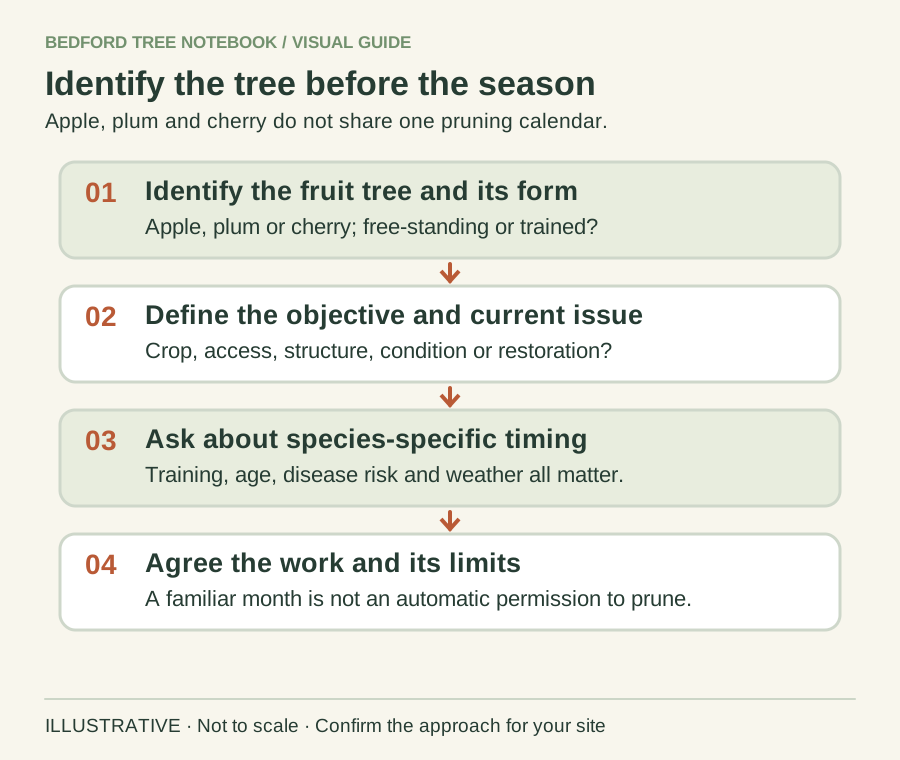
- Apple training form can change the appropriate pruning approach.
- Young and established plums can need different timing; cherry type also matters.
- Check disease considerations, wildlife and any applicable tree controls separately.
Background sources: RHS guidance · RHS guidance · RHS guidance · RHS guidance
Identify the form before discussing a schedule
Tell the specialist whether the tree is freestanding or trained as a restricted form, such as a cordon, espalier or fan. If you are unsure, provide a safe overall view of the branches and supports. A tree against a wall is not necessarily correctly trained, so describe what exists rather than applying a label with confidence you do not have.
The RHS winter apple-pruning guide is useful background for understanding one set of objectives, but should not become a universal instruction for every form. Ask which approach suits this tree and what information about its growth habit or history could change the recommendation.
Explain your fruiting and garden objectives separately
You may want more manageable picking, better access along a path, improved fruiting or simply advice about an inherited tree. Put those aims in order. A request for a lower crown can conflict with retaining the shape, fruiting wood or long-term structure the specialist would otherwise favour.
Our large-tree small-garden guide helps frame a space conflict without assuming severe pruning is the solution. Ask what the proposed work is expected to improve and which outcomes cannot be promised. Pruning is not a guarantee of a particular crop, and a photograph of another attractive apple tree should not override the assessment of your specimen.
Describe cropping history without inventing a cause
Record whether the tree has cropped, how consistently and whether there were noticeable changes in blossom or fruit. Note approximate years and any unusual weather or damage you remember. If the variety is unknown, say so rather than guessing from the colour of an apple.
Poor fruiting can have several explanations, so do not assume that cutting harder will fix it. Ask whether identification, pollination, establishment, growing conditions or other questions need investigation alongside pruning. The useful record is a factual history that helps the specialist decide what to assess. It is not a home diagnosis or a requirement to buy several treatments before the first conversation.
Keep old pruning and current growth visible
Tell the adviser about previous reductions, long gaps in management or repeated strong regrowth. Photographs and written specifications can help distinguish what was intended from what you remember. Do not remove shoots in advance merely to make the tree look less neglected during the visit.
Ask whether renovation, limited maintenance or a staged plan is appropriate. Our young-versus-mature pruning guide explains why developing a young structure and altering an established tree are different tasks. A staged proposal should identify its objective and review points rather than promise that several severe cuts will inevitably create the preferred compact shape.
Ask for timing that suits the tree and operation
The form, growth response, fruiting objective and condition can influence the recommended timing. Ask why the proposed appointment is suitable rather than assuming all apple work belongs in winter or all fruit trees should be cut immediately after harvest. The specialist should be able to explain the recommendation for your tree.
Use the general pruning-time guide as background to those questions. If an inspection reveals a different concern, ask whether the planned work should change or wait for further advice. Calendar convenience and contractor availability are practical considerations, but neither establishes that a particular operation is appropriate for the actual specimen.
RHS distinguishes winter pruning of freestanding apple trees from summer pruning commonly used for restricted trained forms, including cordons and espaliers. The different purposes mean neither “all apples in winter” nor “all fruit trees in summer” is a reliable brief. Fruiting habit, vigour, weather and the actual operation can affect the recommendation, so ask the specialist to connect the chosen timing with your tree's form and objective.
Include condition concerns before accepting routine maintenance
Report altered leaf colour, a damaged branch, cavities or changes around the base. Those observations may need assessment separate from a fruiting-prune proposal. A tree that produces apples is not automatically free from structural issues, and poor cropping does not itself prove the tree is unsafe.
Our cracks and cavities guide helps describe features without attempting a diagnosis. Do not probe wounds, test limbs or climb for a better photograph. Ask what the service includes and whether a separate arboricultural opinion is justified. Experience with fruit production and competence in the safety aspects of larger-tree work should both be considered where relevant.
Describe access, supports and what is below
Tell the specialist about walls, wires, fragile supports, greenhouses, paths and restricted access. A trained tree may depend on a structure that needs separate attention; pruning advice does not establish that a fence or wall is sound. Ask who will assess or repair supports if they are part of the concern.
Read tree work near sheds and greenhouses to prepare the practical information. Do not assume a small garden tree can be worked on safely with whatever household ladder is available. Let the competent provider plan the actual work and explain what preparation, if any, the homeowner can safely undertake beforehand.
Check controls and wildlife without relying on crop type
An apple tree's fruiting role should not be used as a blanket answer to legal or wildlife questions. Ask the responsible council or appropriate adviser how any relevant controls apply to the actual tree and proposed work. Do not infer permission from a generic description of garden orchard maintenance.
The Bedford protection-check guide provides a starting point, while active bird nests need separate consideration. A horticulturally preferred time is not proof that a nest is absent. Keep any necessary permissions and ecological advice aligned with the written specification before practical work is instructed.
Ask for an understandable aftercare and review record
A useful specialist visit should leave you knowing what was done, why and what to observe next. Ask how the recommendation relates to the tree's form and future management. If further stages are suggested, note their intended purpose and what findings could change them.
Our long-term Bedford tree-care guide helps keep those decisions together. Record the specification, completion date and any advice about supports, condition or later assessment. Avoid judging the entire service by the next harvest alone. The agreed objectives may include structure, access or gradual improvement, and crop size can vary for reasons beyond the pruning operation.
Your next step
Prepare a brief covering form, known variety, history, cropping and your priorities. Ask a suitably experienced specialist to explain the recommended timing, extent and future plan. Keep condition or support concerns separate where they require other assessment, check relevant controls and wildlife, and retain a clear written record rather than relying on an instruction to give the tree its usual cut.
Turn the advice into a useful project brief.
Start with the postcode, the work you have in mind and any access considerations.
Prepare your enquiryNo obligation. A site assessment may be needed to confirm the work and price.
Sources & further reading
- RHS: apples, winter pruning
- RHS: pruning trees
- Bedford Borough Council: protected trees
- Natural England: wild birds, protection and licences
- RHS: summer pruning apples and pears
Sources checked 31 October 2026. How we prepare guidance.