
In this guide Show sections
General guidance, not a professional assessment. Confirm site-specific advice and current requirements before work.
Planning tree work in Bedford or nearby?
Start with the postcode, the work you have in mind and any access considerations.
Prepare your enquiryNo obligation. A site assessment may be needed to confirm the work and price.
Before you make arrangements
Show the designer the existing surface, proposed footprint, levels, trees and service routes. Include neighbouring trees where relevant. Our visible-roots guide explains why the roots you can see are only part of the picture; underground-services guidance raises a separate set of checks before ground disturbance.
Design around trees before digging
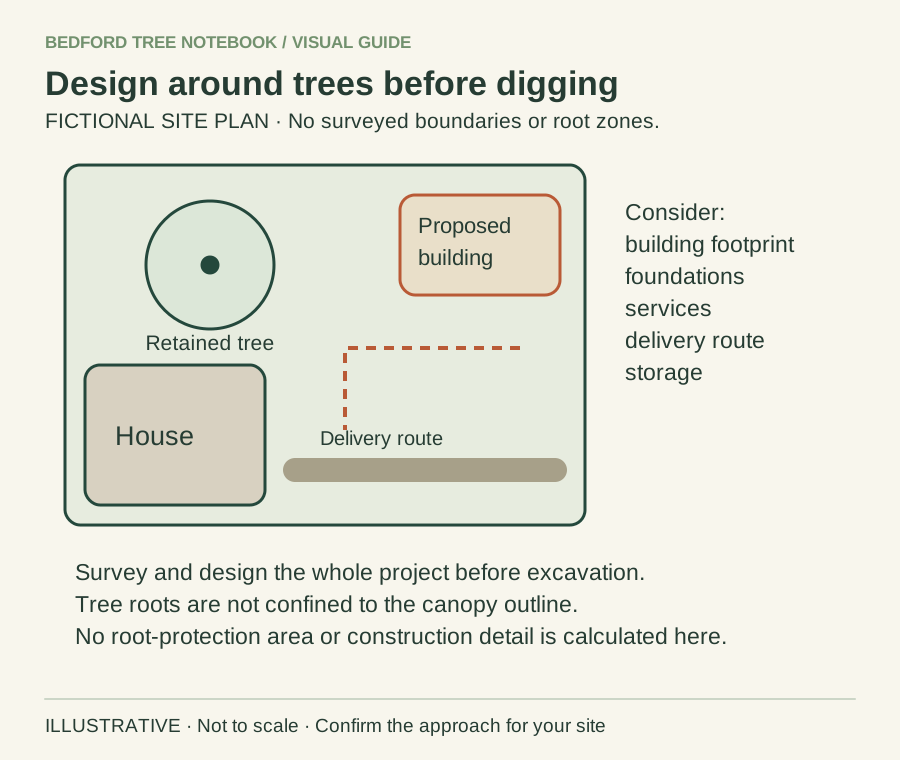
- Include foundations, service trenches, delivery, storage and future maintenance in the brief.
- Commission the relevant site-specific survey and design before excavation.
- A canopy outline does not map all roots, and permitted development does not cancel tree controls.
Background sources: Bedford Borough Council guidance · GOV.UK guidance
Start with the problem the driveway must solve
Describe whether you need more parking space, a safer walking surface, better drainage or replacement of a failing finish. Each objective may allow several designs. A proposal to excavate and rebuild the whole area should not become the default merely because a tree root is visible beside the paving.
Photograph uneven areas from a safe position and record where water collects. Do not remove slabs or dig around roots to make the cause appear clearer. Ask the designer which observations need specialist investigation. Our tree-work site-visit guide helps distinguish useful preliminary information from questions that cannot be settled remotely.
Assess roots before specifying excavation
Ask an arboricultural adviser how the retained trees constrain the proposed works. The rooting pattern depends on the tree and site; it cannot be established by a tidy circle drawn at the canopy edge. If root investigation is justified, agree its purpose, method and professional oversight before the paving contractor begins.
Do not cut a root simply because it obstructs the proposed edge or appears small at the exposed point. Root damage can affect condition or stability, and the consequences may not be obvious immediately. If a contractor proposes pruning roots as a routine preparation item, ask what assessment supports that approach and whether the design can be changed instead.
Compare the complete construction build-up
The finished surface may look similar while the excavation, sub-base, edge restraints and loading arrangements differ substantially. Ask for a section or written description that shows what happens below ground, not just a sample of the paving. Share this with the professionals assessing the trees and ground.
A permeable surface is not automatically a complete tree-protection design. Nor does a description such as “no-dig” establish that installation, edges, drainage and later traffic are acceptable for every location. Ask how the actual specification addresses the tree constraints. Keep the construction assumptions visible when comparing quotations so a cheaper surface finish does not conceal a different and potentially unsuitable ground operation.
Consider changes in level and water movement
Raising the surface can cover parts of the rooting environment, while lowering it can remove soil or roots. Changes in drainage may also alter conditions around a retained tree. Discuss these effects with the designer and arboricultural adviser rather than treating levels as a purely cosmetic choice.
Record existing falls and drainage features without assuming they explain every wet or uneven patch. If waterlogging is already a concern, read waterlogged gardens and tree concerns and ask what investigation is appropriate. The driveway design should address the actual site; this guide cannot specify a drainage system, foundation depth or universal clearance from a trunk.
Check boundaries, services and highway connections
A driveway may involve a shared entrance, neighbouring land, buried utilities or a connection to a public pavement. Confirm who controls each part of the project and which approvals are needed. Tree constraints and highway permissions should be checked separately rather than assuming that approval of one element settles the others.
Our parking and shared-access guide helps prepare practical questions. For Bedford-area properties, confirm the responsible authority for the actual location. If a dropped kerb or pavement alteration is involved, use the relevant council's current process and competent advice. Do not begin by removing a roadside tree or cutting roots to simplify the application.
Keep construction activity out of the assumptions
Ask how vehicles, pallets, spoil and equipment will reach and occupy the site during the work. A design may retain a tree on paper while the installation route repeatedly crosses sensitive ground. Identify storage and access arrangements early enough for the contractor to price and plan them properly.
Read protecting a lawn during tree work for the wider principle of agreeing protection rather than assuming clean-up can reverse all disturbance. Arboricultural advice may require specific arrangements for the actual project. Tell the site team what has been agreed and who must be consulted if the route, excavation or machinery changes once work starts.
Check tree controls before agreeing irreversible work
Use Bedford Borough Council's protected-tree resources or the responsible authority's equivalent to investigate relevant controls. Root-related works can raise questions as well as branch cutting. Ask the council and your adviser how the actual proposal should be handled rather than assuming a hidden part of a tree is outside consideration.
Check relevant planning conditions too. Our planning-conditions guide helps you assemble the documents. The absence of an obvious TPO symbol is not professional confirmation that the driveway method is suitable. Keep legal permission, tree advice and construction design as connected but distinct pieces of the decision.
Agree the finish and handover in writing
A complete driveway quotation should describe the agreed method, area, levels, drainage, protection and treatment of unforeseen findings. Ask what happens if roots or services differ from expectations, who can stop the work and how an alternative will be authorised. Do not give a vague instruction to remove whatever gets in the way.
Keep photographs and the final drawings with the contract records. At completion, compare the agreed finish and any recorded changes, and ask about continuing maintenance. Our tree concerns after building work guide explains useful records if a concern arises later. An attractive new surface alone cannot confirm that retained trees have been unaffected.
Avoid choosing between price totals too early
Imagine two driveway quotations using the same attractive paving sample. One includes broad excavation and standard edging, while another proposes a different construction approach to address a retained tree. Comparing only the totals conceals an important difference in what is being built.
Ask the designer and appropriate specialist whether each proposal meets the agreed requirements before deciding which price represents value. This is a hypothetical comparison, not a recommendation for a particular system or a Bedford price benchmark. If the scope is revised, ask for the quotation and drawings to be updated together so the contractor does not price one method and install another.
Your next step
Prepare a complete driveway brief and seek appropriate arboricultural input before excavation or level changes are specified. Coordinate the tree assessment with construction, drainage, service and highway requirements. Use the quotation checklist for any separate tree-work proposal, and keep it distinct from the paving contract so responsibilities do not disappear between trades.
Turn the advice into a useful project brief.
Start with the postcode, the work you have in mind and any access considerations.
Prepare your enquiryNo obligation. A site assessment may be needed to confirm the work and price.
Sources & further reading
- RHS: trees near buildings
- Bedford Borough Council: protected trees
- GOV.UK: Tree Preservation Orders and trees in conservation areas
- HSE: avoiding danger from underground services
Sources checked 31 October 2026. How we prepare guidance.