
In this guide Show sections
General guidance, not a professional assessment. Confirm site-specific advice and current requirements before work.
Planning tree work in Bedford or nearby?
Start with the postcode, the work you have in mind and any access considerations.
Prepare your enquiryNo obligation. A site assessment may be needed to confirm the work and price.
Before you make arrangements
If a wall appears unstable or the tree has moved, keep people away and seek the appropriate urgent advice. Do not climb onto the wall, excavate behind it or remove loose material to investigate. Record the location from somewhere safe. Our tree assessment signs help separate a new concern from an assumption based only on a tree standing close to a structure.
One setting, two assessment scopes
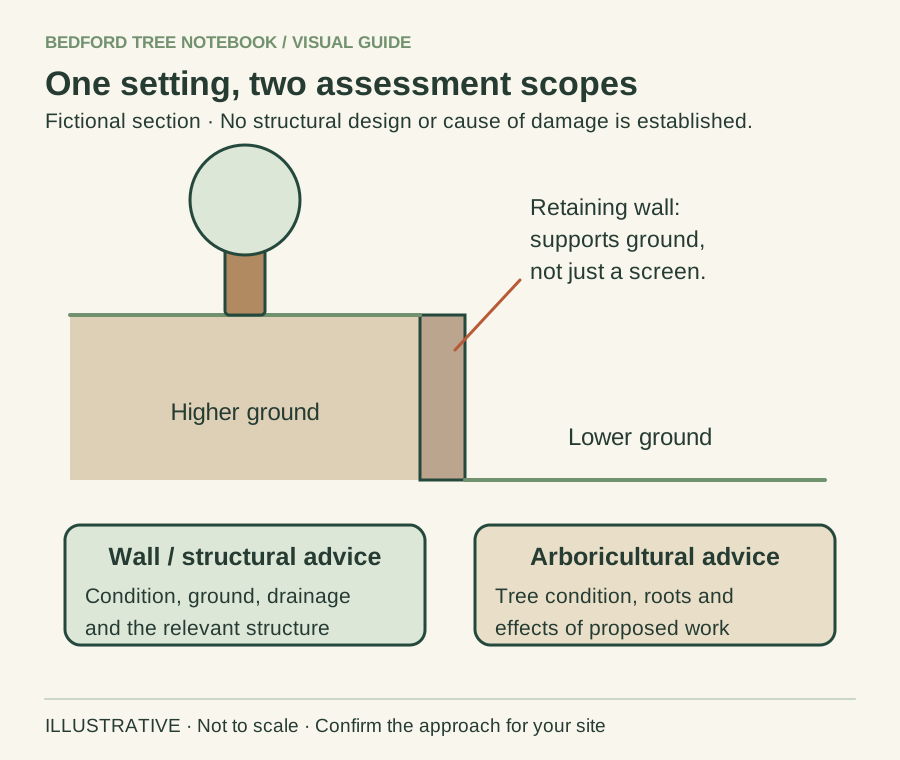
- Explain levels, observed changes, drainage and planned works to the appropriate specialists.
- A tree’s proximity to a wall does not by itself prove the cause of a defect.
- Do not excavate, cut roots, change loads or attempt a wall repair from a garden diagram.
Background sources: RICS guidance · RHS guidance
Explain what the wall retains
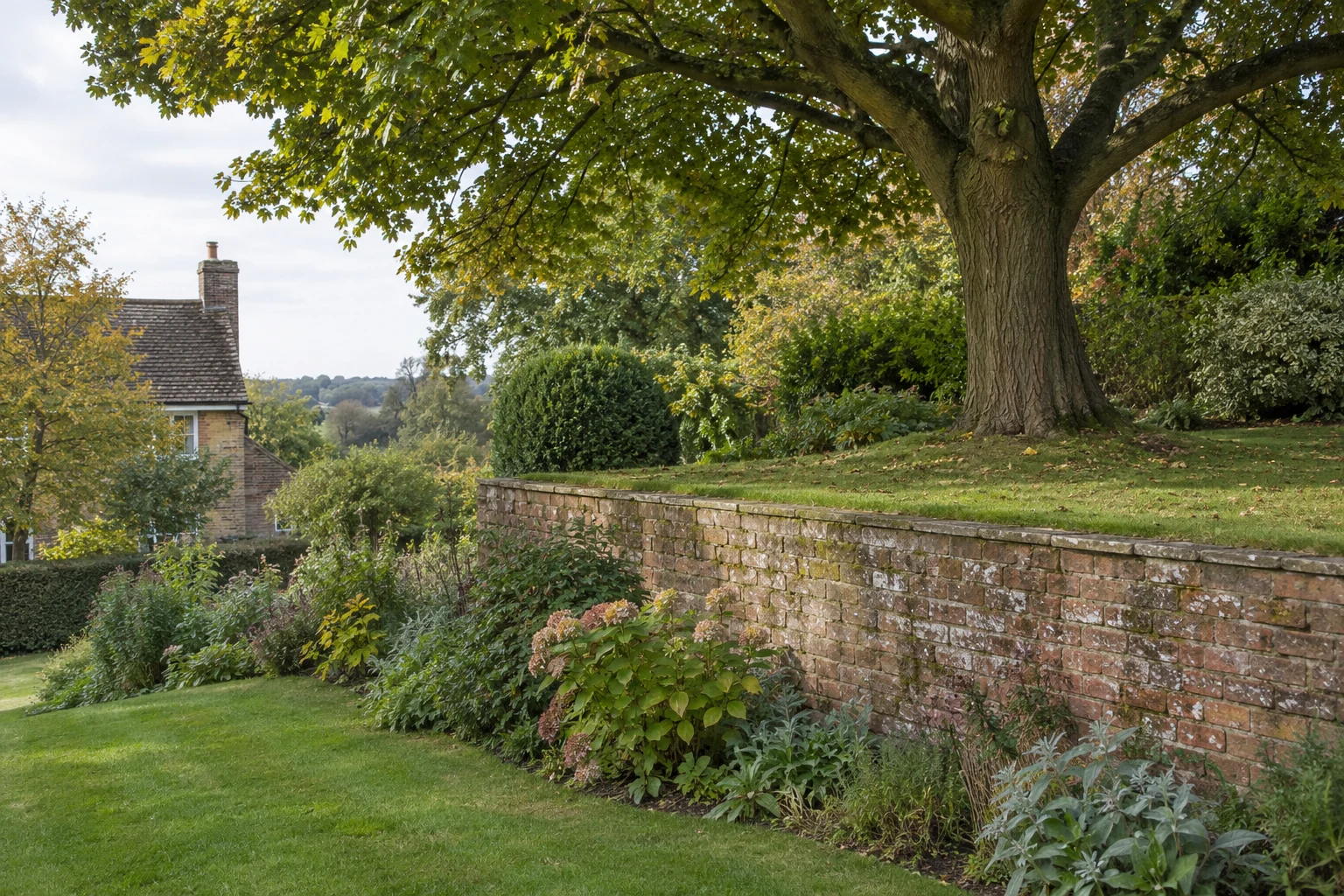
Describe the difference in ground levels and which side contains the tree. Mention paths, buildings, parking or access above and below the wall, including neighbouring land. A wide photograph from a safe viewpoint helps show that relationship better than a cropped image of one crack.
Say when you do not know how the wall was built or what lies behind it. Do not describe every boundary wall as a retaining wall simply because soil touches it. The professional assessing the structure needs the actual situation, while the tree adviser needs to understand the setting in which roots and proposed works will be considered. Keep those questions connected from the first enquiry.
Separate observations from the proposed cause
A bulge, crack or displaced surface can have more than one possible explanation. Finding roots nearby does not establish that the tree is the sole cause or that removal will resolve the problem. Avoid presenting a conclusion before the relevant investigation has been undertaken.
The RHS guide to trees near buildings provides background on different interactions between roots and structures. It is not a diagnosis of a retaining wall. Tell the specialists what changed, when it was noticed and which evidence is available. If a contractor suggests a remedy immediately, ask what assessment supports it and which part of the situation remains outside their expertise.
Collect the useful history
Gather earlier photographs, structural advice, tree reports and details of previous repair or landscaping work. Note changes in ground level, drainage, loading or access if known. A recent project may be relevant context, but its timing should not be treated as proof of causation.
Our tree concerns after building work helps organise a factual timeline. If different owners hold different records, seek appropriate cooperation rather than filling the gaps from memory. Label information as confirmed, reported or unknown. This makes it easier for the advisers to decide what investigation is needed and prevents a second quotation repeating assumptions from an earlier unsupported explanation.
Define the two assessment roles
A structural professional can consider the wall and retained-ground problem, while an arboricultural professional considers the tree and implications of proposed work. Ask what each commission includes and who will coordinate recommendations. Neither should be assumed to certify the other discipline through a passing comment.
Use tree consultant or contractor to clarify the tree role. If an insurer, surveyor or other body has requested information, confirm its requirements before commissioning a report. The useful outcome is advice that can work together, rather than two separate proposals that conflict when a builder wants to excavate exactly where the tree assessment says further consideration is needed.
Do not cut roots as a diagnostic test
Avoid exposing or severing roots to see whether the wall moves or to create room for a repair. Root work can affect a retained tree and should be considered with the actual structural proposal. Removing a visible section does not map the remaining system or establish the consequences.
Our visible-root guide and Forest Research discussion of roots and trenching provide background. Do not calculate a safe cut position from a generic diagram. If investigation is recommended, ask who will carry it out, what controls are needed and how the findings will inform the coordinated plan.
Check boundaries and authority
Establish who controls the wall, tree, retained land and route required for access. These may not all belong to the same person. A neighbour’s willingness to discuss repairs is useful, but it does not replace a clear agreement about who may instruct each part of the work.
Read shared-boundary tree work before assuming that a fence line or the position of a trunk settles every ownership question. Where documents or responsibilities are disputed, obtain suitable property or legal advice. Do not enter another garden, remove masonry or direct cutting to someone else’s tree while the underlying authority remains unclear. The contractor needs an understandable instruction chain.
Bring permissions and services into the scope
Check applicable tree controls and any requirements relevant to the structural proposal. Use Bedford TPO checks as the tree-record starting point. If the wall, site or building has other constraints, raise them with the relevant adviser rather than assuming the absence of a TPO settles the whole project.
Mention known drains, utilities and access restrictions before ground work is considered. Our underground-services guide helps prepare that information. A proposed repair method should not be agreed on the basis that the surrounding ground is clear simply because no pipe is visible. Keep structural design, tree permission and utility considerations distinct but coordinated.
Agree sequence and change control
Once the advice is available, set out which investigation or operation must happen first and who approves any change. The work plan should identify responsibility for the wall, retained tree, access and reinstatement. A tree operation should not be improvised because masonry work has uncovered an unexpected feature.
Our neighbour building-project guide describes a similar coordination problem. Ask how the team will stop and obtain clarification if conditions differ from the agreed assumptions. Keep the latest scope and reports available to the people doing the work. A price for one trade should not silently include design decisions or remedial work that nobody has assessed or authorised.
Keep a meaningful completion record
After the agreed work, retain the final advice, actual scope and any recommended follow-up. Ask the appropriate specialist what remains to be monitored and which change should prompt contact. A repaired face or removed tree does not itself demonstrate that every structural and tree question has been answered.
Use the completion checklist for the tree-work handover and keep any structural handover alongside it. If landscaping follows, share the retained constraints so new ground levels or access do not undermine the agreed outcome. A clear record should explain what was concluded and completed, not reduce the project to an unsupported statement that the tree caused the wall problem.
Your next step
Describe the whole relationship between tree, wall and ground levels, then obtain the appropriate coordinated advice. Leave roots and masonry undisturbed until the plan is clear. Use the quotation checklist for any resulting tree operation, making its limits, permissions and connection with the structural work explicit.
Turn the advice into a useful project brief.
Start with the postcode, the work you have in mind and any access considerations.
Prepare your enquiryNo obligation. A site assessment may be needed to confirm the work and price.
Sources & further reading
- RHS: trees near buildings
- Forest Research: tree roots and trenching
- Bedford Borough Council: protected trees
Sources checked 31 October 2026. How we prepare guidance.