
In this guide Show sections
General guidance, not a professional assessment. Confirm site-specific advice and current requirements before work.
Planning tree work in Bedford or nearby?
Start with the postcode, the work you have in mind and any access considerations.
Prepare your enquiryNo obligation. A site assessment may be needed to confirm the work and price.
Before you make arrangements
Find the system documents and identify the person responsible for its operation and maintenance. Do not lift covers, enter equipment or excavate to locate pipes yourself. Mention private drainage at the first tree-work enquiry, even if the planned operation looks confined to the crown. Our trees beside drains guide explains why a tree observation and a drainage diagnosis are different questions.
Identify the type of system without guessing
Use installation, maintenance or property records to describe the equipment. If you do not know whether it is a septic tank, small treatment plant or another arrangement, say so and seek the appropriate system advice. Terminology affects the questions a competent person needs to answer.
The GOV.UK private wastewater overview provides the England starting point. Do not assume that a local water company controls every part of a private system or that a neighbouring property has the same arrangement. If several properties share equipment, establish who holds the records and may authorise the investigations or access needed for this project.
Map the known features and uncertainty
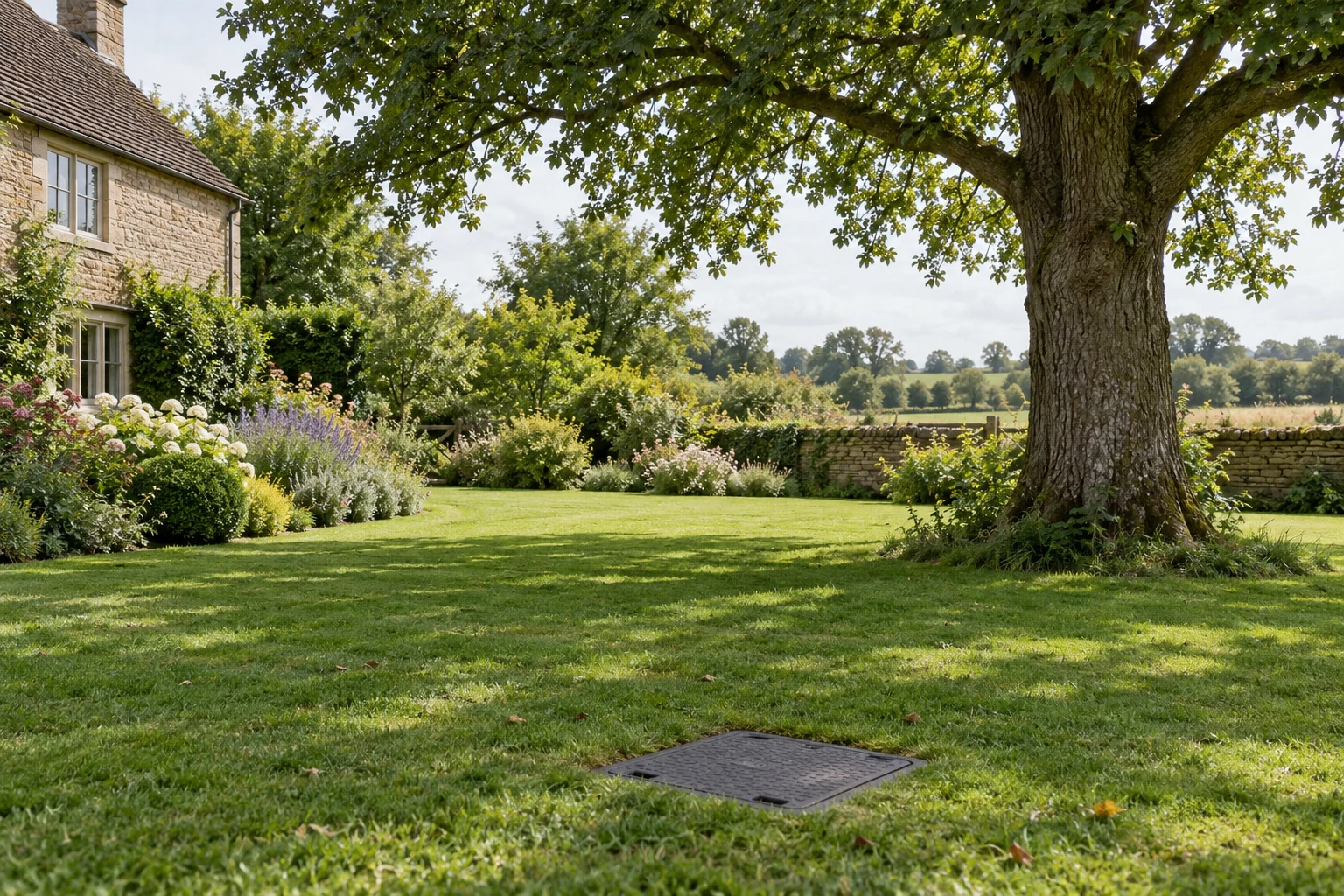
Give the tree contractor a plan showing recorded covers, equipment and routes, with a clear distinction between confirmed information and an approximate recollection. Include the source and date of any drawing. A cover visible in the lawn does not establish where all pipes or drainage features lie.
Use reading a location plan to keep tree identifiers consistent. Ask the wastewater specialist what information is reliable and what needs checking before equipment moves or ground work begins. Do not turn a sketch into a claimed safe zone around the system. The intended use of the plan is communication, not a homeowner’s engineering clearance.
Separate suspected root involvement from evidence
A tree near the system does not prove it caused a blockage, leak or other problem. If a drainage issue is part of the reason for tree work, obtain the relevant findings and share them with the arboricultural adviser. The two services may need to coordinate rather than each assuming the other has established the cause.
Our visible-root guide explains why the roots you can see do not map the complete system. Avoid proposing root cutting or tree removal as an investigative shortcut. Ask what the drainage inspection establishes, which questions remain and whether the proposed remedy could affect retained trees or other parts of the private installation.
Describe the whole tree-work operation
A pruning visit, a large removal and a stump excavation can interact with the site in different ways. Explain where vehicles, equipment, loading and timber handling are proposed, not only which tree is involved. A route across apparently open grass may cross private drainage features.
Our rural property enquiry guide helps describe the wider setting. Tell the contractor about maintenance access that must remain available to the wastewater system and any restrictions already advised by its specialist. Do not invite a team to park on an unassessed area because it is close to the tree. A workable route needs appropriate consideration before the date and price are treated as settled.
Treat stump and root work as a separate scope
If grinding, excavation or surface-root treatment is being considered, specify it expressly. Felling does not automatically include the stump, and the absence of an above-ground trunk does not mean the site is ready for drainage alteration or construction. Ask the relevant professionals to consider the intended final use.
Read stump grinding and excavation and underground services before agreeing the operation. Do not apply a universal tree-to-tank distance from an internet illustration. Equipment layout, roots, soil and the proposed work vary. The brief should identify constraints and responsibilities rather than invite the homeowner to design a safe excavation boundary.
Keep system compliance with the competent adviser
Tree work does not itself establish whether a private wastewater system complies with the rules applying to it. The GOV.UK general binding rules depend on matters including the system and its discharge. Ask the system adviser to explain what applies to the actual installation.
This guide does not determine permits, discharge compliance or an engineering design. Keep those findings with the project rather than asking a tree contractor to certify them through an unrelated quotation. If the planned garden work changes after advice, check whether the private-system assessment also needs updating. A tree recommendation and a wastewater authorisation are separate records.
Resolve shared ownership and access
Where equipment or access is shared, clarify who can approve the work and who needs information about disruption. An arrangement remembered from a previous owner may not establish the current position. Obtain appropriate property or legal advice where the documents are unclear or the parties disagree.
Our shared-boundary tree guide helps separate tree ownership from entry to land. Make communication practical: identify one project contact who can obtain the necessary decisions without pretending to own every affected feature. A contractor should not arrive with one person’s assurance only to learn that another party controls the route, drainage equipment or permission to enter the working area.
Coordinate protection and the final quotation
The written scope should identify the tree operation, site constraints, access assumptions and responsibilities for any specialist input. State what remains provisional and how an unexpected finding will be handled. Tree-protection and wildlife checks also remain relevant; use Bedford TPO checks for the starting records.
The quotation checklist helps compare proposals. If a wastewater contractor and a tree business are both involved, ask who coordinates their advice and the order of visits. Do not assume that each quotation includes protecting or reinstating everything the other trade may affect. Any limits to the assessment should remain visible before the operation is authorised.
Retain the updated information
After the agreed work, keep the final tree scope, system advice, access record and any updated plans together. Ask the responsible specialists about follow-up where a condition or installation has changed. Do not treat the absence of a visible problem immediately afterwards as a test of every buried component.
If replacement planting or paving follows, pass on the information rather than letting the next contractor start from an empty lawn photograph. The replacement planting guide helps connect future trees with existing site constraints. A useful project leaves the owner with a clearer record of the system and tree decisions, not simply one fewer obstacle above ground.
Your next step
Tell the tree business about private drainage immediately and gather reliable system records. Coordinate the appropriate wastewater and tree advice before access or excavation is agreed. Keep compliance, ownership and tree permissions separate, and record the final operation and unresolved questions using the quotation checklist.
Turn the advice into a useful project brief.
Start with the postcode, the work you have in mind and any access considerations.
Prepare your enquiryNo obligation. A site assessment may be needed to confirm the work and price.
Sources & further reading
- GOV.UK: septic tanks and sewage treatment plants overview
- GOV.UK: general binding rules for private wastewater systems
- HSE: avoiding danger from underground services
Sources checked 31 October 2026. How we prepare guidance.