
In this guide Show sections
General guidance, not a professional assessment. Confirm site-specific advice and current requirements before work.
Planning tree work in Bedford or nearby?
Start with the postcode, the work you have in mind and any access considerations.
Prepare your enquiryNo obligation. A site assessment may be needed to confirm the work and price.
Before you make arrangements
Describe whether branches touch the roof or equipment, cast shade at particular times or simply look close from the garden. Keep away from hanging material and electrical equipment. Do not climb onto the roof to measure separation or obtain photographs. Our branch-contact guide helps distinguish an observed relationship from a predetermined pruning instruction.
Tree shade and electrical safety differ
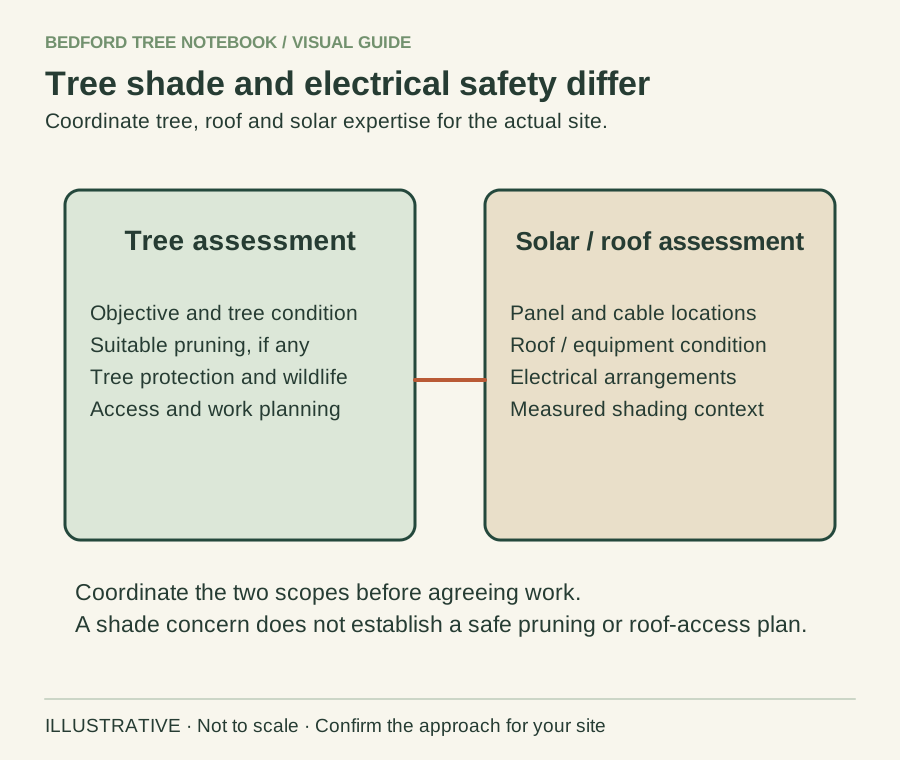
- Describe whether the issue is shade, physical contact or an equipment concern.
- Ask the solar or electrical professional about the actual installation.
- Do not climb onto the roof, disconnect equipment or assume a household switch makes all PV components safe.
Background sources: historicengland.org.uk · HSE guidance
Define the outcome you want
Write a plain statement of the issue. A concern about reduced generation is different from a branch brushing a roof, and neither establishes that the entire tree needs removal. Identify the season and part of the day involved where that information is already available from normal observation.
Use patio shade and pruning objectives to frame a light-related question without assuming the remedy. Tell the arborist whether you are considering new panels or maintaining an existing installation. The useful brief starts with the result needed and the constraints, leaving the professional to explain whether a suitable tree operation can reasonably contribute.
Keep solar performance questions with the right adviser
If output is the concern, speak to the installer or an appropriate solar professional about the actual system and its evidence. A tree contractor should not be expected to guarantee an electricity yield from a canopy photograph. Equally, a performance recommendation is not an arboricultural specification.
Provide relevant findings to the tree adviser so that the two conversations connect. Ask what is known, what is assumed and which effects are seasonal. Avoid accepting a claim that any reduction will produce a particular financial saving without a sound assessment of the installation. This guide does not estimate energy returns or compare the economics of retaining and removing a tree.
Do not use the roof as a viewing platform
Photographs taken from an accessible ground-level position can explain the relationship between the tree and roof. Say when an angle cannot be obtained safely. Do not use a ladder, lean out of a window or step onto panels to get a more complete view.
The HSE roof-work guidance explains why roof access needs appropriate planning and competence. Tree work near an installation also needs the business to understand what equipment is present. Do not infer an electrical clearance distance from a general tree diagram or assume that turning off a household switch settles the condition of every part of a solar system.
Describe contact and other observed changes
If a branch appears to rub a roof or panel, report that relationship accurately and avoid touching or moving it. If there has been a break, storm damage or change in the tree’s position, explain that separately. A close branch and a damaged installation are not interchangeable observations.
Our hanging-branch guide is relevant if timber remains lodged above the roof. Where there may be damage, ask the appropriate roof or solar professional how it should be assessed, while the arborist considers the tree. Do not assume a pruning price includes equipment inspection, electrical work or repairing the roof after a branch has been removed.
Ask about suitable tree management
Explain the tree’s species if known, approximate scale, previous work and the reason you are seeking advice. A reduction, thinning or selective branch operation can have different purposes and limitations. The proposal needs to suit the actual tree rather than reproduce the outline of a different specimen shown in a photograph.
Read reduction versus thinning before comparing terminology. Ask how the recommended work relates to the identified objective and what future growth may mean for maintenance. Do not request severe topping simply to create a large empty space above panels. A suitable recommendation may include limits to what tree work can achieve or consideration of another approach.
Coordinate the visit and working space
Tell the contractor about panels, associated equipment, fragile roof features and access restrictions before a quotation visit. Explain whether another specialist needs to attend or supply information. The business must decide how its work can be planned; the homeowner should not propose a makeshift access method to fit a preferred date.
Our work near sheds and greenhouses covers a similar need to identify fragile surroundings. Agree who communicates with the installer or roof professional and what remains to be checked. If the garden is reached through a shared route, include that in the brief so equipment and material handling are considered together with the tree’s position.
Check protection, ownership and wildlife
Solar-panel ownership does not give an automatic right to prune someone else’s tree or bypass controls on your own tree. Establish the owner, relevant planning authority and any protection before agreeing operations. Our Bedford TPO guide provides the starting records.
If the tree crosses a boundary, read overhanging branches and resolve access and authority appropriately. Wildlife requirements also remain relevant. A commercial objective relating to generation is not permission for a particular cut. Where the work proposal changes after input from the solar specialist, make sure the tree and regulatory checks relate to that revised proposal rather than an earlier outline.
Compare a complete scope
A useful quotation identifies the tree, proposed operation, access assumptions, protection of nearby features and responsibility for waste. It should also distinguish the contractor’s work from any solar-system or roof service arranged separately. Ask what the business has inspected and which assumptions remain provisional.
Use the quotation checklist to compare proposals fairly. If a business makes a performance promise outside its assessed scope, ask for clarification before relying on it. Agree how changes discovered on site will be recorded and authorised. A vague instruction to clear the panels can otherwise leave you uncertain about the intended tree result, the protected equipment and the limits of responsibility.
Plan for the relationship over time
Keep the final advice and operation with the installation records. Ask what future tree growth or site changes should prompt another conversation, without assuming a fixed recurring reduction is suitable for every tree. A new installation or replacement tree may allow a broader design discussion before problems develop.
Our long-term Bedford tree-care guide helps connect that planning with other garden decisions. If replacement planting is considered, assess mature size and location rather than selecting only for its appearance on planting day. Managing the relationship is more useful than repeatedly buying an unclear one-off cut while losing the reason for the original recommendation.
Your next step
Separate shade, contact and equipment condition in your brief, then coordinate the appropriate tree and solar or roof advice. Keep your observations at ground level and avoid assumed electrical clearances or DIY access. Once a suitable operation is agreed, record its limits and use the quotation checklist before booking.
Turn the advice into a useful project brief.
Start with the postcode, the work you have in mind and any access considerations.
Prepare your enquiryNo obligation. A site assessment may be needed to confirm the work and price.
Sources & further reading
Sources checked 31 October 2026. How we prepare guidance.