
In this guide Show sections
General guidance, not a professional assessment. Confirm site-specific advice and current requirements before work.
Planning tree work in Bedford or nearby?
Start with the postcode, the work you have in mind and any access considerations.
Prepare your enquiryNo obligation. A site assessment may be needed to confirm the work and price.
Before you make arrangements
Describe the tree, previous work and the concern that prompted the enquiry. Include nearby buildings, drains, boundaries and changes to the garden. Our large-tree small-garden guide helps distinguish a space problem from a tree-health concern before you decide which professional service to request.
History before the next intervention
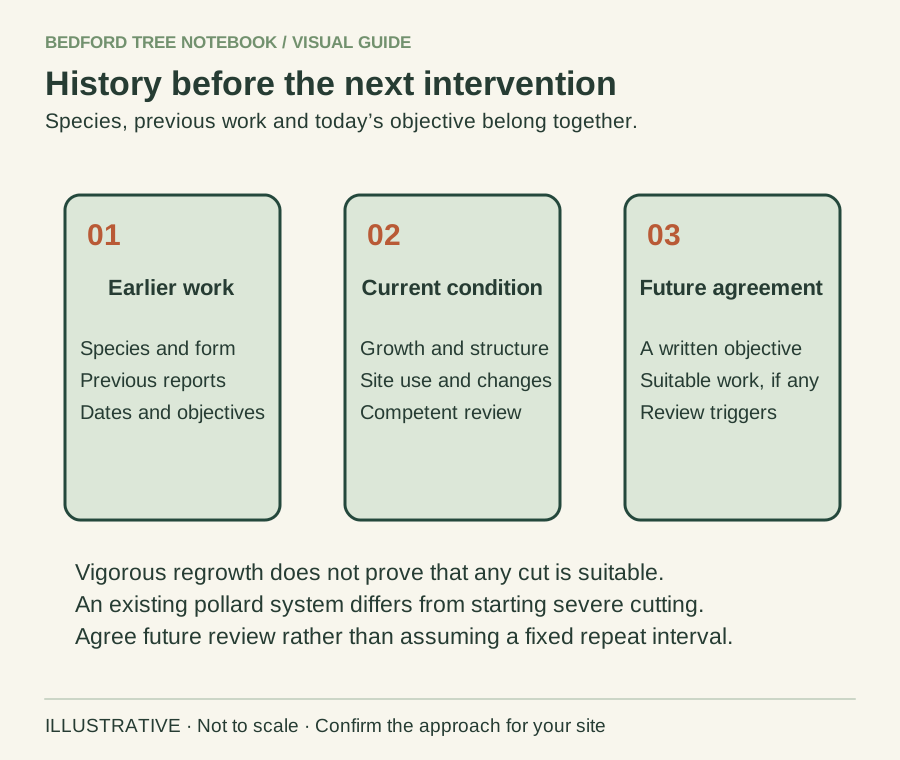
- Identify the species and any established management system.
- Distinguish basal shoots, crown regrowth and structural concerns.
- Ask what future care is appropriate instead of assuming regrowth permits repeated severe cutting.
Background sources: RHS guidance · RHS guidance · RHS guidance
Identify the willow and its management history
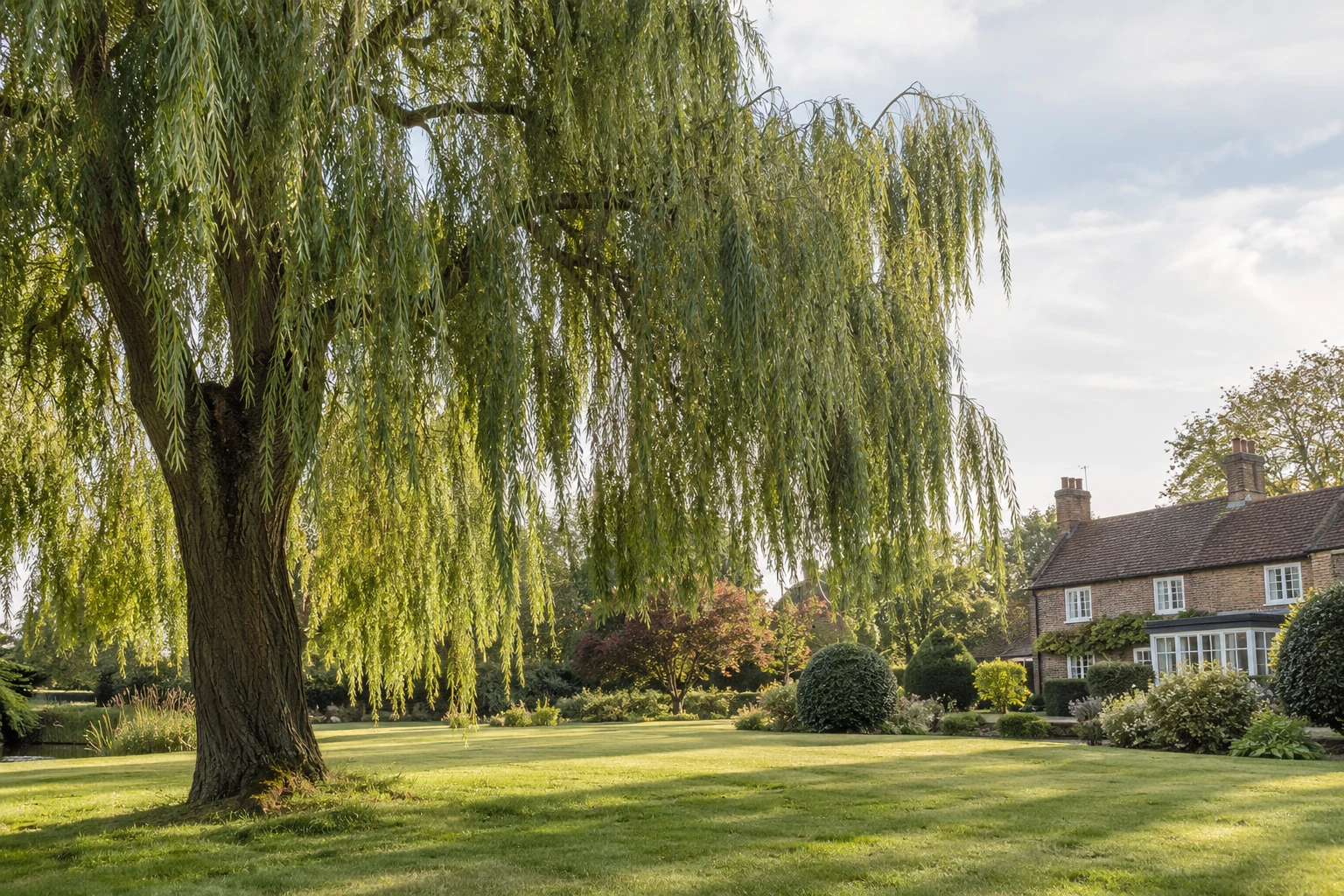
Keep any planting records or earlier reports, and ask the professional to confirm the tree's identity. A mature garden specimen should not be managed on the assumption that all willows tolerate exactly the same treatment. Explain whether it has previously been pollarded, reduced or allowed to develop its natural form.
If you inherited the tree, say which parts of the history are unknown. Our pollarding-versus-topping guide explains why an established management system and a one-off severe cut are not interchangeable descriptions. Previous regrowth does not automatically prove that repeating the same operation is appropriate for the tree's present condition or surroundings.
RHS separates willow trees from the shrubby willows grown for colourful young stems. Advice about repeatedly cutting a suitable ornamental-stem shrub should not be transferred to a mature weeping willow. That distinction is particularly useful when an internet search returns attractive coppiced displays: the plant, objective and management system may be quite different from your retained garden tree.
Make the homeowner’s objective specific
Is the concern clearance, loss of light, debris, size, a visible change or possible effects on a building? Separate those issues rather than using “the willow is out of control” as the whole brief. A professional can then explain which concerns can reasonably be addressed and which require other advice.
The patio-shade guide is useful when light is the aim. If the concern is a branch near a roof, describe that relationship separately. Do not assume one broad reduction will resolve every issue. Ask what result the proposed operation is expected to produce and what continuing management it may create.
Assess the current tree rather than its reputation
Willows are often discussed as vigorous trees, but a reputation for regrowth is not a structural assessment. Ask the arborist to consider the actual branches, stem, existing wounds and site use. Avoid treating an old, irregular or previously cut tree as safe merely because it continues to produce foliage.
Our tree assessment signs guide helps you report a change from safe ground. If the concern involves a newly hanging or broken branch, keep away and arrange the appropriate professional response. Do not pull at branches, test their strength or begin clearing material before an assessment in order to make the visit easier.
Keep drainage and building questions evidence-led
A willow near a house or drain does not establish the cause of a defect. The RHS guidance on trees near buildings explains why the building, ground and drainage context matter. If there are cracks, movement or repeated blockage, involve the relevant building or drainage adviser and insurer as appropriate.
Read trees beside drains before commissioning removal as a supposed cure. Tree and building advice should be coordinated with the actual findings. Do not assume every Bedford garden has identical soil conditions, or that removing a tree is an insignificant precaution with no further consequences to consider.
Think about the space needed after the work
A shorter crown immediately after pruning is only one stage in the tree's development. Ask about likely future growth and the practical implications of the recommendation. If continued management is proposed, clarify its purpose, expected review and what circumstances could change the approach.
Our long-term tree-care guide helps turn the recommendation into a record rather than an informal repeat booking. Do not accept a promise that vigorous regrowth can always be kept within the same small outline without consequences. If the tree and garden use are fundamentally incompatible, ask for a considered comparison of alternatives, including the permissions and establishment needs of any replacement planting.
Consider roots when altering the garden
Paving, excavation, drainage installation and changes of level may affect a retained willow. Show the proposed works to the arboricultural adviser before treating them as a separate landscaping job. The canopy edge is not a survey of the root system, and surface appearance does not establish a clear excavation route.
Use visible roots in a lawn to understand the limits of what you can observe. Do not cut roots or install a barrier on the strength of a generic internet suggestion. Ask which investigations, design changes or other specialist input are justified for the actual project and keep the recommendations coordinated with the contractor's plans.
Account for habitat and waterside settings
If the willow grows beside a pond, ditch or other water feature, tell the professional before the visit. The work may need to consider access, ground condition, habitat and possible effects on the surrounding area as well as the tree. Do not enter unstable banks or water to obtain better photographs.
The garden-pond tree-work guide raises practical questions, while active bird nests and possible bat features need their own consideration. Ask what environmental checks are appropriate. A convenient pruning season or an apparently quiet site does not establish that all wildlife and other requirements have been satisfied.
Check ownership, access and tree protection
A willow close to a boundary may have branches over more than one garden. Establish who can instruct the work and who must agree to access. Do not assume a neighbour's concern gives you authority to enter their land, or that ownership removes any applicable protection controls.
Our shared-boundary guide helps prepare the discussion. Check the actual property's responsible authority and relevant records before practical work. If a management recommendation changes, keep the revised scope consistent with any permission. Avoid using “willow maintenance” as an undefined label covering everything from limited branch work to removing the whole tree.
Compare complete work proposals
Ask each contractor to quote for the same assessed outcome. Include access, protection of the garden, handling of branches and timber, and whether any stump treatment or reinstatement is included. A proposal to retain a managed tree is a different job from removal and replacement preparation.
The tree-work quotation checklist helps expose those differences. Ask what follow-up is recommended for the retained tree and keep it with the completion record. The aim is an understandable management decision based on the individual willow and garden, rather than a dramatic short-term appearance that leaves future responsibilities unexplained.
Your next step
Prepare a species-aware brief and seek advice that considers condition, site use and previous management. Coordinate building or drainage concerns with the relevant specialists, and check ownership, wildlife and protection before work. Ask what the proposal means for the tree and garden over time, including realistic alternatives where the available space and desired use conflict.
Turn the advice into a useful project brief.
Start with the postcode, the work you have in mind and any access considerations.
Prepare your enquiryNo obligation. A site assessment may be needed to confirm the work and price.
Sources & further reading
- RHS: pruning trees
- RHS: trees near buildings
- Bedford Borough Council: protected trees
- Natural England: wild birds, protection and licences
- RHS: growing willow trees
- RHS: willows for winter colour
- RHS: pollarding
Sources checked 31 October 2026. How we prepare guidance.