
In this guide Show sections
General guidance, not a professional assessment. Confirm site-specific advice and current requirements before work.
Planning tree work in Bedford or nearby?
Start with the postcode, the work you have in mind and any access considerations.
Prepare your enquiryNo obligation. A site assessment may be needed to confirm the work and price.
Before you make arrangements
Observe from the ground without pulling stems, climbing or disturbing cavities and nests. Record whether the concern is appearance, access for inspection, a change in the tree or growth into surrounding structures. Our tree assessment signs guide helps distinguish an observation to report from an attempt to diagnose condition yourself.
Ivy: support, habitat and context
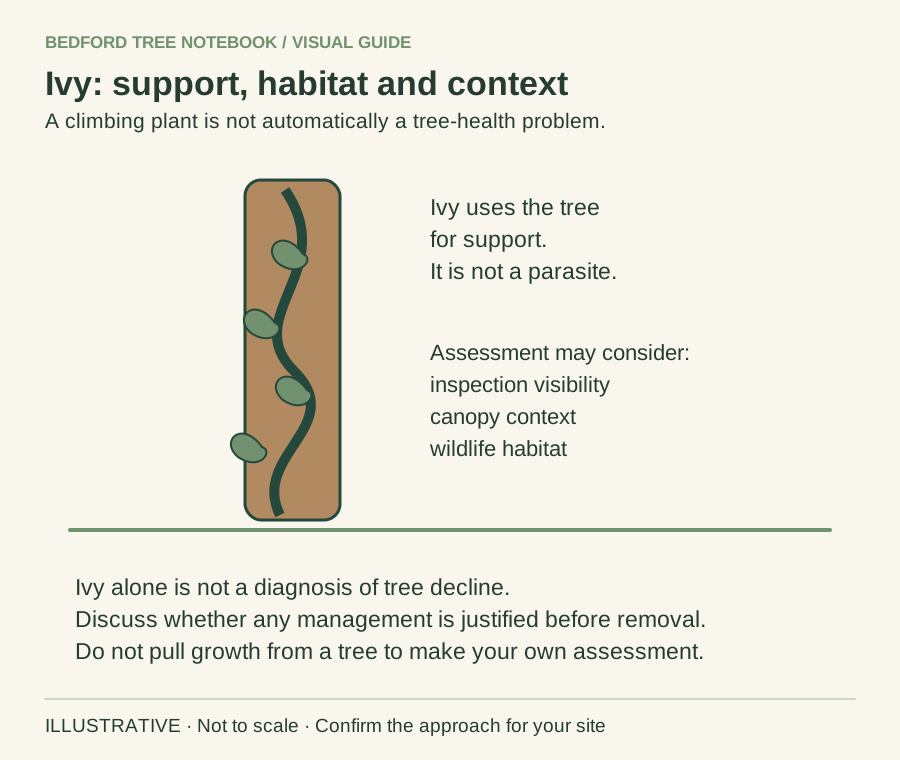
- Do not assume ivy is strangling or feeding from the tree.
- Discuss inspection access, canopy context and wildlife before proposing management.
- Avoid stripping, climbing or pulling growth to investigate a concern.
Background sources: RHS guidance
Understand the basic relationship
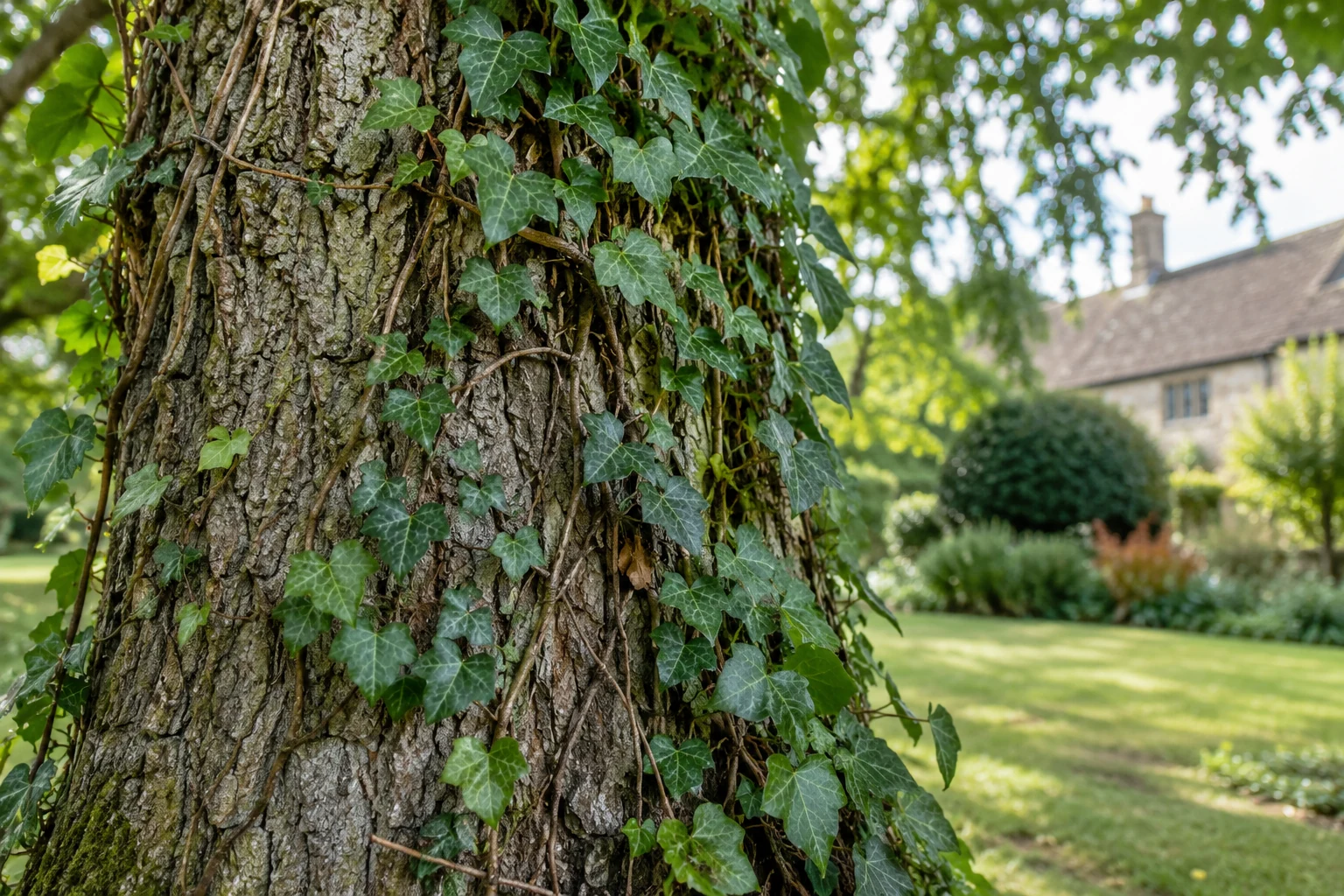
The RHS ivy guidance explains that ivy does not directly harm healthy trees in the simple way often claimed. It is not a parasite extracting its food from the tree. The familiar description that it invariably “strangles” a tree should not be used as a diagnosis or as a reason for automatic clearance.
That does not mean every ivy-covered tree needs no consideration. The tree's condition, amount of growth, setting and management objectives matter. Ask the arborist to explain what they observe and what problem any proposed operation is intended to address. A clear reason is more useful than a general dislike of ivy.
Distinguish ivy from the condition of the tree
A thin crown, dead branches or another change may have more than one explanation. Do not assume ivy caused it merely because the stems are visible. Tell the professional what has changed and when, and mention previous work, building activity or other relevant events around the tree.
Our ash-dieback introduction illustrates the wider principle that a visual symptom is not a complete diagnosis. An assessment may need to consider the tree separately from the climber. Avoid removing material before the visit simply to make the picture look clearer; ask what information the professional wants and what can be observed safely without interference.
Ask whether ivy limits the inspection
Dense growth can make some tree features harder to see. Ask the person inspecting the tree which parts were visible, which were obscured and whether further investigation or carefully planned management is justified. The report should explain its limitations rather than implying that a quick look through foliage answers every structural question.
The consultant-or-contractor guide helps define the service you need. If an independent assessment is the aim, say so before accepting a price for ivy removal. A practical clearance quotation and an opinion about the tree's condition may be separate deliverables. Ask how any recommended next stage will improve the evidence or address the identified concern.
Include wildlife before choosing a method or date
Ivy can provide shelter and food for wildlife, so the ecological context belongs in the conversation from the start. Check for relevant bird and bat issues through appropriate professional advice; a quiet-looking tree is not proof that nothing uses it. Avoid inspecting cavities or pulling growth apart to see what is inside.
Read active bird nests and tree work and possible bat features before arranging changes. Do not treat a calendar month as automatic clearance. The actual tree, growth and proposed work need consideration, and some circumstances may require specialist input before an operation can be specified or scheduled.
Discuss proportionate options rather than total stripping
Ask whether retention, limited management or another response would meet the objective. The answer may depend on the amount and position of growth and what needs to be inspected or kept clear. This article does not prescribe where to sever stems or how to remove ivy from a tree.
Pulling attached growth from height or using tools near bark can create hazards or damage, so do not prepare the tree for the team by attempting the work yourself. If the professional recommends management, ask what will remain, what will change and why. A specification should distinguish the ivy operation from any pruning of the host tree rather than combining both under an undefined “tidy up”.
Keep buildings and neighbouring land within the brief
Ivy may also extend onto a wall, fence or neighbouring planting. Tell the professional about those connections, but do not assume advice for a tree automatically applies to a building or fragile boundary. Different surfaces, ownership and condition can require different assessment or specialists.
Our shared-boundary guide helps prepare access and ownership questions. If growth reaches a listed building or sensitive structure, raise that context before anyone starts. Agree which areas the contractor is instructed to address and which are excluded. A neat-looking result is not enough if the work has exceeded the owner's authority or disturbed a feature that needed separate advice.
Check controls for any associated tree work
If the proposal includes pruning, root work or other operations affecting the tree, check protection and permissions for that actual work. Do not assume that describing the visit as ivy management settles every regulatory question. Ask the responsible council or adviser about uncertainty before instructions are given.
Use Bedford tree-protection checks as the local starting point and identify the correct authority for the exact property. Keep the ivy proposal distinct from a recommendation to reduce or remove the tree. Our crown-operation comparison explains why additional pruning needs a clear objective and specification of its own.
Agree the expected result and later review
Ask how the tree and ivy are expected to look after the proposed work and what follow-up, if any, is recommended. Some visible change may develop over time, so avoid treating a staged or limited approach as a failure merely because the tree is not immediately bare. Get the explanation in terms you understand before accepting the quotation.
The quotation checklist helps record access, debris handling and exclusions. If inspection limitations remain afterwards, ask how they should be recorded and whether another assessment is advised. Keep the report and work record together. Successful ivy management should be judged against the agreed objective, not an unsupported promise that every future tree concern has disappeared.
Describe the desired outcome without prejudging it
Instead of requesting a bare trunk, explain the practical concern: a feature cannot be inspected, growth is reaching a structure, or you have noticed a change in the tree. Ask whether the proposed ivy management would address that concern and what may be lost if all growth is removed.
This makes it easier to compare a recommendation to retain, manage selectively or investigate further. If the advice differs from what you expected, ask for the reasoning rather than requesting a more severe operation by default. A well-defined objective protects the value of the assessment and helps avoid work based solely on appearance.
Your next step
Tell the arborist what worries you about the ivy and ask for an assessment of the actual tree, growth and site. Discuss wildlife, inspection limits and proportionate options before choosing an operation. If management is justified, obtain a clear written scope and any necessary permission advice. Retaining ivy may be appropriate; automatic removal should not replace an informed decision.
For new planting rather than existing ivy, choosing climbers around trees helps distinguish a suitable planting plan from an unassessed burden on the tree.
Turn the advice into a useful project brief.
Start with the postcode, the work you have in mind and any access considerations.
Prepare your enquiryNo obligation. A site assessment may be needed to confirm the work and price.
Sources & further reading
- Natural England: wild birds, protection and licences
- Natural England: bats, protection and licences
- Bedford Borough Council: protected trees
- RHS: ivy
Sources checked 31 October 2026. How we prepare guidance.