
In this guide Show sections
General guidance, not a professional assessment. Confirm site-specific advice and current requirements before work.
Planning tree work in Bedford or nearby?
Start with the postcode, the work you have in mind and any access considerations.
Prepare your enquiryNo obligation. A site assessment may be needed to confirm the work and price.
Before you make arrangements
Identify the tree and proposed climber as accurately as possible, including the cultivar where known. Explain whether you are choosing a new plant or reviewing growth already present. Our ivy-on-trees guide addresses one familiar situation; its advice should not be applied unchanged to every other climber.
Understand that climbers use different attachment methods
RHS describes climbers that attach with tendrils, twining stems, stem roots or sticky pads, alongside wall shrubs needing support. These differences affect how a plant occupies space and what maintenance may be required. A trellis-grown plant and a self-clinging climber spreading through a tree are not the same garden arrangement.
The RHS climbing-plants guide provides a useful introduction. Use it to identify the questions, not to conclude that any vigorous plant can safely use any tree. Ask how the proposed growth will be supported and managed over time, including what happens if it exceeds the space or becomes difficult to reach.
Compare mature vigour, not just the nursery pot
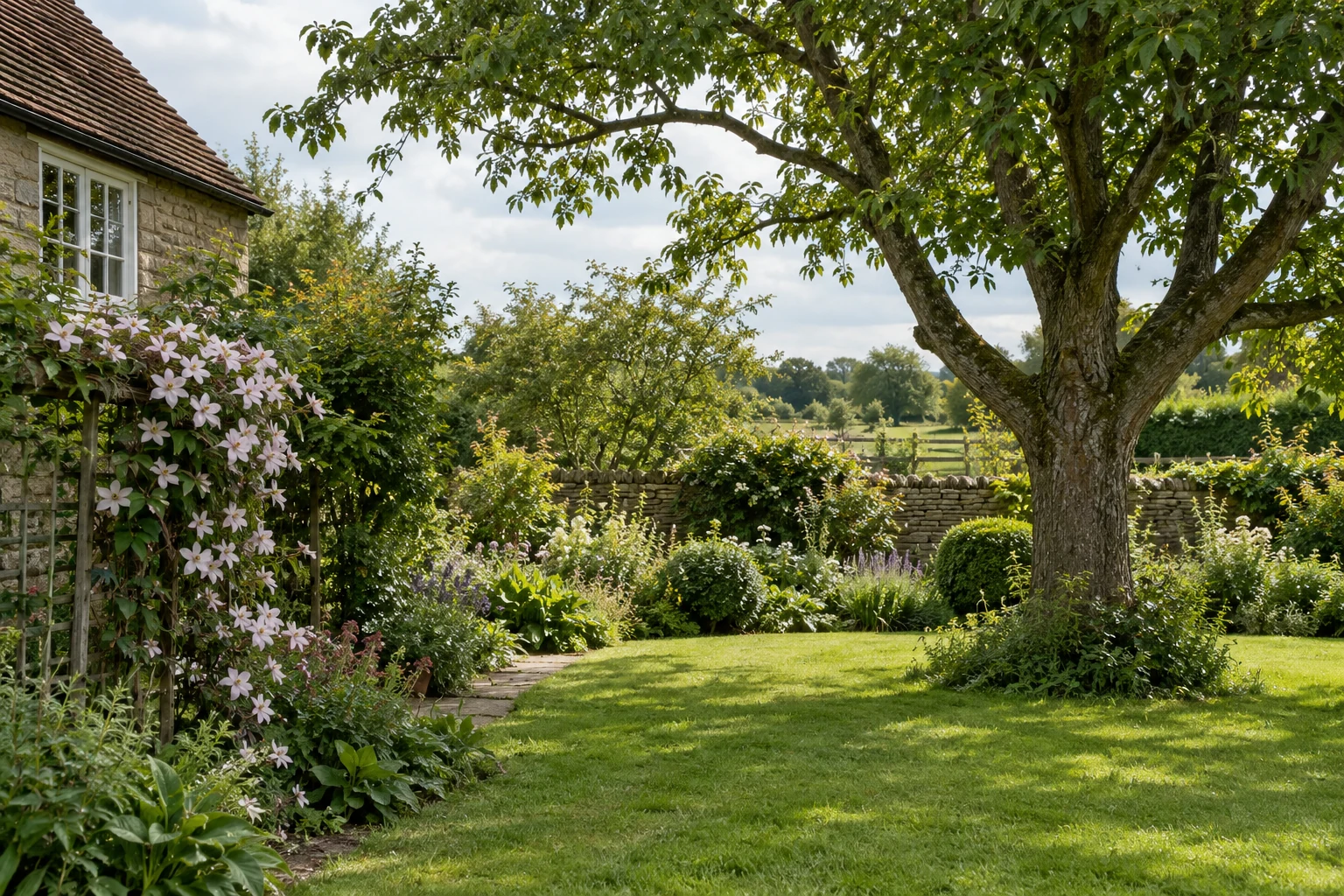
A small plant can develop into a large mass of growth. Check the species and cultivar's likely mature extent and habit rather than relying on its appearance at purchase. Some clematis are relatively manageable in a particular setting, while others are vigorous enough to outgrow a limited support.
RHS clematis-growing guidance specifically highlights the need to allow enough room. The practical question is whether the proposed climber and host are compatible at maturity and can be managed without repeatedly disturbing the tree. Do not use a compact young tree as a convenient temporary support for a plant whose eventual size has not been considered.
RHS guidance includes growing suitable clematis into mature trees and large shrubs, so a tree-and-climber combination is not inherently inappropriate. The choice needs to suit both plants and remain manageable. That is a reason to assess compatibility carefully, not to assume every existing climber must be removed.
Assess the host tree before adding growth
Consider the tree's species, age, condition, size and existing management needs. A tree with an unresolved condition concern should not simply be covered with a climber to improve its appearance. Ask whether the combination would hinder assessment or complicate future work.
The tree assessment signs guide helps describe changes from safe ground, and the consultant-or-contractor guide helps define an assessment commission. Do not assume a leafy crown certifies structural suitability as a support. The horticultural suitability of the climber and the condition of the host are separate questions that need to be considered together.
Plan the planting position without disturbing roots
Planting beside an established tree involves more than selecting a route for stems. The new plant needs suitable conditions, while digging and later cultivation may disturb retained roots. Ask for advice where the proposed position or existing roots make that uncertain. Do not cut tree roots to create an attractive planting pocket.
Read visible roots in a lawn and raised beds near trees before adding soil or changing the planting area. A deep mound against the trunk is not a substitute for a suitable location. Consider whether a separate support and planting position would reduce the conflict while meeting the original garden objective.
Think through future pruning and access
Climbers differ in their pruning requirements, and the chosen form may become difficult to reach once it extends through a tree. Ask how routine care can be carried out safely without climbing or damaging the host. A combination that looks attractive immediately may be impractical to maintain later.
Our pruning-time guide explains why one season does not suit every species or operation. Do not assume the climber and tree can be managed during the same visit with the same approach. A clear plan should explain which plant is being worked on, who can reach it safely and what limits or specialist help may be needed.
Keep inspection visibility in the design
Dense growth can obscure bark, junctions and cavities that a professional may need to assess. Ask whether the proposed combination would create avoidable inspection limits, especially on an older tree or one with existing recommendations. Do not strip growth from height yourself to obtain a better view.
If a climber is already established, record what is visible and ask what further assessment or management is justified. Our cracks-and-cavities guide explains why a hidden feature and an exposed feature both require interpretation. Removing a climber is not automatically necessary, but neither should its presence become a reason to give an unqualified assurance about the unseen parts of a tree.
Recognise habitat without assuming there are no constraints
Climbers can provide flowers, shelter and food for wildlife. Those benefits belong in the choice, along with the host tree's condition and your ability to manage the planting. If changing established growth, discuss relevant wildlife checks rather than treating removal as a purely cosmetic garden task.
Our active-nest guide and possible bat-features guide cover different issues. Do not investigate cavities or pull apart dense growth to prove it is clear. A recommended horticultural timing does not establish an ecological all-clear. The actual plants, features and proposed work need consideration before an operation is scheduled.
Consider an independent support honestly
A trellis, pergola or other structure may allow more control over the climber's extent and maintenance. That can be a useful alternative, but it creates its own questions about strength, ownership, position and installation. Do not assume posts or foundations may be placed among retained tree roots without assessment.
If the support is near a boundary, use the shared-boundary guide to prepare the discussion. Keep the long-term canopy and access in mind rather than positioning the structure solely for the first flowering season. A separate support is a design option, not a universal guarantee that every climber or installation method will suit the site.
Keep tree work separate from climber management
If practical work is proposed, the written scope should identify which plant is being managed and which tree operations, if any, are included. Ask about applicable tree controls and ownership where relevant. Describing the whole visit as tidying climbers should not conceal an additional proposal to prune the host tree.
The quotation checklist helps record the distinction, access and waste arrangements. At completion, ask what remains and what future care is recommended. Good plant selection is partly about avoiding repeated conflict: choose a combination whose mature appearance, inspection needs and maintenance responsibilities you can understand before it becomes difficult to change.
Your next step
Choose by species, cultivar, vigour and future management rather than flower colour alone. Consider the host tree's condition, rooting environment and inspection needs, and compare a separate support where appropriate. For established growth, ask for a proportionate assessed plan rather than assuming every climber must be removed or every tree is suitable to carry it.
Turn the advice into a useful project brief.
Start with the postcode, the work you have in mind and any access considerations.
Prepare your enquiryNo obligation. A site assessment may be needed to confirm the work and price.
Sources & further reading
- RHS: climbing plants
- RHS: growing clematis
- RHS: ivy on trees and as groundcover
- RHS: planting trees and shrubs
- RHS: training climbers
- Natural England: wild birds protection and licences
Sources checked 31 October 2026. How we prepare guidance.