
In this guide Show sections
General guidance, not a professional assessment. Confirm site-specific advice and current requirements before work.
Planning tree work in Bedford or nearby?
Start with the postcode, the work you have in mind and any access considerations.
Prepare your enquiryNo obligation. A site assessment may be needed to confirm the work and price.
What to check
Do not assume every affected ash needs immediate removal. A professional assessment considers condition, location and the risks associated with any proposed work.
Record a concern without diagnosing
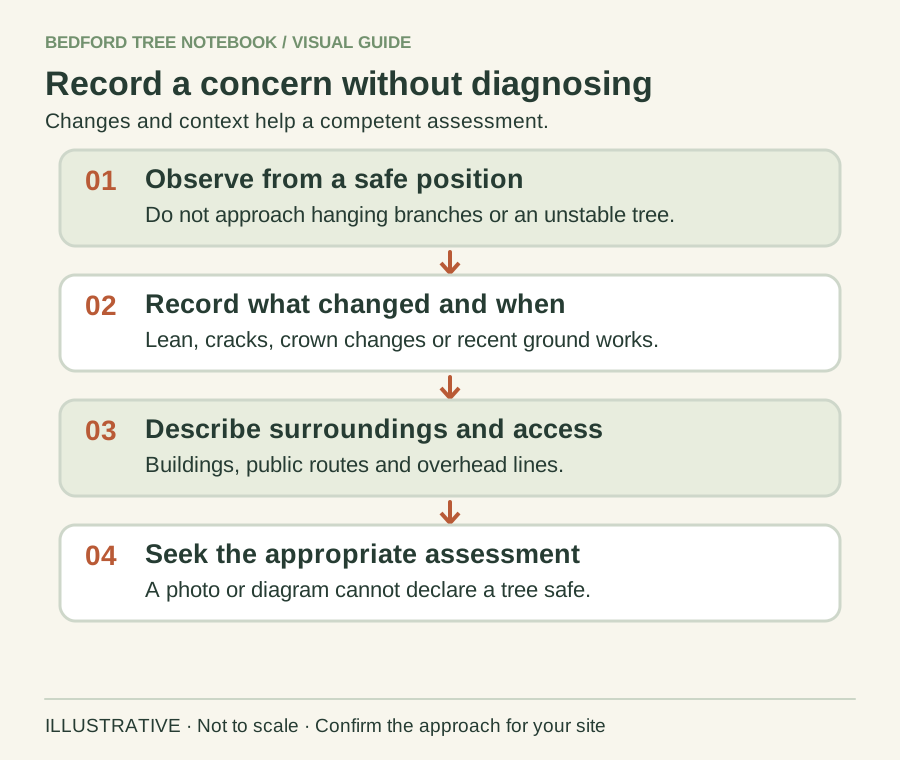
- Do not approach a potentially unstable tree to collect evidence.
- Similar visible symptoms can have different causes.
- Do not infer safety or a legal exemption from this workflow.
Identify the tree and the concern
If you are unsure that the tree is ash, say so. From a safe place, describe where you see sparse foliage, dead branches or changes in the crown. A homeowner enquiry should record observations rather than label every declining ash as a confirmed case.
Location changes the questions
A tree beside a busy route or building presents different assessment considerations from one in a little-used part of a large property. Tell the professional what surrounds it and how the area is used. This does not allow a website tool to calculate the risk.
Ask about the proposed method
Make suspected decline clear before obtaining a quote, so the contractor can decide what expertise and equipment are appropriate. Do not attempt to test the strength of branches or climb the tree. Any work proposal should follow an assessment rather than assumptions from photographs alone.
Retaining useful records
Keep the assessment, recommended actions and any follow-up arrangements together. If monitoring is recommended, ask what changes should prompt another inspection. The information here is an enquiry-preparation guide, not a disease identification key or an instruction to fell.
Begin by checking what is known
If the tree has not been identified, say so in the enquiry. Do not let an online image comparison become a confirmed diagnosis. Describe the visible concern from a safe place and explain whether it affects the whole crown or a particular part. Retain photographs from previous years if you already have them, but do not approach a damaged limb to collect close-up evidence or try to expose symptoms under bark.
The Forestry Commission guidance on ash dieback and Forest Research material provide authoritative background. A homeowner's next decision is about obtaining suitable assessment, not learning a quick test that certifies the tree. Our tree-assessment signs guide helps structure that first account. Separate the tree's identity, suspected disease and any concern about its condition so that a professional can explain what is known and what needs further investigation.
Describe how the space is used
Give the assessor a clear picture of buildings, parking, paths, seating and other regular activity near the tree. A professional needs to understand the location as well as symptoms. Do not try to calculate a risk score from this article or assume that a tree in a large garden has no relevant exposure. Explain changes in surrounding use, such as a new play area or a route now used by visitors.
If the tree is on public land, use the Bedford reporting guide rather than commissioning work you cannot authorise. Where ownership is uncertain, state that uncertainty. The information should help the right organisation locate and assess the concern. It does not establish responsibility for every tree visible from your garden, and a council's planning role should not be confused with ownership or maintenance of a particular ash tree.
Hypothetical example: suspected disease beside a parking space
Imagine a homeowner notices thinning foliage on a possible ash near the family parking area. The useful enquiry identifies the position, says the species is unconfirmed and records when the change was noticed. The homeowner should not climb to compare leaves, shake branches or conclude that all nearby trees must also be removed. A professional can decide how to assess the tree and advise on appropriate management.
This fictional example does not establish a diagnosis, prescribe felling or suggest that a particular canopy appearance has one explanation. It illustrates how a concern about health and the use of the surrounding space can be described together without overstating either. Our removal versus pruning guide helps prepare later questions about the recommendation, but the options must be considered for the actual tree. The label of a suspected disease cannot replace an assessment of the work proposed.
Make the concern visible before asking for a work price
Tell prospective businesses about suspected ash dieback or decline at the first contact. Ask what assessment is needed before deciding on a method or quotation. A business needs to know the nature of the concern to consider relevant competence and planning. Do not commission a routine operation on the assumption that a worker can make any necessary changes after climbing or cutting has started.
Our choosing a tree surgeon guide helps with the relevant evidence questions. Ask who is making the recommendation, whether a written assessment is included and what remains outside the quote. Keep the assessment fee distinct from any later work if different services are involved. A low remote removal figure may tell you little about the attention given to the tree's condition. Choose an understood process rather than treating the first price received as confirmation that the situation has been assessed.
Retention, follow-up and permission need separate answers
Ask the professional to explain the management recommendation and any follow-up. If retaining and reviewing the tree is advised, clarify what would trigger another assessment and who arranges it. If work is recommended, obtain the reasons and specification, then check relevant controls. Suspected or confirmed disease should not be treated as a blanket exemption from the planning process or other requirements.
The dangerous-tree permission guide explains why urgent exceptions depend on the facts. Keep reports, decisions and final work records together so that later advice is based on a coherent history. If replacement planting forms part of the eventual project, discuss the new growing space rather than automatically ordering another tree for the same position. This article remains an editorial starting point pending specialist review; its purpose is to improve the enquiry and decision process, not diagnose disease or direct hazardous work.
Should I ask for every nearby ash to be considered?
If several trees concern you, identify them separately and explain what you have observed on each. Do not assume that one suspected problem establishes the condition of every specimen. A clear site plan helps the professional define the scope of the assessment and avoid confusing multiple photographs of one tree with several trees. Ask which findings and follow-up relate to each identified tree rather than treating the whole property as one undifferentiated problem.
Your next step
Tell prospective contractors about suspected disease before a visit. Specialist planning may be needed for declining trees; this article requires arboricultural review before publication.
For a different visible concern, fungi around a tree base explains why a feature is a reason for assessment rather than a diagnosis by itself.
For an uncertain leaf symptom, changes in leaf colour helps organise observations without assigning a disease from appearance alone.
Turn the advice into a useful project brief.
Start with the postcode, the work you have in mind and any access considerations.
Prepare your enquiryNo obligation. A site assessment may be needed to confirm the work and price.
Sources & further reading
- Forestry Commission: managing ash dieback in England
- Forest Research: ash dieback
- HSE: tree-work safety topics
- GOV.UK: Tree Preservation Orders and conservation areas
Sources checked 31 October 2026. How we prepare guidance.