
In this guide Show sections
General guidance, not a professional assessment. Confirm site-specific advice and current requirements before work.
Planning tree work in Bedford or nearby?
Start with the postcode, the work you have in mind and any access considerations.
Prepare your enquiryNo obligation. A site assessment may be needed to confirm the work and price.
Before you make arrangements
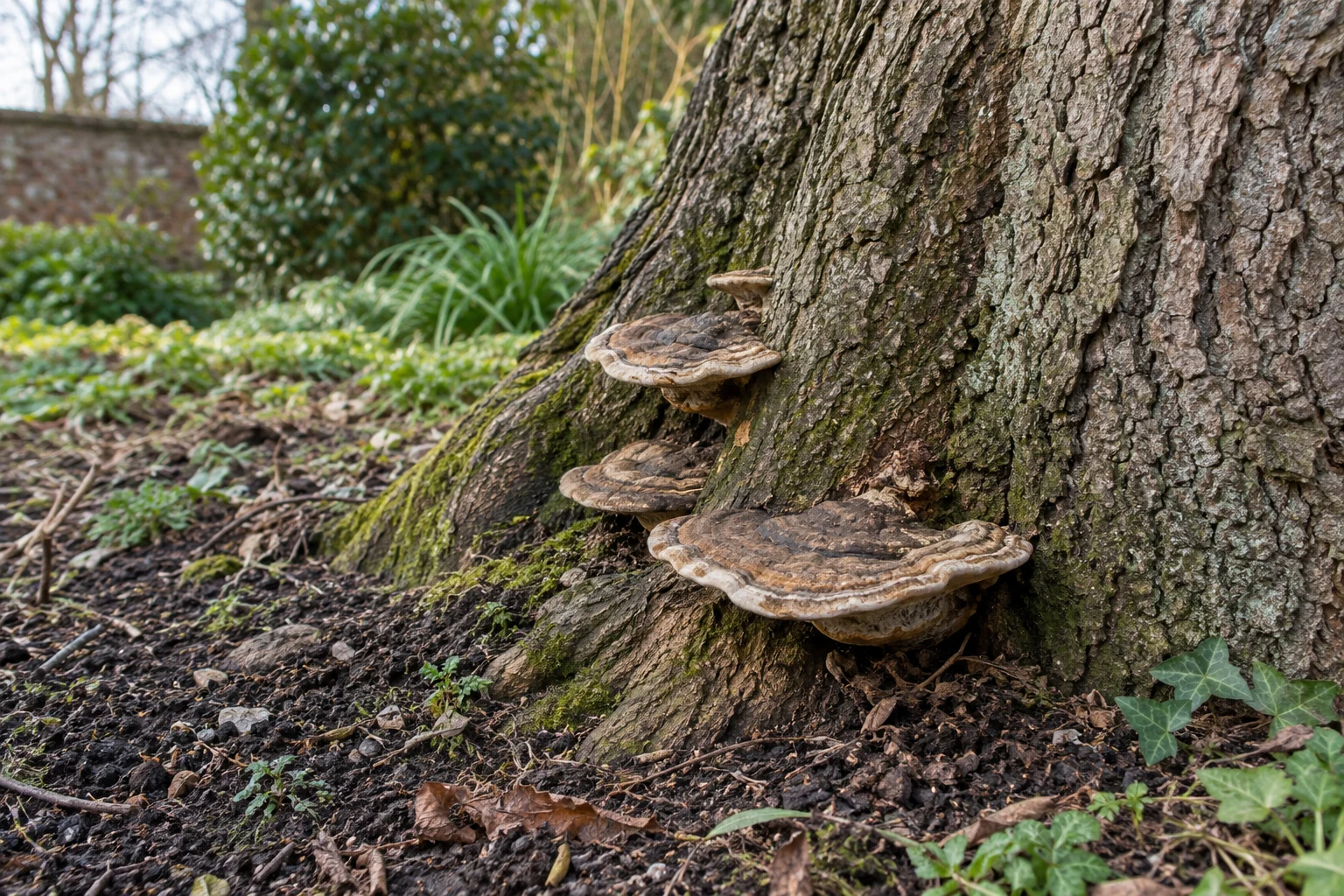
Notice the location from somewhere safe: on the trunk, around the base, on nearby soil or on an old stump. These are different observations. Do not lift bark, dig around roots or remove growths to investigate. If there are hanging branches, a new lean or other immediate concerns, keep people away and use the appropriate urgent reporting route. Our tree assessment signs explain the wider context.
Separate identification from the work decision
Some fungi are involved in wood decay, but a photograph of a fruiting body cannot establish the extent or structural consequences inside a particular tree. The RHS introduction to bracket fungi provides background on that relationship. Identification and tree assessment remain different questions.
When contacting a professional, ask what they will assess and what the resulting advice will cover. A confident species name in an informal message is not the same as a reasoned recommendation about your specimen. You may need an arboricultural consultant rather than a quotation for predetermined cutting; our consultant and contractor comparison explains the distinction.
Record where the growth appears
A useful message connects the observation with the whole tree. Say whether the growth is attached to the stem, emerging at the soil line or appearing some distance away. If several trees stand close together, label a simple photograph so the professional knows which tree you mean. Do not assume that the nearest visible trunk explains every growth on the lawn.
Photograph the wider setting only where you can do so without approaching a suspected hazard. Include an approximate date and whether you have noticed the feature before. Avoid scraping the surface to obtain a cleaner image. The undisturbed appearance may be more useful than a sample collected without advice.
Describe the tree’s surroundings
The assessor needs to understand what surrounds the tree as well as the feature that caught your attention. Mention a frequently used seating area, neighbouring building, road, public route or play space. Explain normal access and whether anyone has already restricted use of part of the garden.
These details help define the commission; they do not let a homeowner calculate a safe distance. If the tree appears unstable, stay away rather than using a tape measure near its base. Our leaning-tree guide helps you describe a change in position without deciding its cause or stability. Do not ask children to stand beside a trunk for photographic scale.
Keep changes and history together
Write down relevant events without making them a diagnosis. A recent trench, change in ground level, vehicle access across the garden or branch failure may be worth reporting. Distinguish what you witnessed from what a previous occupier or neighbour remembers. If you have earlier reports, provide their dates and tree identifiers.
A short timeline is more useful than a large collection of unlabelled photographs. For example, record when the growth was first noticed and when nearby work occurred, without asserting that one caused the other. Read tree concerns after building work if recent construction forms part of the background. Historical advice may need reassessment when circumstances change.
Do not try to cure a structural question
Removing visible fungi, painting a wound or covering an opening should not be treated as a way to establish safety. Nor should you begin cutting roots or branches because an internet photograph appears similar to your tree. Such actions can change the evidence and create additional problems while leaving the original question unresolved.
Ask the professional what should be left undisturbed before their visit and whether any interim access arrangements are needed. If they recommend further investigation, request an explanation of its purpose, limitations and cost before authorising it. The appropriate assessment method depends on the tree and the concern, not simply on owning a particular diagnostic device.
Agree what the assessment will deliver
Clarify whether you are commissioning an initial visit, a written assessment, further investigation or a work quotation. Ask how the tree will be identified, how recommendations will be communicated and what should trigger another contact. A recommendation to monitor a feature needs a practical explanation of who does what and when advice should be revisited.
If several family members share the property, make sure the written findings reach the person who instructs future garden work. A brief verbal reassurance passed through someone else can lose important conditions. Keep the original document with the date and the assessor’s details rather than reducing it to “the tree was checked”.
Check controls before any proposed work
An assessment finding does not automatically remove tree-protection or wildlife requirements. Before agreeing a recommendation involving cutting, confirm the relevant controls for the actual property and the exact operation. Our Bedford TPO guide provides a starting point. A garden address alone does not confirm the responsible planning authority.
If urgency is claimed, ask the professional how that affects the correct procedure and what evidence is needed. Do not assume that the presence of decay fungi proves a dangerous-tree exemption. The dangerous-tree permission guide explains why concern, diagnosis and a legal exception need to be kept separate.
Compare recommendations rather than just prices
One proposal may provide a documented assessment and another may offer only removal. Ask both businesses to explain the service being priced. A quotation that begins with a predetermined operation might not answer your original question about whether the tree can reasonably be retained.
If work is recommended, request the exact specification, relevant permission responsibilities, waste arrangements and any follow-up. If the advice differs substantially, consider obtaining an independent opinion before committing, while respecting any immediate access restrictions advised by a competent professional. Keep changes in writing so a later work team does not act on an outdated assumption about the feature or the intended outcome.
Use the findings to manage the next step
After the visit, check that the tree named in the advice is the one you intended. Read any limitations, recommended actions and review triggers. If the report refers to an inaccessible area or an investigation not undertaken, ask how that affects the conclusion rather than treating an incomplete inspection as a complete answer.
Where monitoring is recommended, make the record easy to find and share observations with the assessor if the specified trigger occurs. Where work is recommended, compare the finished scope with the assessment before booking. Keeping the observation, reasoning and instruction together helps prevent a visible fungal feature becoming an unsupported assumption in later garden decisions.
Your next step
Prepare a concise note containing the tree’s location, what you noticed, the date, safe photographs and relevant history. Ask for the kind of assessment you need before asking for a cutting price. If work is subsequently recommended, use the tree-work quotation checklist to turn that recommendation into a clear written scope.
If the crown has not developed leaves, our tree not in leaf guide explains what context to record before assuming the whole tree is dead.
Turn the advice into a useful project brief.
Start with the postcode, the work you have in mind and any access considerations.
Prepare your enquiryNo obligation. A site assessment may be needed to confirm the work and price.
Sources & further reading
- RHS: bracket fungi
- Bedford Borough Council: protected trees
- GOV.UK: TPOs and trees in conservation areas
Sources checked 31 October 2026. How we prepare guidance.