
In this guide Show sections
General guidance, not a professional assessment. Confirm site-specific advice and current requirements before work.
Planning tree work in Bedford or nearby?
Start with the postcode, the work you have in mind and any access considerations.
Prepare your enquiryNo obligation. A site assessment may be needed to confirm the work and price.
Before you make arrangements
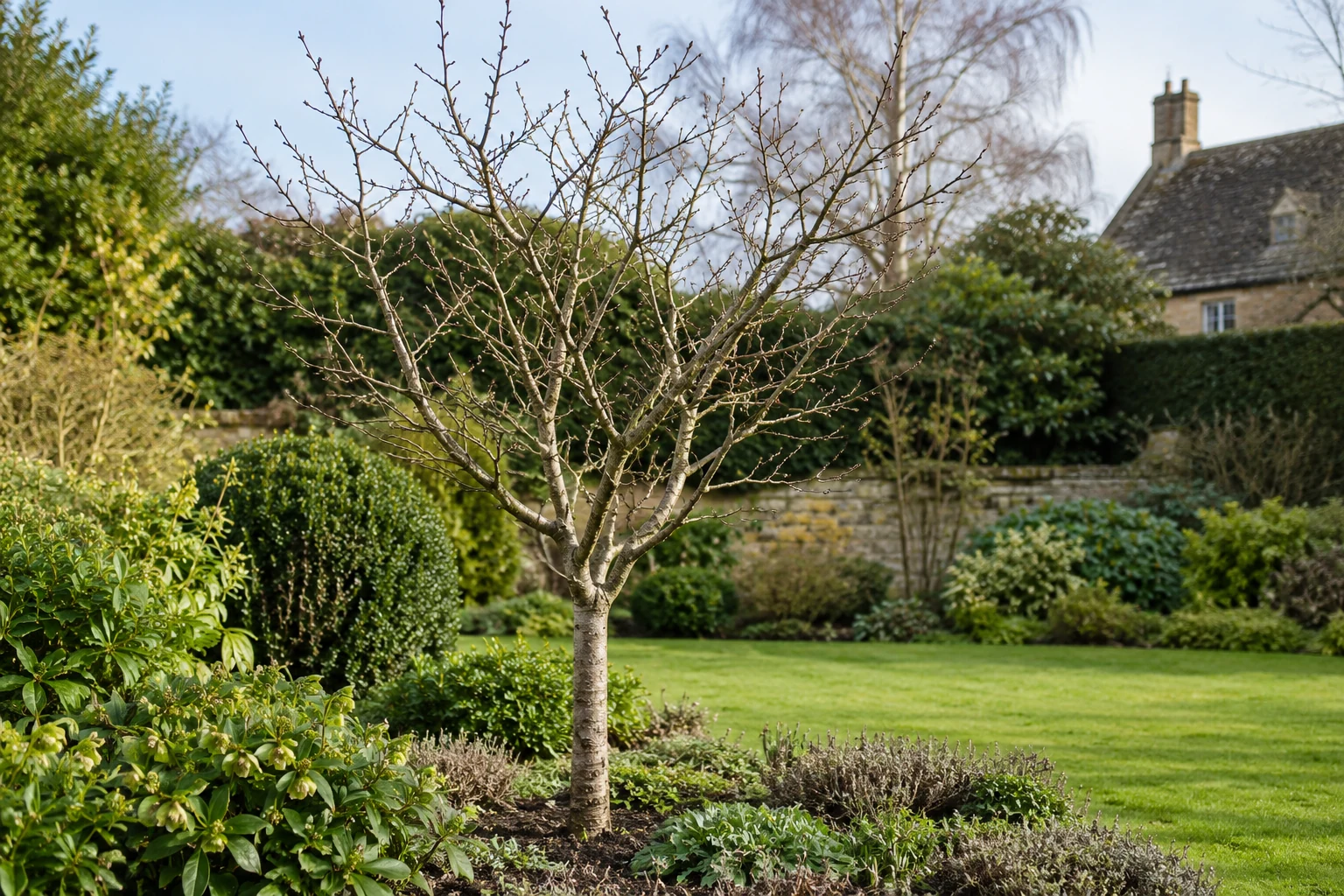
Record the date, which parts remain bare and whether you know the species. Say if the tree leafed normally last year or has been newly planted. Keep clear if there are hanging branches, movement or another immediate concern; our assessment-signs guide explains why a foliage question should not distract from a separate safety issue.
A record is more useful than a guess
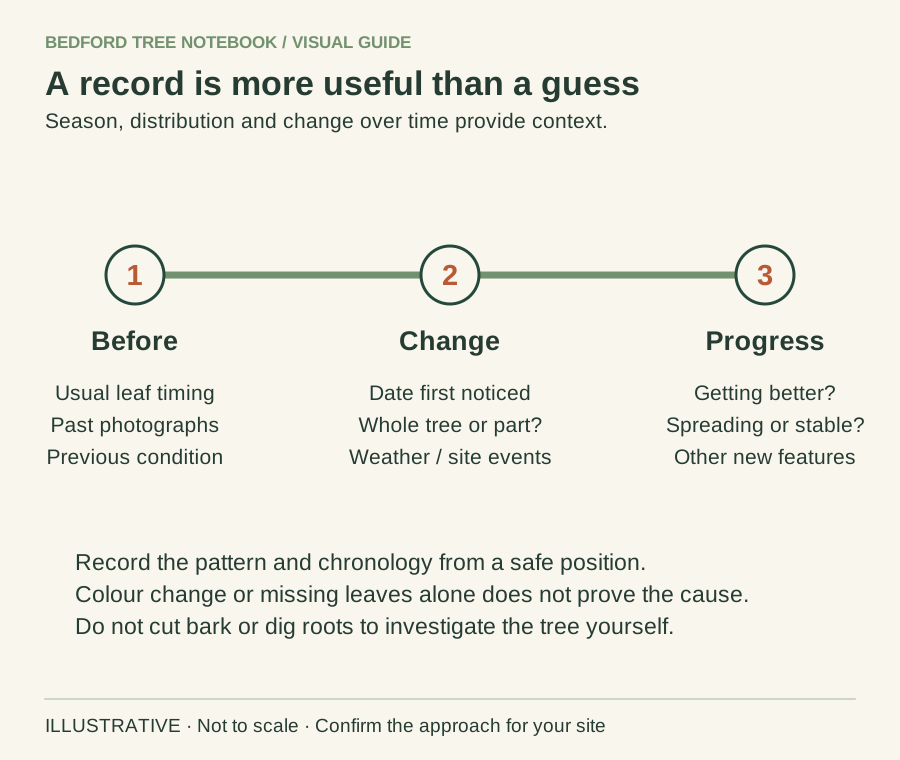
- Record dates, location on the tree and relevant site or weather changes.
- Photograph only from safe, accessible ground without approaching hazards.
- Seek appropriate assessment if changes persist, worsen or accompany structural concerns.
Background sources: RHS guidance · RHS guidance · RHS guidance
Begin with identification and timing
Different trees do not all follow the same visible timetable. Ask whether the specimen has been reliably identified and whether the comparison is with the same kind of tree. A neighbour’s earlier leaf growth is useful context, but it is not a diagnosis of your tree.
The RHS guide to trees and shrubs that have died describes possible causes and signs for gardeners. Use that background to frame a question rather than to declare the condition of a mature tree from a distance. A professional may need to assess more than the presence or absence of leaves before recommending management.
Describe the extent of the observation
Is the whole tree bare, one side affected or a particular branch different from the rest? Can you see buds from a normal, safe viewpoint, or is the crown too distant to observe clearly? Give the assessor those distinctions and say when a detail is uncertain.
A photograph of the whole crown and setting can be more useful than a cropped twig image with no location. Do not climb or break branches to collect evidence. Our leaf-colour guide helps describe a broader pattern where some foliage is present. An accurate account of what remains unknown prevents an attractive close-up from implying that the entire crown has been inspected.
Bring the recent history
Mention planting, drought, prolonged saturation, construction, soil changes and earlier pruning if they are part of the known history. Keep dates approximate where necessary, and separate your observations from what a previous owner has reported. A change noticed after another event does not establish that the event caused it.
Read tree concerns after building work if recent construction is relevant. Supply any available report or planting record instead of reducing it to a remembered reassurance. If the tree has struggled over several seasons, a short sequence of dated observations is more informative than treating this year’s bare appearance as an isolated surprise.
Distinguish a new planting from an established tree
For a newly planted specimen, provide the planting date, stock details and aftercare record. Ask the supplier what growth was expected and what information they need to investigate the concern. A young tree still establishing in its new position raises a different practical enquiry from a mature tree that has changed suddenly.
Our first-summer tree-care guide explains the care handover. Do not automatically add water, fertiliser or a severe pruning treatment because growth is disappointing. Moisture conditions and other factors need checking. If several recent plantings have different outcomes, identify them individually rather than sending one message saying that all the trees are failing.
Avoid invasive home tests
Scraping, cutting or snapping material can damage a tree and may not answer the management question you actually need resolved. Do not remove bark from a mature stem or reach into a cavity to establish whether the tree is alive. Ask the professional what can safely be recorded before a visit.
A tree can require assessment for several reasons beyond its seasonal appearance. Our cracks-and-cavities guide helps keep those observations separate. If the assessor suggests a particular investigation, ask what it will establish and how the result will affect the recommendation. A simple internet test should not become the sole basis for removal, structural reassurance or a claimed permission exception.
Choose the right assessment commission
Explain whether you need horticultural advice, a tree-condition assessment, an independent report or a work proposal. Tell the business if an insurer, property surveyor or planning enquiry has prompted the request, because a casual quotation visit may not meet that purpose.
Use tree surgeon or consultant to compare the roles. Ask what the visit includes, whether the findings will be recorded and what limitations apply if parts of the tree cannot be accessed. If you only ask for a removal price, the resulting proposal may not explain whether retention, further observation or another investigation was considered. Set the question before agreeing the service.
Keep safety and urgency specific
A lack of leaves alone does not let a homeowner set a safe access distance or decide whether a tree will fail. Explain any additional changes, including a new lean, hanging material or movement around the base. If there is an immediate danger, use the appropriate urgent route rather than waiting for a routine website enquiry.
Read a hanging broken branch if that feature is present. Do not enter underneath to confirm whether a branch is dead. The professional’s response should reflect the actual concern and setting; avoid asking for blanket reassurance from a single crown photograph when the underlying issue involves people, buildings or a public route.
Check the position before agreeing removal
If the eventual recommendation is removal or other work, establish ownership and applicable tree controls for the property. Use Bedford TPO checks to find the relevant starting records. A conclusion about health does not mean that every proposed operation can proceed without its own checks.
Where dead-tree procedures or another exception may be relevant, ask the professional and authority about the actual evidence and notification requirements. Do not assume a bare crown proves the legal position. Keep the assessment and any dated evidence with the work proposal so that later decisions are tied to the correct tree and facts, rather than a general note that it looked dead.
Make follow-up observations purposeful
If advice is to revisit the tree later, ask what should be observed, when contact should resume and which changes should prompt earlier advice. Record the limitation if the initial assessment cannot settle the question. A specific follow-up plan is more useful than an indefinite instruction to wait and see.
If replacement planting is discussed, first understand the site and likely reason for failure. Our replacement planting guide helps keep the next tree’s needs in view. Avoid using the same unresolved site and aftercare arrangement automatically. Keep the original concern, findings and next action together so a seasonal question results in an informed plan rather than repeated guesswork.
Your next step
Prepare a dated description of the whole tree, known species and planting history, then ask for advice suited to the question. Do not damage material to perform a home diagnosis. If work follows, agree the findings, controls and scope before booking; our quotation checklist helps document that final step.
Turn the advice into a useful project brief.
Start with the postcode, the work you have in mind and any access considerations.
Prepare your enquiryNo obligation. A site assessment may be needed to confirm the work and price.
Sources & further reading
Sources checked 31 October 2026. How we prepare guidance.