
In this guide Show sections
General guidance, not a professional assessment. Confirm site-specific advice and current requirements before work.
Planning tree work in Bedford or nearby?
Start with the postcode, the work you have in mind and any access considerations.
Prepare your enquiryNo obligation. A site assessment may be needed to confirm the work and price.
Before you make arrangements
Record what you value about the tree and what has prompted the enquiry. Is there a new feature, a clearance problem or a proposed change to the garden? Our Bedford tree-work checklist helps assemble that information without turning an observation into an assumed diagnosis.
Begin with the individual oak
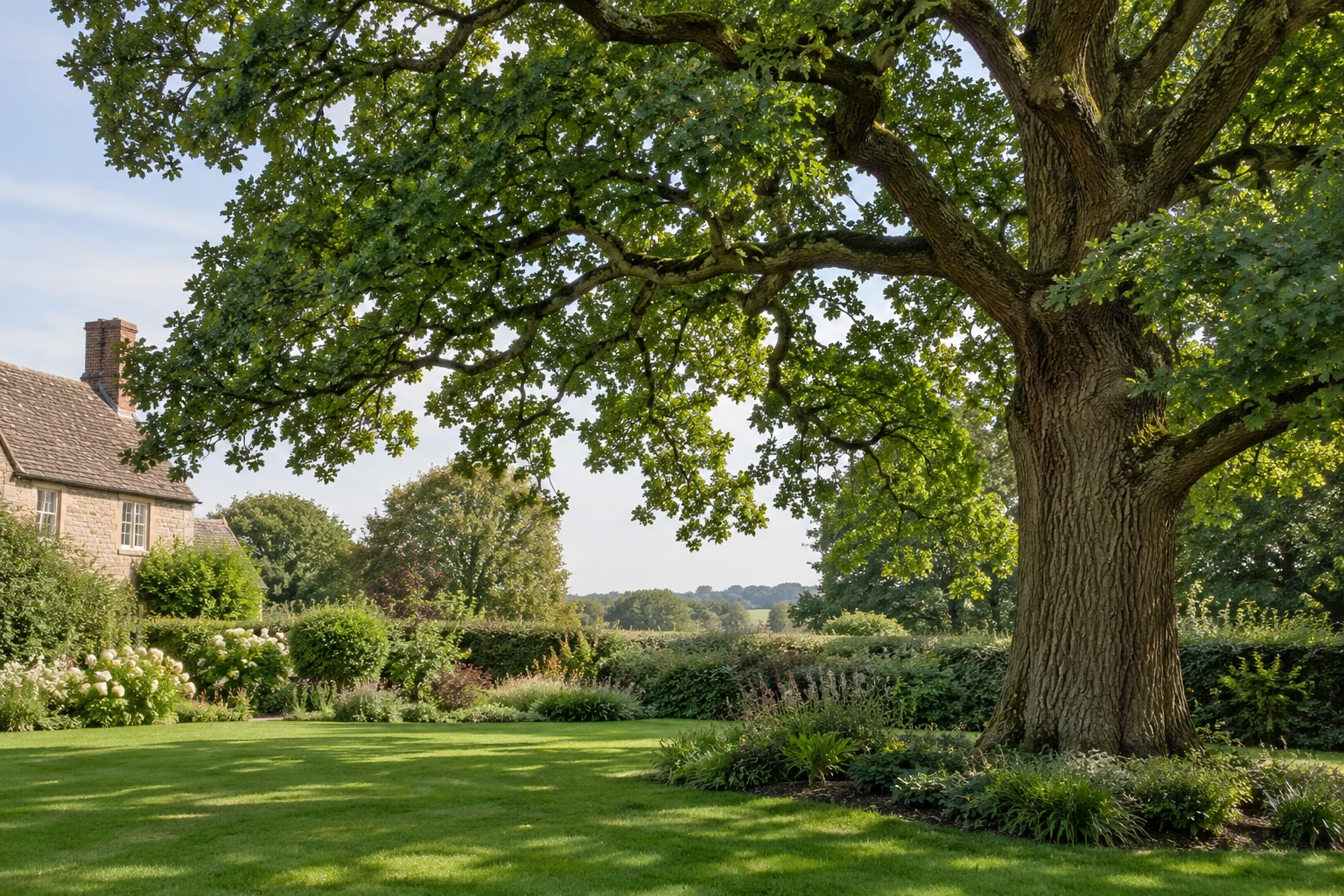
Ask for the species to be identified where that affects advice, and explain any known planting or management history. An evergreen oak and a deciduous oak do not have identical appearances or seasonal patterns. A broad crown, old bark and an irregular branch arrangement should be considered in the context of the actual specimen rather than compared with an idealised garden shape.
The RHS oak guide describes the diversity of the group. Keep your own notes factual: the location, visible changes, known previous work and what lies around the tree. If identification is uncertain, say so; an inaccurate name can misdirect later conversations and records.
Define the reason for any proposed pruning
Explain the problem before choosing a crown operation. A branch contacting a structure, access beneath the crown and general dissatisfaction with shade are different questions. Ask what work, if any, would meet your objective while taking the tree's age, condition and form into account.
Our crown reduction versus thinning guide helps separate dimensions from internal density. Do not assume an oak needs heavy pruning because it is large, or that a generic percentage is a complete specification. The proposal should identify the tree and intended result. A competent recommendation may be limited work, further assessment or retention without the cutting you initially expected.
Protect the conditions around the tree
Look beyond the trunk when planning changes. Parking, soil storage, paving, excavation or altered ground levels can affect the rooting environment. A new driveway or garden structure should be assessed as a project, not treated as harmless because the canopy will remain untouched.
Read driveways near trees before specifying groundworks. Do not use the canopy outline as a map of every root, and do not cut exposed roots to simplify a landscaping job. Tell the adviser about changes that have already happened as well as proposals. A record of activities around the tree can be important if its condition later changes.
Consider habitat and age together
An older tree may provide habitat in bark, cavities, deadwood and surrounding vegetation. Those features require thoughtful assessment rather than automatic removal in pursuit of a uniformly tidy appearance. At the same time, a feature near an occupied area may justify a specific safety or management question.
Our possible bat features guide and active-nest guide explain why wildlife needs consideration before work. Do not investigate cavities or remove material to see what is inside. Ask the professional how habitat value, tree condition and site use will be considered together, including whether specialist ecological advice is needed for the actual proposal.
Record changes without diagnosing oak disease
If you notice a change in foliage, bark or branch condition, record when it appeared and whether it seems to be spreading. A photograph taken from safe ground can help describe location, but does not identify a disease or establish the strength of the tree. Avoid treating an online image match as a diagnosis.
Use changes in leaf colour to prepare a useful observation record. Ask whether the professional needs further inspection or specialist disease advice. If reporting through an official tree-health route is recommended, provide the details requested rather than removing bark, collecting material or carrying out experiments that may damage the tree or disturb habitat.
Keep buildings and drainage concerns evidence-led
The presence of an oak near a house is not, by itself, proof that it is causing damage. If cracks, drainage defects or movement are the concern, start with the relevant building professional and insurer rather than ordering removal as a precaution. Tree advice should be coordinated with the actual findings.
Our subsidence-concerns guide explains that sequence. Do not assume every Bedford property has the same ground conditions or that species alone settles causation. Equally, do not dismiss a properly raised concern because the oak has stood there for many years. Keep building evidence, tree observations and proposed practical work distinct until the advisers have considered how they relate.
Check protection for the actual property
A mature oak may be subject to tree protection or other controls, but its size or species does not tell you its legal status. Use the responsible council's records and ask for clarification where the location or order is unclear. A Bedford postal address alone does not establish the local planning authority.
Our Bedford protection-map guide helps explain mapped features and underlying documents. Do not treat a proposed garden improvement as permission to damage roots or remove branches. If work is recommended, keep the assessed specification aligned with the relevant application, decision or other authorised route before the contractor is instructed.
Agree a review plan rather than a fixed cutting cycle
Ask what further observation or professional review is appropriate for this tree and its surroundings. The answer may depend on site use, previous findings and future changes. A standard annual cutting visit is not automatically a suitable care plan, and an inspection is not a permanent guarantee of safety.
The long-term Bedford tree-care guide helps organise actions and records. Identify which recommendations are immediate, which are conditional and which concern later review. Ask what changes should prompt contact sooner. That makes the plan responsive to the actual tree rather than simply repeating the same operation because it was done during a previous visit.
Keep practical work understandable
If work is justified, obtain a written specification, site-specific quotation and clear explanation of waste handling, access and exclusions. Describe fragile structures, gates and public routes before the visit. Ask who is responsible for any permission or ecological input that remains outstanding.
Use the quotation checklist to compare the finished outcome rather than headline totals. At handover, ask the contractor to explain the result against the specification and record any remaining recommendations. The goal is proportionate care for a retained tree and the people using the garden, not a promise that one visit has eliminated every possible future concern.
Your next step
Prepare a brief about the oak, its setting and your actual objective. Seek appropriate arboricultural advice, check relevant controls and coordinate any building or development questions with the right specialists. Keep records of findings and completed work, and review the plan when the tree or site changes. Retention with limited intervention may be a considered management decision.
Turn the advice into a useful project brief.
Start with the postcode, the work you have in mind and any access considerations.
Prepare your enquiryNo obligation. A site assessment may be needed to confirm the work and price.
Sources & further reading
- RHS: oak
- Bedford Borough Council: protected trees
- GOV.UK: Tree Preservation Orders and conservation areas
- RHS: trees near buildings
- National Tree Safety Group: common sense risk management, 2024 summary
- RHS: tree pruning guide
- Forest Research: acute oak decline
- Forestry Commission: managing oak processionary moth in England
Sources checked 31 October 2026. How we prepare guidance.