
In this guide Show sections
General guidance, not a professional assessment. Confirm site-specific advice and current requirements before work.
Planning tree work in Bedford or nearby?
Start with the postcode, the work you have in mind and any access considerations.
Prepare your enquiryNo obligation. A site assessment may be needed to confirm the work and price.
Before you make arrangements
Find the tenancy agreement, site rules and contact for the organisation managing the allotment. Identify the tree’s location and whether it is within a plot, on a shared boundary or outside the site. Our shared-boundary guide helps distinguish where branches extend from where a tree is rooted and who may have authority to instruct work.
Permission starts with the actual site
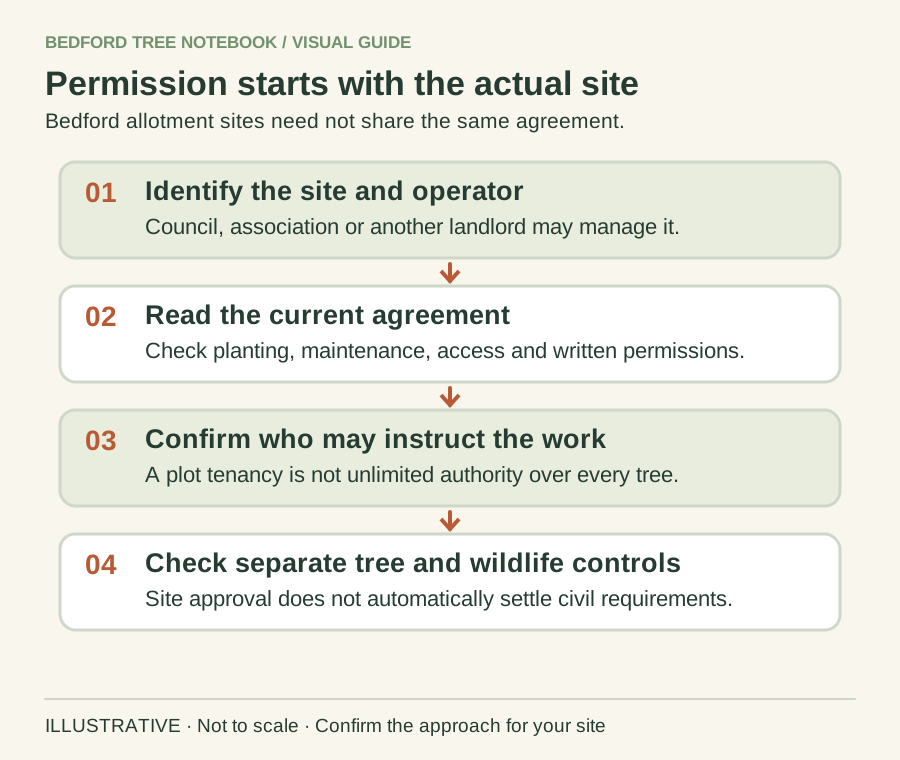
- Find the current tenancy and the person or body authorised to decide the proposal.
- A rule requiring permission to plant does not automatically describe permission to prune or remove.
- Keep written site authority distinct from tree protection, wildlife and safe contractor arrangements.
Background sources: Bedford Borough Council guidance · GOV.UK guidance
Identify the actual site operator
Begin with the organisation responsible for your particular allotment, not a rule remembered from another site. The Bedford Borough allotment information is a starting point for council sites and other local arrangements. Check who currently manages the site and where tree enquiries should go.
A parish body, association or another operator may have its own agreement and procedure. Ask for the current version if your paperwork is old or incomplete. Keep the distinction between the landowner and day-to-day site manager visible: one may receive enquiries while another retains authority for particular decisions. A neighbouring plot holder’s account can be helpful context without being the approval you need.
Read planting and work clauses separately
Look for clauses about planting trees, pruning, removal, plot clearance and responsibilities at the end of the tenancy. A rule about introducing a new tree should not automatically be interpreted as the full removal procedure for an established specimen. Ask the manager to clarify which clause and authority apply to your proposal.
If the documents require written permission, obtain it through the actual site process rather than relying on a casual conversation. Describe the plant and proposed outcome clearly enough for a useful answer. Avoid treating silence, an available contractor or the fact that another plot has a similar tree as permission to proceed. Record any conditions attached to the decision.
Locate and identify the tree
Give the plot number, relevant site features and a labelled photograph or simple sketch. Explain whether the specimen is a fruit tree, another deliberately planted tree or growth whose origin is unknown. Do not remove material to settle an uncertain boundary or identification question.
Use self-seeded boundary trees if seedlings or connected growth are involved. The site manager may need to distinguish an individual plot tree from shared boundary planting before deciding who should commission advice. If the plant is retained, reliable identification helps frame future care. If removal is requested, its exact location prevents an approval for one stem becoming a broader boundary clearance.
Set the horticultural objective
For a fruit tree, explain whether the aim is condition advice, manageable harvesting, restoration or replacement. Species and management history can affect appropriate timing and operations. A neglected crown is not automatically a reason for a severe one-off cut.
Our apple-tree brief and plum and cherry timing guide help prepare species-specific questions. Ask whether the site expects a particular adviser or approval before a contractor is booked. A general job description such as trimming the allotment tree may conceal an uncertain outcome. The proposal should say which specimen and what problem the recommended work is intended to address.
Check civil controls as well as tenancy rules
Site permission and tree-protection requirements are separate matters. Establish the responsible planning authority and check the position for the actual tree and operation where relevant. Use Bedford TPO checks and the official GOV.UK tree guidance as starting resources.
Do not assume that all fruit trees, plot trees or self-seeded specimens are subject to the same exemption. If an exception is suggested, ask the authority how it applies to the circumstances. A site manager’s agreement does not itself settle a TPO question, and a council tree decision does not replace permission required under the tenancy. Keep the two records together without treating them as interchangeable.
Include wildlife and shared habitat
Allotment hedges, rough edges, ponds and old trees can have habitat value. Explain any proposed ground disturbance or clearance, not just the named tree operation. Do not move log piles or clear dense boundary growth in preparation before the relevant considerations are understood.
Read active nests and tree work and ponds and habitat planning where relevant. A quiet site or an autumn date does not automatically settle wildlife requirements. Ask the professional and manager what checks are needed for the actual proposal. If another plot holder reports a wildlife concern, pass on the observation accurately rather than dismissing it or attempting to investigate protected features yourself.
Arrange access with the manager
Tell the business about gates, shared paths, parking restrictions, working hours and neighbouring plots. Confirm who can admit the team and whether the manager needs to coordinate other users. A normal pedestrian plot route may not be suitable for equipment or removing material.
Our narrow-access guide helps organise route information. Do not promise use of another plot or common area without authority. If the work affects a public route, investigate that process separately. The manager and contractor should agree practical arrangements before arrival so plot holders are not left improvising access, moving equipment or directing people around an unplanned working area.
Agree timber, debris and reinstatement
State whether branches, logs, chippings and any stump treatment are included and where retained material may go. A shared compost area or bonfire location should not be assumed available for every kind of tree waste. Use the current site rules and the contractor’s lawful arrangements for the actual materials.
Our waste-removal scope helps distinguish the streams. If the plot will be replanted or handed back, agree the required finish separately from the cutting operation. A quote to remove a crown may leave a stem or stump, while a stump operation may still leave preparation for later cultivation. Clarify responsibility before the project is priced as one simple clearance.
Keep a record for the next plot holder
Retain the manager’s decision, relevant controls, final scope and completion information. If a tree remains with recommended care or a review action, make sure the appropriate person has that information. Do not leave the record only with a contractor who may never return to the site.
Use the completion checklist to discuss what was done and what remains. Where replacement planting is agreed, record the permitted location and any conditions alongside its aftercare. A clear handover helps the manager and future plot holder understand the arrangement, rather than inheriting an unexplained tree, stump or old assurance that all permissions were sorted out.
Your next step
Start with the current agreement and the manager of the specific site, then identify the tree and proposed outcome. Keep tenancy permission, civil tree controls and wildlife considerations separate. Agree access and waste arrangements before booking, using the quotation checklist to make the final operation and responsibilities clear.
Turn the advice into a useful project brief.
Start with the postcode, the work you have in mind and any access considerations.
Prepare your enquiryNo obligation. A site assessment may be needed to confirm the work and price.
Sources & further reading
- Bedford Borough Council: allotment information
- GOV.UK: tree-protection guidance
- Natural England: wild birds, protection and licences
Sources checked 31 October 2026. How we prepare guidance.