
In this guide Show sections
General guidance, not a professional assessment. Confirm site-specific advice and current requirements before work.
Planning tree work in Bedford or nearby?
Start with the postcode, the work you have in mind and any access considerations.
Prepare your enquiryNo obligation. A site assessment may be needed to confirm the work and price.
Before you make arrangements
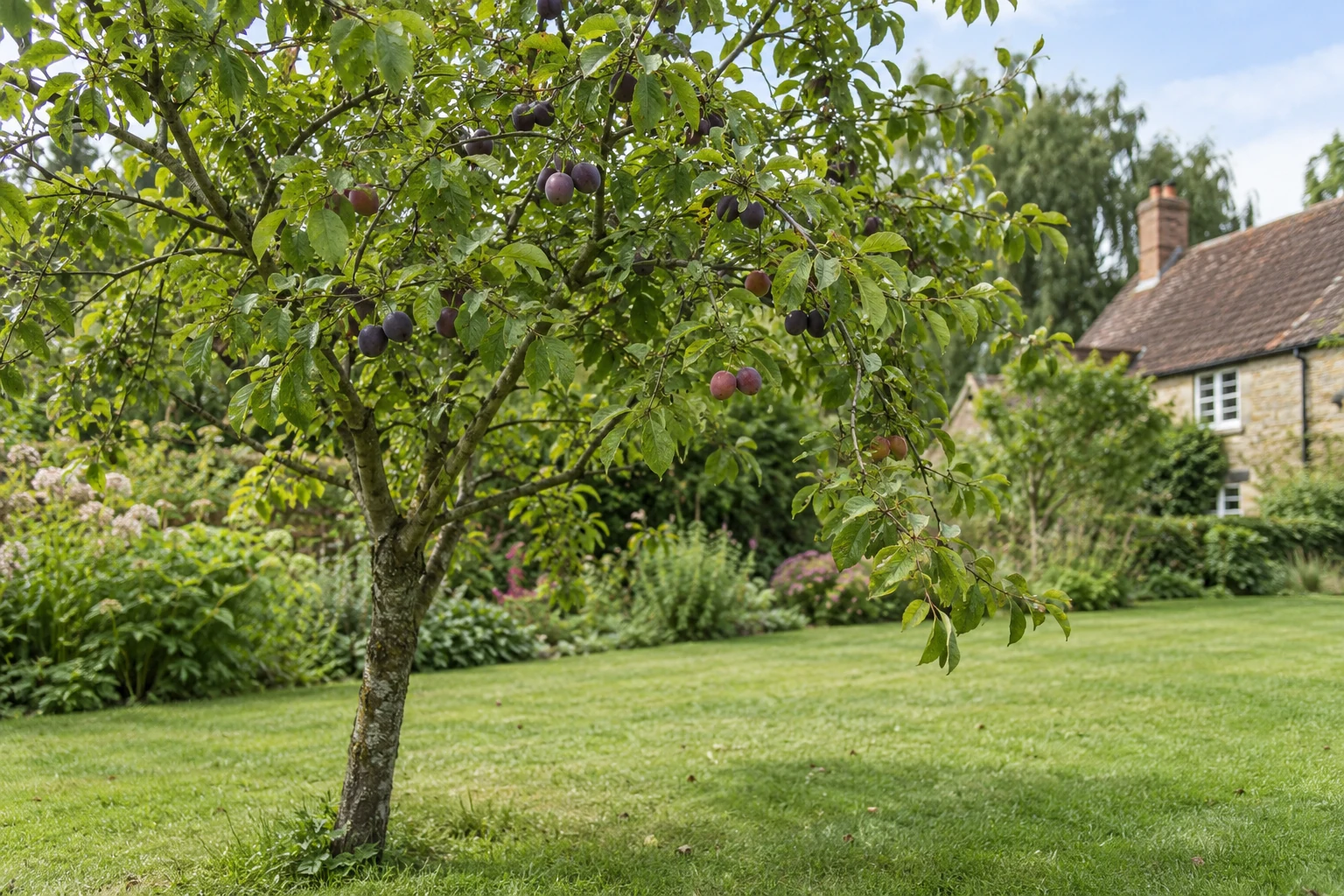
Gather the planting label or earlier records where available, and explain whether the tree is young, established, fruiting, ornamental or trained. Photograph it only from safe ground. Our fruit-tree specialist guide helps define the advice you need before arranging practical work.
Identify the tree before the season
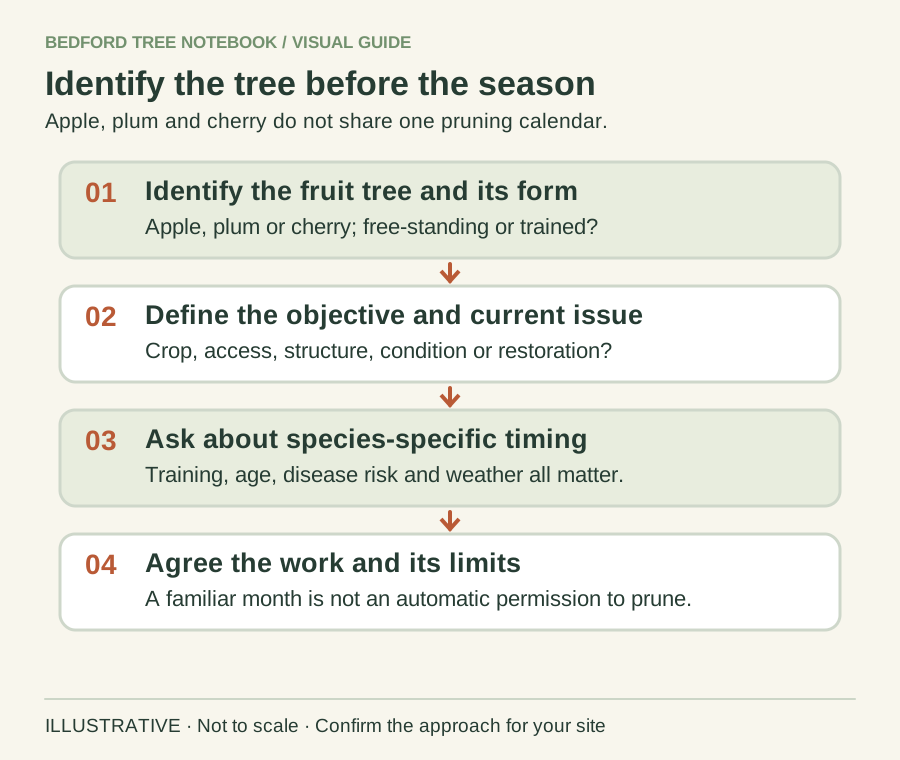
- Apple training form can change the appropriate pruning approach.
- Young and established plums can need different timing; cherry type also matters.
- Check disease considerations, wildlife and any applicable tree controls separately.
Background sources: RHS guidance · RHS guidance · RHS guidance · RHS guidance
Confirm what the tree actually is
Plum and cherry are common descriptions covering different garden situations. An ornamental cherry, a fruiting cherry and an established plum should not automatically receive the same operation. If the variety or exact identity is unknown, provide any reliable records and ask the specialist to confirm the details that affect advice.
Explain the form too: freestanding, trained or previously altered. A tree close to a wall is not necessarily a correctly managed fan. Our apple-tree brief illustrates the value of describing form and history, but its timing discussion should not be transferred uncritically to stone fruit. Identification is part of making the instruction useful.
Understand the disease reason for different timing
Silver leaf and bacterial canker are among the considerations that influence advice for plums and cherries. A suitable recommendation should account for the actual species and work rather than treating all dormant-season cutting as equivalent. The RHS plum-pruning guide explains why young and established trees can have different timing needs.
Use that distinction to ask informed questions, not to diagnose a disease or book an operation from a headline alone. Ask what would lead the professional to change the timing. The right decision may depend on the tree's present state and purpose, not simply whether a nominal summer appointment is available.
Keep young-tree development separate from established-tree work
Formative work on a young tree and pruning of an established specimen serve different purposes. Age, existing structure and previous management can alter both timing and extent. Ask which stage the adviser considers your tree to be in and how that affects the recommendation.
Our young-versus-mature pruning guide provides a broader explanation. Do not assume an established tree can be made into a compact young shape through one severe operation. Equally, do not assume that guidance about a mature fruiting tree supplies the complete plan for recently planted stock. Keep the actual tree and desired outcome at the centre of the discussion.
RHS advises early-spring pruning for young plums and mid-summer pruning for established trees, while avoiding routine winter pruning because of silver-leaf risk. Fruiting cherries are commonly managed after harvest in summer, with the cherry type and proposed operation still needing attention. These distinctions provide useful starting knowledge without creating a single compulsory date for every plum, ornamental cherry or damaged tree.
Explain the objective before selecting a date
You may be asking about fruit production, clearance, an awkward branch, an inherited shape or a newly noticed problem. Rank those aims and distinguish elective improvement from an issue that requires assessment first. A different objective can mean a different professional service, not just a different appointment slot.
Read branches touching a roof where clearance is the concern. Avoid requesting drastic size reduction because the tree feels inconvenient at harvest. Ask what outcome is feasible and how it relates to the tree's health and future form. The calendar cannot make an unsuitable extent of work appropriate for a particular specimen.
Do not diagnose silver leaf from colour alone
A silvery appearance, changed foliage or dieback should be reported, but photographs and common names do not settle the cause. Ask whether the condition needs closer assessment or specialist input before pruning is specified. Record when the change appeared and which part of the tree is affected.
Our leaf-colour guide helps organise that history. Do not make trial cuts, remove bark or collect material unless an appropriate professional has explained a justified process you can safely follow. A disease-related concern should not disappear into an ordinary tidy-up instruction, and a healthy-looking part of the crown does not establish the condition of every branch.
Discuss previous severe work and regrowth
If the tree has been repeatedly shortened or neglected for a long period, provide the history honestly. Ask whether the present structure supports your intended objective and whether a staged approach is recommended. Staging is not a guarantee that an unsuitable tree can be reshaped safely into any desired form.
The pollarding-versus-topping guide helps explain why management labels should not be swapped casually. A plum or cherry with strong regrowth after an old cut has not thereby become suitable for an established pollarding system. Ask the specialist to describe the actual proposal and future implications rather than relying on familiar terms from another tree in the garden.
Plan access and the space below the tree
Tell the provider about greenhouses, sheds, fences, overhead lines, public routes and the path into the garden. A fruit tree can be modest in height while still presenting awkward working conditions. Do not offer an improvised ladder or undertake preliminary branch removal to make the visit easier.
Use measuring the whole access route to describe gates, turns and restrictions. Ask which safe preparation is appropriate and what should be left for the team. A quotation should identify waste arrangements and exclusions as well as the pruning objective, especially if several fruit trees with different recommendations are included in one visit.
Check wildlife and protection independently
Suitable horticultural timing does not prove that the proposed work can proceed without further checks. Birds may be using the tree, and other wildlife or tree controls can be relevant to the particular site. Ask what assessment and permission advice are needed rather than treating a summer date as automatic clearance.
Our active-nest guide and Bedford protection checks cover different parts of that process. Confirm the responsible council for the actual property if uncertain. Keep the work specification consistent with any relevant decision or advice, and recheck the position if the proposed operation changes after a closer inspection.
Keep recommendations for different trees distinct
If a contractor is visiting for several trees, label each specimen and record the separate recommendation. A single invoice line for “fruit trees pruned” can hide important differences in timing, objective and completed work. Ask which operations are included now and which are deferred for a stated reason.
The quotation checklist helps clarify scope. Retain the completion record with any further recommendations so the next visit does not default to the same treatment for every tree. A useful plan is specific enough to explain why the plum, cherry and apple may be handled differently, without expecting the homeowner to design the cuts themselves.
Your next step
Identify the tree and describe its age, form, history and purpose of work. Ask a suitable specialist to explain the recommended timing and extent, including any condition concerns that need assessment first. Keep plum, cherry and apple advice distinct, and check wildlife and controls separately. A species-aware plan is more useful than a blanket appointment for all fruit trees.
Turn the advice into a useful project brief.
Start with the postcode, the work you have in mind and any access considerations.
Prepare your enquiryNo obligation. A site assessment may be needed to confirm the work and price.
Sources & further reading
- RHS: plums, pruning
- RHS: cherries, growing guide
- RHS: silver leaf
- Natural England: wild birds, protection and licences
- Bedford Borough Council: protected trees
- RHS: tree pruning guide
Sources checked 31 October 2026. How we prepare guidance.