
In this guide Show sections
General guidance, not a professional assessment. Confirm site-specific advice and current requirements before work.
Planning tree work in Bedford or nearby?
Start with the postcode, the work you have in mind and any access considerations.
Prepare your enquiryNo obligation. A site assessment may be needed to confirm the work and price.
Before you make arrangements
Start with the person or body responsible for the churchyard and its records. Confirm whether the site is active, closed or subject to another management arrangement, and who may authorise advice and expenditure. Do not assume that the person tending graves has authority to instruct tree operations. Our tree consultant guide helps distinguish an assessment from a work quotation.
Church and civil controls are separate
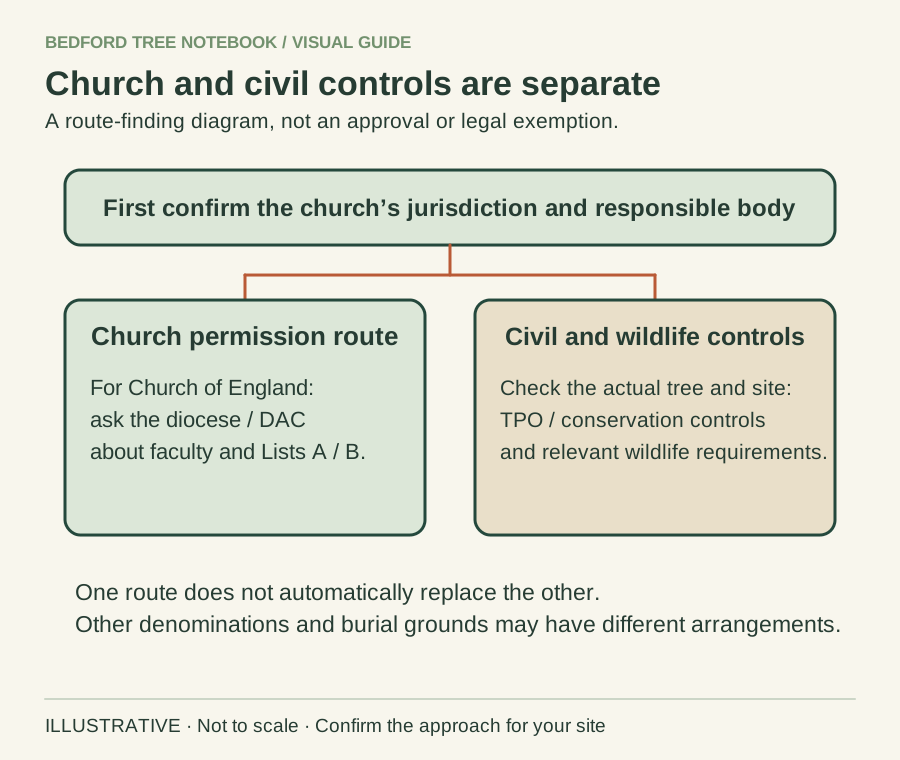
- Identify the church, responsible body and applicable jurisdiction before commissioning work.
- For Church of England property, seek current diocesan or DAC advice about the permission route.
- Check civil tree controls and wildlife requirements separately; one approval does not settle every requirement.
Background sources: www.churchofengland.org · www.churchofengland.org · GOV.UK guidance
Establish the site’s own governance
Identify the churchyard’s denomination, status and decision-making route. If ownership or maintenance has transferred or is shared, obtain the relevant documents and advice. A closed churchyard can involve different arrangements from an active burial ground, so avoid applying a general description without checking the actual site.
For Church of England sites, the ChurchCare tree guidance is a useful starting point. It must not be presented as the rulebook for every denomination or cemetery. Ask the relevant governing body how the proposed assessment and work should be handled, who holds authority and which supporting records are needed before a contractor is appointed.
Check ecclesiastical and civil controls separately
For a Church of England churchyard, consult the diocesan advice on the applicable permissions route, including faculty or other authorisation where relevant. The required route depends on the work and circumstances. Use the Church of England permissions guidance and the current process advised by the diocese rather than an old portal instruction.
Civil tree, planning and wildlife controls remain a separate consideration. Our Bedford TPO guide helps locate the starting records. A church approval should not be described as blanket civil permission, and a council tree decision should not be assumed to settle every internal churchyard authorisation.
Connect trees with an understandable site record
Give trees consistent identifiers linked to paths, buildings and other stable features. A plan should make clear which specimen each assessment or work item concerns. Treat memorial and burial information appropriately; a contractor’s brief does not need unrestricted personal details about people associated with the site.
Read tree-location plans for the basic relationship between labels and written work. Keep dated reports, decisions and completed operations connected to those identifiers. If the site contains veteran or unusual trees, mention that when commissioning advice so the service reflects the tree and setting rather than treating all specimens as routine maintenance items.
Describe how people use the churchyard
Explain paths to the church, parking, regular gathering areas, graveside visits, public routes and occasional events. A place that is quiet during a weekday assessment may be heavily used at another time. The adviser needs the real pattern of use and any known changes planned for the grounds.
The National Tree Safety Group guidance supports proportionate management in the actual setting. Do not turn that into an identical annual survey or pruning rule for every churchyard tree. Ask the competent adviser to explain the appropriate observations, assessment and review arrangements, including how new concerns should be reported when the usual site contact is unavailable.
Consider history, habitat and retention
Tell the adviser about earlier reports, management history, known features and any habitat advice. A hollow, old pruning point or ivy-covered stem should prompt an appropriate question rather than an automatic instruction to strip or remove the tree. The value of retention and the implications of work need to be considered with the actual condition.
Our cavities guide and ivy guide help frame those observations. Raise potential bat features and active nesting concerns before the work programme is fixed. Do not ask volunteers to clear cavities, remove habitat material or cut back cover to make a tree easier to photograph before the relevant advice has been obtained.
Protect memorials and the ground
Describe fragile memorials, walls, paths, buried infrastructure and access limitations in the first brief. Do not assume that an open grass area is available for heavy access, material storage or stump excavation. The site’s burial and heritage context may require specialist input or authorisation beyond an ordinary tree-work visit.
Our stump-work limitations helps identify why an apparently simple stump request needs a separate scope. Agree who will advise on ground disturbance and relevant restrictions. Tree contractors should receive the constraints without being asked to determine matters outside their commission, and volunteers should not begin preparation that could disturb graves, memorials or other sensitive features.
Plan work around visitors and services
Coordinate the proposed programme with worship, funerals, maintenance, events and normal access. Ask how the business will manage its working area and communicate with the person controlling the site. A quiet date is helpful information, but it does not replace the contractor’s planning and public-safety arrangements.
The HSE public-safety guidance provides relevant background. Clarify who informs users of any agreed access changes and who handles a conflicting booking. Do not leave volunteers to direct visitors through an improvised route beside machinery. If a public right of way is affected, investigate that route’s requirements separately rather than assuming a churchyard notice authorises a closure.
Turn advice into an approved work scope
The final instruction should identify trees, operations, relevant approvals, access constraints, material handling and responsibilities for any reinstatement. If a consultant has advised and another business will deliver the work, make sure the team receives the current approved specification rather than an earlier quotation summary.
Use the quotation checklist and permission-change guide to keep the handover clear. If inspection leads to a different operation, check how the revised proposal affects ecclesiastical, civil and wildlife matters. Do not treat an attendance date or an available team as a reason to bypass clarification. A well-kept decision trail protects the purpose of the work as well as the site record.
Keep the management record usable
After completion, retain findings, authorisations, the final scope and outstanding actions in the site’s normal record system. Record any review recommendation and who will arrange it. Hand that information to the next churchwarden, grounds lead or responsible body instead of relying on someone’s memory of a contractor visit.
Our long-term tree-care plan helps organise this sequence. Where trees are replaced or new facilities proposed, revisit the constraints early so mature size, access and sensitive ground are considered together. The goal is continuing informed care of a shared place, not a single clearance job that leaves future decision-makers without the reasoning or documents.
Your next step
Begin with the responsible churchyard body and the site’s specific permissions route, then commission competent tree advice. Keep ecclesiastical authorisation, civil controls, wildlife and sensitive-ground matters distinct. Translate the agreed outcome into a clear work scope and retain the records, using the completion checklist for the practical handover.
Turn the advice into a useful project brief.
Start with the postcode, the work you have in mind and any access considerations.
Prepare your enquiryNo obligation. A site assessment may be needed to confirm the work and price.
Sources & further reading
- Church of England: churchyard tree guidance
- Church of England: talk to your DAC about permissions
- National Tree Safety Group: 2024 summary
- Bedford Borough Council: protected trees
Sources checked 31 October 2026. How we prepare guidance.