
In this guide Show sections
General guidance, not a professional assessment. Confirm site-specific advice and current requirements before work.
Planning tree work in Bedford or nearby?
Start with the postcode, the work you have in mind and any access considerations.
Prepare your enquiryNo obligation. A site assessment may be needed to confirm the work and price.
Before you make arrangements
Identify the responsible premises lead, the person authorised to commission advice and the body controlling the land. Check landlord or group arrangements where relevant. Gather current tree reports and unresolved actions. Our tree consultant or contractor guide helps distinguish an assessment, a management recommendation and a quotation for already specified work.
Connect responsibility with site use
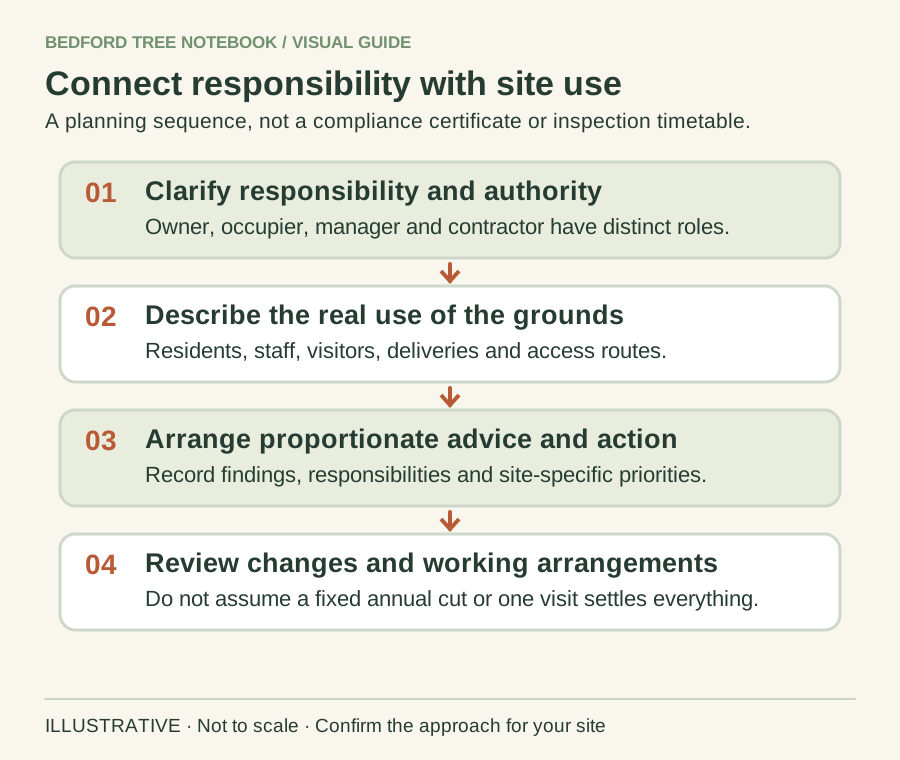
- Clarify who can commission advice, approve work and act on findings.
- Describe how people actually use the grounds, including access requirements and occasional activities.
- Keep appropriate records and review arrangements proportionate to the site; a contractor does not remove every duty of the operator.
Background sources: National Tree Safety Group guidance · HSE guidance · www.cqc.org.uk
Place trees within the premises system
The home needs a clear route from an observation to a decision and, where appropriate, action. Decide who receives a concern, commissions competent advice and checks that recommendations have been considered. A facilities inbox alone is not a complete process if nobody knows who reviews its contents when a key member of staff is absent.
The CQC Regulation 15 guidance provides context for suitable, maintained premises and grounds within its applicable scope. It should not be presented as a specific annual tree-survey rule or a guarantee of a particular rating. Keep tree arrangements within the provider’s actual responsibilities and procedures.
Describe actual outdoor use
Give the adviser a plan showing seating, accessible paths, entrances, visitor areas, parking, deliveries and any public access. Explain different patterns of use through the day and season. A garden may be quiet during an inspection but regularly used for another activity or by people who need particular access arrangements.
Provide the operational information needed without circulating residents’ personal or clinical details in a contractor’s brief. The National Tree Safety Group guidance supports proportionate management in context. Ask the adviser to explain suitable observations, assessment and review triggers for the site rather than copying a fixed inspection or pruning schedule from another home.
Keep tree identifiers understandable
Connect each relevant tree or group with a stable identifier on a plan or labelled photograph. The reception team, grounds worker and visiting assessor should be able to identify the same specimen without relying on one employee’s memory. Keep earlier identifiers where practical so report history remains connected.
Our tree-location-plan guide explains the relationship between labels and site features. Record uncertainty about ownership or inaccessible areas rather than quietly omitting them. If several organisations maintain adjoining land, distinguish their trees in the brief. Clear location information prevents a concern reported near one entrance from being closed against a work item for another part of the grounds.
Commission the service the home needs
State whether the request concerns a new observation, management of the tree stock or a planned change to the garden. Provide earlier reports and identify recommended actions whose completion cannot be confirmed. If a wider group or insurer requests particular information, establish those requirements before the visit.
Our long-term tree-care guide helps organise decisions and records. Ask what the proposed service includes, how findings will be communicated and what its limitations are. A quotation for pruning may not answer a condition question, and an informal grounds-maintenance visit should not be retrospectively described as a formal inspection of every tree. Keep the commissioned question and output clear.
Give staff a practical reporting route
Staff should know how to pass on a new lean, hanging branch, damage or other concern from a safe position. Ask for the location and what changed, not a diagnosis or a close photograph obtained by approaching a potentially unsafe tree. Explain the arrangements outside the normal facilities contact’s hours.
The assessment-signs guide helps frame observations. Where access needs consideration, the home’s responsible team should coordinate with competent advice and its own procedures rather than asking residents or visiting relatives to investigate. Do not assume that a routine enquiry acknowledgement means the tree has been assessed or that an affected route remains suitable for use.
Check controls before fixing the work date
Establish the relevant tree-protection, wildlife and ownership position for the exact operation. Use Bedford TPO checks and planning conditions as starting resources. A care-home setting does not itself bypass those controls.
Explain suspected nests, cavities or habitat features when seeking advice. If another landowner controls access, resolve that separately. Ask who obtains the necessary decisions and what remains provisional. If the scope changes from a limited branch operation to wider work, revisit the checks before the team acts. A convenient gap in the home’s programme is not a substitute for the applicable permissions or a suitable specification.
Coordinate working arrangements with care delivery
Before work, identify the home’s operational contact and the contractor’s lead. Discuss entrances, visiting arrangements, deliveries and access that must remain available. Agree how the home’s visitor, safeguarding and security procedures apply to this appointment without assuming one universal requirement for every contractor or visit.
The HSE public-safety guidance provides background to coordination around tree work. The care team should know the agreed arrangements before arrival. Do not ask staff to improvise traffic control or redirect residents through an unassessed route. If circumstances change, identify who can pause the activity and obtain the appropriate clarification.
Specify protection, waste and the handover
The written proposal should identify tree operations, access assumptions, permission responsibilities and material handling. Include the intended treatment of paths, seating, fences, planting and other retained features. If reinstatement or later landscaping is separate, define the expected handover rather than assuming the garden will be fully restored within the tree price.
Use the quotation checklist and waste scope guide. Ask how changes discovered on site will be approved, especially if the person present cannot authorise extra work. The practical handover should explain when the working area is released and which tasks or restrictions remain; an invoice alone does not communicate those details to the care team.
Retain actions through staff changes
Keep advice, current plans, authorisations, final scopes and completion records in the home’s normal premises system. Assign any review or further investigation to a responsible person. A contractor’s document should lead to an understood decision, not simply be stored as an attachment while the recommended action is forgotten.
Our completion checklist helps close the individual job without losing follow-up. Review the context when the grounds’ use changes, such as a new seating area or altered entrance. During a staff or management handover, provide a concise action summary linked to original records. The next person should be able to see what was assessed, done and left outstanding.
Your next step
Start with the responsible premises lead and a clear account of how the grounds are used. Commission suitable tree advice, then coordinate the authorised work with care delivery and site procedures. Keep the final scope and outstanding actions visible, using the long-term plan guide to support continuity rather than a blanket recurring cutting schedule.
Turn the advice into a useful project brief.
Start with the postcode, the work you have in mind and any access considerations.
Prepare your enquiryNo obligation. A site assessment may be needed to confirm the work and price.
Sources & further reading
- CQC: Regulation 15, premises and equipment
- National Tree Safety Group: 2024 summary guidance
- HSE: managing public safety
- Bedford Borough Council: protected trees
Sources checked 31 October 2026. How we prepare guidance.