
In this guide Show sections
General guidance, not a professional assessment. Confirm site-specific advice and current requirements before work.
Planning tree work in Bedford or nearby?
Start with the postcode, the work you have in mind and any access considerations.
Prepare your enquiryNo obligation. A site assessment may be needed to confirm the work and price.
Before you make arrangements
Take an overall photograph only from safe ground and explain what you want to change. Avoid removing low branches or testing cuts before the assessment. Our pruning-time guide explains why a season suitable for one species or operation may be wrong for another.
Check identification and the existing form
Many garden trees have pale bark or fine branches, so do not rely solely on a familiar common name. If you have a planting label or previous report, keep it with the enquiry. Ask the professional to confirm identification where it affects timing or tolerance of work.
Describe whether the tree has developed naturally or was previously reduced, lifted or otherwise altered. Old pruning history can affect what is now sensible. The young-versus-mature pruning guide provides a useful distinction: developing a young tree and altering an established crown are different objectives. A photograph of a neatly shaped tree elsewhere should not become the specification for your specimen.
Describe the problem before requesting a reduction
A branch near a roof, shade over a particular seat and a tree that appears out of scale with the garden are different concerns. Explain where and when the problem occurs. Ask whether limited clearance, another response or no cutting would better address it than a broad crown reduction.
Our branch-near-roof guide helps prepare one common enquiry. Do not assume shortening every branch produces a lasting smaller version of the same tree. Ask what appearance and future management the proposal is likely to create. The recommendation should be based on the tree rather than a promise to reproduce a chosen outline.
Ask explicitly about species-specific timing
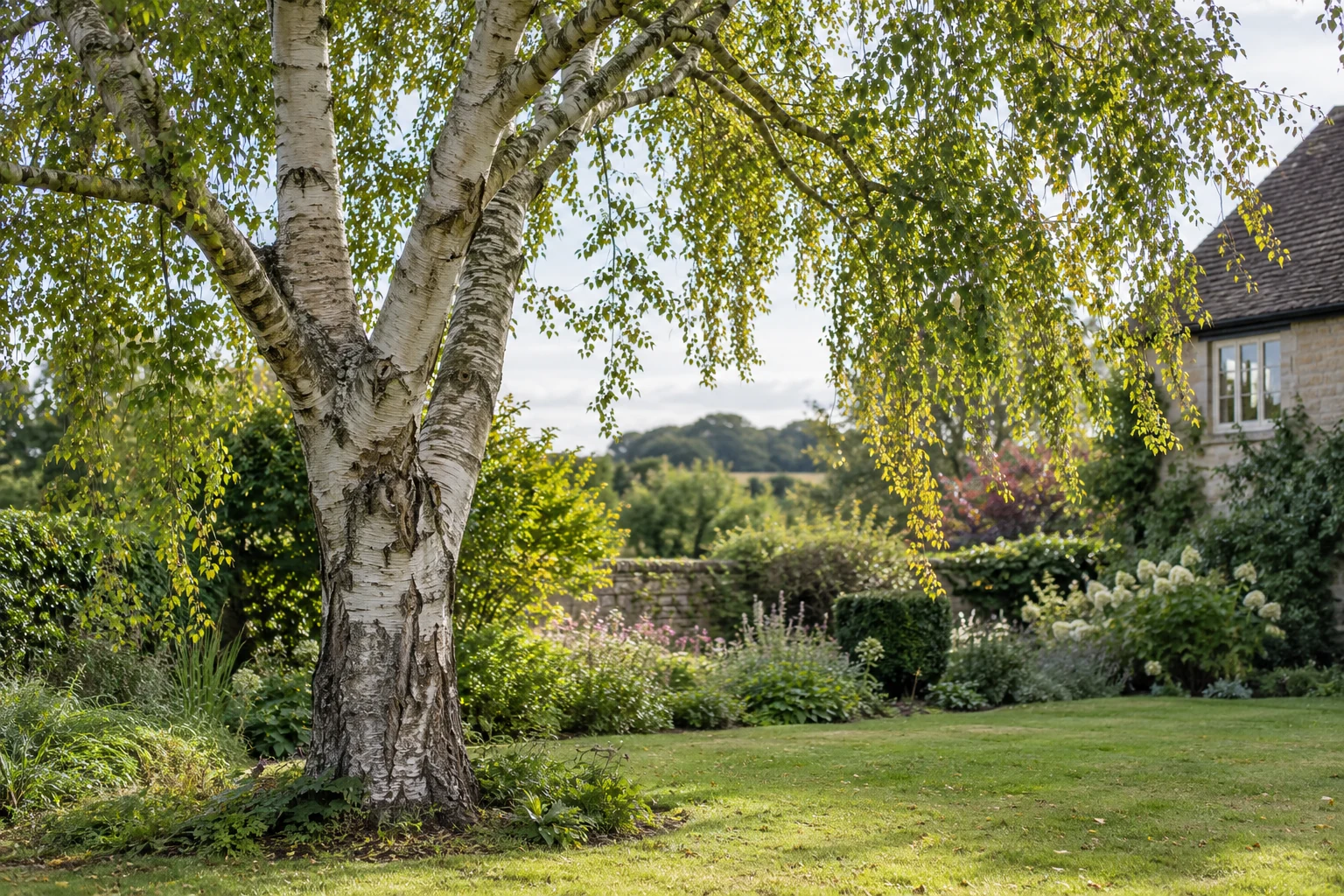
Birch can bleed sap following pruning at unsuitable times, and timing should be discussed with the professional for the actual work. RHS tree-pruning guidance is a useful starting point for recognising exceptions to general seasonal advice. It is not permission to cut a particular tree on a selected date.
Tell the contractor if the proposal is elective maintenance or relates to a newly noticed problem. Ask why the recommended timing suits this tree, what circumstances could change the plan and whether further assessment is needed first. Avoid choosing solely by the earliest available appointment or assuming the same month should be repeated indefinitely.
RHS guidance identifies autumn and early winter as the usual period for pruning birch to avoid heavy sap bleeding, rather than treating late winter or spring as a routine default. This is useful background for an elective-work discussion, not an instruction for every tree or an all-clear on wildlife and permissions. Unexplained bleeding from a stem also needs its own assessment; it should not automatically be attributed to a previous pruning cut.
Understand that extent matters as much as timing
A carefully chosen season does not make any amount of cutting appropriate. Ask for the purpose and intended finished result to be explained, including whether the tree's existing condition or structure limits the work. An undefined request to take a few metres off may conceal a substantial change.
Read crown reduction versus thinning before comparing operations. A contractor should not substitute another label without explaining why. If the desired outcome would require an unsuitable intervention, ask about alternatives and long-term implications. The useful decision may involve changing the garden plan rather than repeatedly forcing the tree into a space it no longer fits comfortably.
Separate leaf or crown changes from a pruning brief
If the birch appears thinner, has changed leaf colour or contains newly dead branches, say so before discussing a routine cut. Those observations may need assessment rather than being resolved by making the crown smaller. Keep a timeline of what changed, including recent works around the roots or prolonged unusual conditions.
Our leaf-colour guide helps make the record useful. A sparse-looking tree in one photograph is not a diagnosis, and a previous pruning date does not explain every later change. Ask whether the professional's service includes assessment of the concern and what further information or specialist input would be needed if the cause remains uncertain.
Include ground conditions and recent garden work
Tell the adviser about paving, trenches, soil storage, altered levels or heavy traffic near the tree. A pruning proposal should not ignore possible changes to the rooting environment. Do not assume that fine surface roots can be cut without consequence because the birch is not as large as another tree nearby.
The tree concerns after building work guide explains useful records. If you are planning a garden office or driveway, raise that before pruning is booked; the issue may require coordinated design advice. Keeping the canopy and ground proposals in separate conversations can lead to contradictory instructions and avoidable disturbance.
Check wildlife, ownership and protection
Fine branches and an open-looking crown do not prove that a tree contains no active nest or other relevant wildlife feature. Discuss checks appropriate to the proposal and do not climb or disturb growth to investigate yourself. Calendar timing is not an ecological clearance.
Use the bird-nest guide alongside the relevant council protection checks. If branches cross a boundary, confirm ownership and access rather than assuming the tree can be worked from any convenient garden. A Bedford postal address does not settle which authority holds the records. Keep those questions resolved independently of whether the proposed pruning is horticulturally appropriate.
Ask how the result will be recorded
A useful written specification identifies the birch and describes the agreed operation in terms both parties understand. It should be consistent with any permission and the professional's assessment, rather than relying on phrases such as “tidy and shape”. Ask which parts of the tree are involved and which are excluded.
Our quotation checklist helps identify access, waste and other scope questions. If the recommendation changes after a closer assessment, pause to confirm the revised work and any approval implications. A new verbal suggestion on the day should not quietly replace the specification you used to decide whether to proceed.
Plan future care without creating a repeat-cut expectation
Ask what follow-up the tree is likely to need and what should prompt another enquiry. Repeating the same reduction because the tree has grown does not automatically form a suitable management system. Keep the report, work specification and completion record so that later advice can account for what was actually done.
If you primarily want less shade, record the affected space and times of day so the professional can explain realistic outcomes. The patio-shade guide helps with that brief. A good decision balances the homeowner's objective with the birch's characteristics, instead of promising a permanently compact crown after a single visit.
Your next step
Ask for identification, a clear pruning objective and an explanation of suitable timing and extent. Report any condition changes before arranging routine work, and check controls and wildlife separately. If a proposed operation seems mainly aimed at fitting the tree to an unsuitable space, discuss alternatives rather than accepting severe cutting as the default solution.
Turn the advice into a useful project brief.
Start with the postcode, the work you have in mind and any access considerations.
Prepare your enquiryNo obligation. A site assessment may be needed to confirm the work and price.
Sources & further reading
- RHS: pruning trees
- Bedford Borough Council: protected trees
- GOV.UK: Tree Preservation Orders and conservation areas
- Natural England: wild birds, protection and licences
- RHS: improving health of declining trees and shrubs
Sources checked 31 October 2026. How we prepare guidance.